(No Date) G50C BG-1079 (Regular Strike)
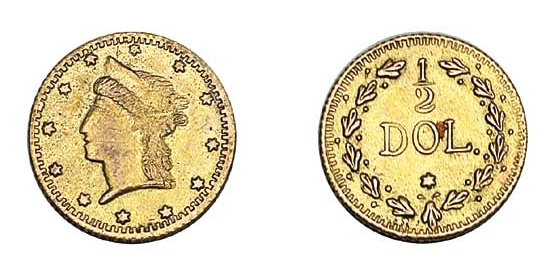
Obverse & Reverse
The (No Date) 50 Cents, BG-1079, is a quintessential example from the second great era of California fractional gold production, often termed 'Period Two' (1858-1882) by numismatists. Unlike their 'Period One' predecessors which were struck out of commercial necessity to alleviate a severe shortage of small change during the initial Gold Rush boom, these later issues were primarily created as souvenirs and jewelry items. By the late 1850s, the San Francisco Mint was in full operation, supplying the region with ample federal coinage and rendering the private fractional gold pieces obsolete as circulating currency. However, the allure of California gold and the romance of the Gold Rush had captivated the nation. Jewelers in San Francisco, many of whom were skilled engravers who had previously produced the Period One coins, recognized a burgeoning market among tourists and locals who desired small, affordable keepsakes of California's golden identity. These 'jeweler's issues' were typically underweight for their stated denomination and often made of a lower fineness gold than the earlier, circulating pieces. Their production was a direct response to market demand for mementos, not a solution to a coinage crisis. The Coinage Act of 1864 technically outlawed all private coinage, but it was not rigorously enforced in California until 1883. This legal gray area allowed the production of these denominated tokens to flourish for two decades. The BG-1079, being undated, is characteristic of this period, as dating was often inconsistent or omitted entirely. These pieces were sold in shops, often incorporated into rings, stickpins, and brooches, serving as tangible symbols of the Golden State long after the frontier chaos had subsided into established commerce. Their modern numismatic significance lies in their direct connection to this secondary, souvenir-driven phase of the Gold Rush's economic and cultural impact, representing a fascinating transition from necessity coinage to nostalgic token.
Associated EventCalifornia Gold Rush (Souvenir/Jewelry Period)
Reason For MintingTo serve the robust tourist and local market for affordable gold souvenirs and jewelry items representative of California.
Minter HistoryThe specific minter or jeweler responsible for the BG-1079 variety is unknown, a common trait for many Period Two issues. Dozens of small, private operations, often run by French or German immigrant jewelers and engravers in San Francisco, produced a wide array of similar tokens. These craftsmen, such as M. Deriberpe, Antoine Louis Nouizillet, and the firm of Frontier, Deviercy & Co., were known to be active during this era, but a definitive attribution for this specific die pairing has been lost to history. Their business model centered on manufacturing these popular gold tokens for direct sale to the public as keepsakes.
Historical SignificanceBG-1079 is significant not as a coin that facilitated commerce, but as a cultural artifact. It represents the commercialization of the Gold Rush mythos, demonstrating how the initial frenzy for wealth evolved into a sustained industry of tourism and nostalgia. These small gold pieces were the tangible, affordable takeaways for a generation fascinated by the promise of the West, making them important relics of 19th-century American popular culture and the enduring legacy of the California Gold Rush.
BG-1079
Denomination50 Cents
Minting Periodca. 1870-1882
Assayer/MinterUnknown Private Jeweler
Geographic OriginSan Francisco, California
Obverse DescriptionA fairly crude bust of a left-facing Liberty Head. Liberty wears a coronet, and her hair is tied in the back. The portrait is surrounded by thirteen five-pointed stars, often weakly struck or indistinct.
Obverse Inscription Reverse DescriptionThe denomination '1/2' is enclosed within a simple wreath composed of two branches tied with a bow at the bottom. Below the bow, the word 'DOLLAR' appears.
Reverse Inscription1/2 DOLLAR
CompositionGold
Stated Fineness Actual FinenessVariable, but typically lower than federal coinage, often ranging from .500 to .800 fine.
Weight0.25 grams
Diameter10.00 mm
EdgePlain
Unknown
Survival EstimateFewer than 100
Rarity ScaleR-5 (Very Scarce)
This token appeals to collectors of California history, Gold Rush memorabilia, and specialists in the extensive Breen-Gillio series of fractional gold. Its charm lies in its status as an authentic, privately-produced gold souvenir from the 19th-century West. The challenge of collecting the hundreds of Period Two varieties adds to its allure for dedicated specialists.
Key VarietiesThe primary variety is the regular business strike, BG-1079. No proof strikings or major die varieties from the period of issue are known or cataloged. Unlike some territorial issues, there are no known official restrikes. Any later-produced items with similar designs are considered modern replicas or fantasy pieces and are not part of the Breen-Gillio catalog.
Authentication TipsGenuine pieces are struck in gold, not brass or gilt base metal. They are typically very thin and often exhibit a weak or uneven strike, especially on the stars or the fine details of the wreath. The surfaces may show fine, parallel striations from the planchet preparation process. Counterfeits are often thicker, have a soapy or cast-like appearance, and may feature a bear on the reverse, a motif never used on genuine 19th-century issues. All genuine Period Two pieces intended as currency substitutes bear a denomination (e.g., 'DOLLAR' or 'CENTS'); pieces marked 'CAL GOLD' without a denomination are typically later tokens.
Shopping ConsiderationsA premium quality example for its grade will show a relatively sharp strike for the issue, with as much detail as possible visible in Liberty's hair and the wreath's leaves. Look for original, uncleaned surfaces that may have a slightly reddish or mellowed gold hue. High-grade examples are often prooflike (PL) due to being sold as souvenirs rather than circulated, and this adds to their appeal. Avoid pieces that have been harshly cleaned, which imparts a bright, lifeless appearance and hairline scratches. Also, be wary of ex-jewelry pieces that may show evidence of mounting, solder, or excessive rim damage.
A coin's grade is its condition, rated on a 1-70 scale. For rare coins, this is the most critical factor in determining value, as a tiny difference in preservation can mean a huge difference in price.
Relevant Grade TypesOriginal period issues were business strikes intended for sale as souvenirs, not circulation. Therefore, they are most commonly found in Mint State (MS, 60-70) grades, often with prooflike surfaces from polished dies. Circulated examples (1-58) exist but are less common, as these were not typically used in daily commerce. No true Proofs (PR/PF) were struck during the original period of issue, and no later-date official restrikes exist.
Mint State CharacteristicsUncirculated examples of BG-1079 are characterized by their strike quality, which is often mediocre. A well-struck piece with full stars and a clear 'DOLLAR' is rare and desirable. Luster is typically reflective and prooflike, though it can sometimes be more satiny. Because the gold is soft and the pieces were handled as novelties, small contact marks are common and should be expected; a 'clean' surface for the grade is a key value driver.
Circulated Wear PatternsOn circulated examples, wear first appears on the high points of Liberty's cheek, hair above the eye, and the coronet. On the reverse, the highest points of the wreath and the bow will show rubbing and flatness first. In lower grades (VF and below), the stars will begin to merge with the fields and the finer details of the wreath will be completely worn away.
Key Factors For ValueFor the BG-1079, the key value factors are strike sharpness and surface preservation. An example with a bold strike commands a significant premium over a weakly struck one, even if both are in the same numeric grade. Original, lustrous surfaces free of distracting marks or cleaning are paramount. Eye appeal is crucial; a piece with attractive, original skin and prooflike fields is highly sought after. Certification by a major grading service (PCGS or NGC) is essential for authenticity and liquidity, and a CAC sticker indicates premium quality for the assigned grade.
PCGS Price Guide
| Grade | Price | Population |
|---|---|---|
| 50 | $4,000.00 | N/A |
| 55 | $5,000.00 | N/A |
| 60 | $6,500.00 | N/A |