1876 G$1 BG-1115 (Regular Strike)
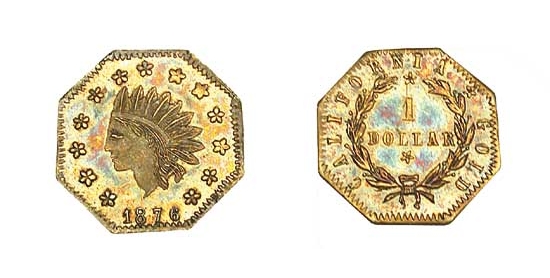
Obverse & Reverse
The 1876 G$1 BG-1115 is a product of the second major phase of California's private gold coinage, a period numismatists classify as 'Period Two' (1859-1882). Unlike the earlier 'Period One' issues, which were struck out of necessity to alleviate a severe shortage of small change during the initial Gold Rush, these later pieces, often termed 'jeweler's issues,' served a different purpose. By 1876, the San Francisco Mint was in full operation, and the acute need for circulating coinage had subsided. Instead, these fractional gold pieces were created by jewelers and private minters to satisfy a continuing commercial and cultural demand. They were used as convenient small units of exchange in a region still deeply rooted in a gold-based economy, served as popular souvenirs for travelers, and were incorporated into jewelry. The Coinage Act of 1864 had officially prohibited private coinage, but enforcement in the West was inconsistent, allowing this practice to continue for nearly two more decades. The BG-1115, struck in America's centennial year, represents the persistence of a uniquely Californian numismatic tradition. These pieces were often produced with less intrinsic gold value relative to their face value compared to federal coinage, a common characteristic of Period Two issues. Their production was typically accomplished using manual screw presses or even the more primitive hammer-striking method, resulting in coins that often lack the uniformity of federal issues. The BG-1115 is an artifact of this fascinating gray market, a tangible link to the post-Gold Rush economy of San Francisco where gold was still king, and the lines between currency, token, and keepsake were delightfully blurred.
Associated EventPost-California Gold Rush Era
Reason For MintingTo serve as convenient small change, souvenirs, and jewelry items in a gold-centric regional economy after the initial coin shortage had passed.
Minter HistoryThe specific minter of the BG-1115 variety is unknown, a common trait for many 'Period Two' California Fractional Gold pieces. During this era (1859-1882), production was dominated by various San Francisco-based jewelers and artisans. Unlike the more formally organized assayers of the Gold Rush peak, these minters often operated without clear identifying marks. Their work is characterized by a wide diversity of designs and often cruder manufacturing techniques. Research by authorities like Walter Breen, Ronald Gillio, and Robert D. Leonard Jr. has identified some makers from this period, but many, including the producer of this specific die pairing, remain anonymous.
Historical SignificanceThe BG-1115 is significant as an example of the continued private production of gold coinage long after the federal government attempted to prohibit it. It represents a mature phase of the California fractional gold series, where the purpose shifted from necessity to commercial convenience and novelty, reflecting the unique economic and cultural landscape of late 19th-century California. Its extreme rarity today underscores the small-scale, ephemeral nature of these private minting operations.
N/A
DenominationG$1
Minting Period1876
Assayer/MinterUnknown Private Minter
Geographic OriginSan Francisco, California
Obverse DescriptionAn Indian Princess head facing left, wearing a feathered headdress. The portrait is encircled by 13 six-pointed stars, representing the original colonies. The date '1876' appears below the bust. The design is set within a beaded border on an octagonal planchet.
Obverse Inscription1876
Reverse DescriptionThe central device is the denomination '1' and the word 'DOLLAR' contained within a wreath of two olive branches tied with a bow at the bottom. The legend 'CALIFORNIA GOLD' is inscribed outside the wreath, following the octagonal shape of the coin. A beaded border encircles the design.
Reverse InscriptionCALIFORNIA GOLD 1 DOLLAR
CompositionGold
Stated Fineness Actual FinenessTypically varied for Period Two issues, often below federal standards.
Weight0.50 grams
Diameter11.00 mm
EdgePlain
Extremely low; likely fewer than 100.
Survival Estimate2-3 known examples.
Rarity ScaleR-8 (per Heritage Auctions auction catalogs)
This coin's appeal is immense, driven by its legendary rarity as one of the key stoppers in the California Fractional Gold series. Being an octagonal dollar from the Centennial year adds historical resonance. For the advanced specialist, acquiring a BG-1115 is a pinnacle achievement, representing one of the most elusive and desirable varieties in the entire field of private and territorial gold.
Key VarietiesThe BG-1115 is a unique die marriage and has no major varieties from its original minting period. As a 'Period Two' issue, it was not subject to later official restriking programs like some earlier territorial issues. Collectors should be aware of a closely related variety, BG-1115A, which uses a different reverse die.
Authentication TipsAuthentication is critical. Genuine examples exhibit sharp, albeit sometimes uneven, die characteristics consistent with mid-19th century private minting technology. The stars should be well-formed, and the details in the hair and feathers, though potentially softly struck, should match known genuine examples. The surfaces of authentic pieces often have a slightly prooflike or reflective quality. Counterfeits are rampant in the series; many are cast fakes with soft, porous details or are struck from modern dies. Any potential purchase must be certified by a top-tier grading service like PCGS or NGC, as their experts have access to confirmed exemplars for comparison.
Shopping ConsiderationsFor a coin of this rarity, grade is almost a secondary consideration to authenticity and existence. A 'premium quality' example would be one that is well-struck for the variety, showing clear details in the Indian's headdress and the wreath on the reverse. Look for original, uncleaned surfaces, which may exhibit attractive coppery-gold toning. Given their use in jewelry, any piece that is confirmed to be free of mounting evidence or repairs commands a significant premium. Small, honest planchet flaws or strike weaknesses are to be expected and are far more acceptable than cleaning, scratches, or other post-strike damage. The buyer should focus on acquiring a problem-free, certified example, as even a lightly circulated piece is a monumental prize.
A coin's grade is its condition, rated on a 1-70 scale. For rare coins, this is the most critical factor in determining value, as a tiny difference in preservation can mean a huge difference in price.
Relevant Grade TypesAll known original examples of BG-1115 are business strikes, intended for commerce or sale, and are found in Circulated (1-58) and Mint State (MS, 60-70) grades. Due to their immediate collector interest and use as keepsakes, high-grade examples have survived. No true Proofs were struck during the original period of issue. Later-date Proof restrikes or special collector strikings do not exist for this variety. The reflective surfaces sometimes seen on these are a product of polished dies and are properly designated as Deep Prooflike (DPL) or Prooflike (PL) business strikes.
Mint State CharacteristicsUncirculated examples are typically characterized by a sharp, yet somewhat rustic, strike. The central devices, such as the highest points of the feathers and hair, may show some softness. Luster is a key attribute, often appearing as flashy and reflective (prooflike) due to the use of polished dies by the jeweler-minters. Bag marks are less common than on larger federal coins due to their small size, but tiny handling marks or planchet imperfections made during the crude manufacturing process are common and should be expected.
Circulated Wear PatternsWear first appears on the highest points of the design. On the obverse, this includes the cheek, the eyebrow, and the details of the feathers in the headdress. On the reverse, the high points of the wreath's leaves and the numeral '1' will show the first signs of friction. In lower grades (VF and below), the stars and peripheral lettering will begin to merge with the fields.
Key Factors For ValueWith only 2-3 examples known, the primary factor for value is simply the availability of a specimen for sale. Beyond that, a Mint State grade commands a massive premium over any circulated example. Surface quality is paramount; an example with original, lustrous, and unimparied surfaces is vastly superior to one that has been cleaned, polished, or previously mounted as jewelry. Strike quality is also important; a coin with a bold strike on both the central Indian portrait and the reverse wreath is highly desirable. Finally, eye appeal, driven by attractive toning and problem-free surfaces, will always elevate value. A CAC sticker on a coin this rare would be a significant endorsement of its quality for the assigned grade.
PCGS Price Guide
| Grade | Price | Population |
|---|---|---|
| 55 | $1,400.00 | 1 |
| 55+ | $1,500.00 | N/A |
| 58 | $1,750.00 | 1 |
| 58+ | $1,900.00 | N/A |
| 60 | $2,150.00 | 1 |
| 61 | $2,500.00 | N/A |
| 62 | $3,000.00 | 6 |
| 62+ | $3,350.00 | N/A |
| 63 | $4,250.00 | 2 |
| 63+ | $4,750.00 | N/A |
| 64 | $6,000.00 | 1 |
| 66 | N/A | N/A |