1872 G$1 BG-1207 (Regular Strike)
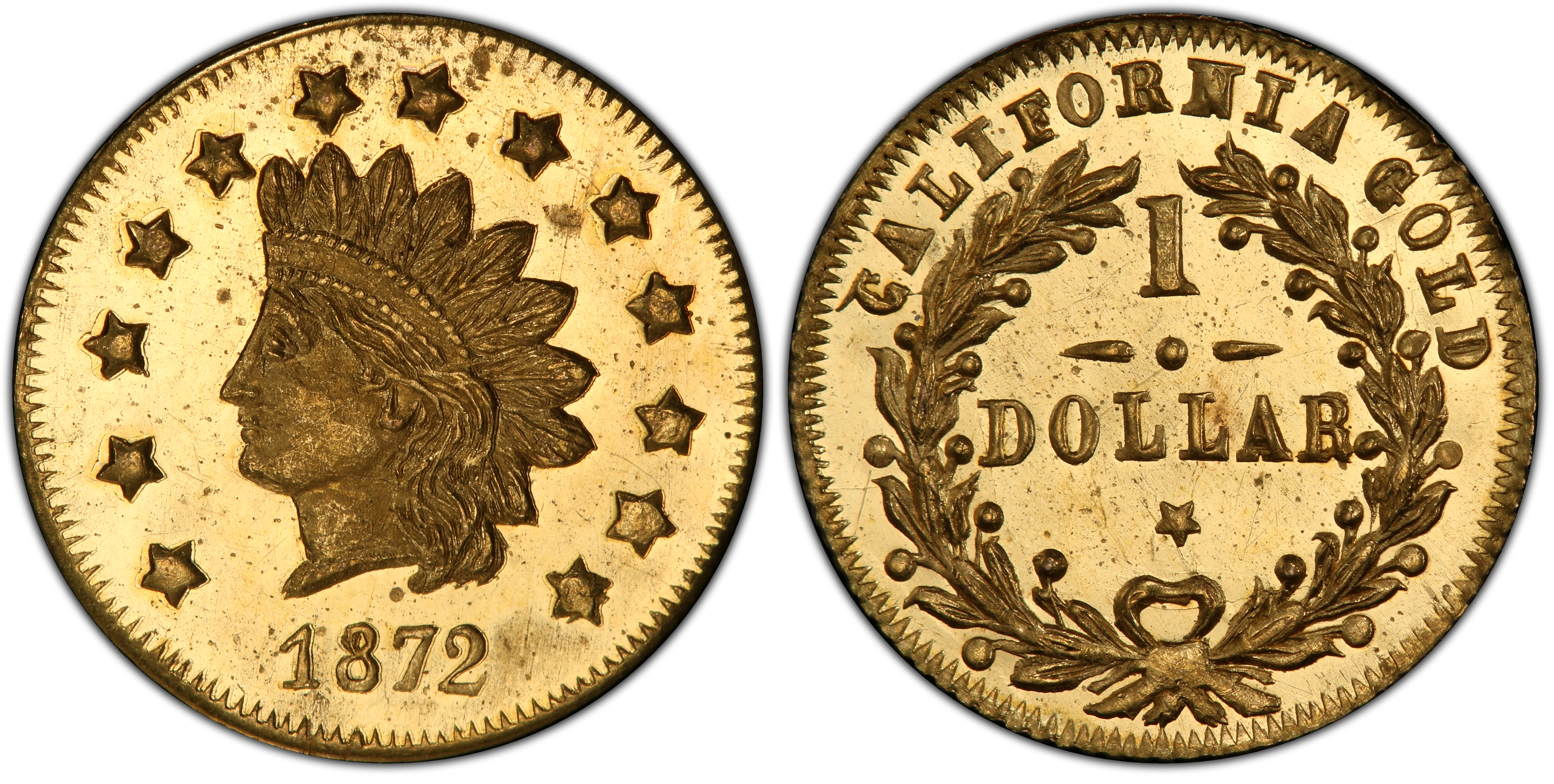
Obverse & Reverse
The 1872 G$1 BG-1207 is a quintessential example of 'Period Two' California Fractional Gold, a fascinating numismatic category that bridges the gap between utilitarian coinage and commercial souvenirs. The story of these diminutive gold pieces begins in the frenzied aftermath of the 1848 California Gold Rush. The massive influx of population and gold dust created a severe shortage of small-denomination coinage, making everyday transactions cumbersome. To fill this void, private jewelers and metallurgists began striking their own quarter, half, and one-dollar gold pieces starting in 1852. These 'Period One' issues (1852-1857) were generally of good quality and intended to circulate, solving a genuine economic problem. However, by the late 1850s, the new San Francisco Mint was in full operation, alleviating the coin shortage. The rationale for producing fractional gold shifted. The once-crude mining camps were transforming into a bustling, civilized society, and San Francisco was becoming a tourist destination. Enterprising jewelers recognized a new market: mementos of the romanticized Gold Rush era. This marked the beginning of Period Two (1859-1882), characterized by pieces struck not for commerce, but for sale as souvenirs, watch fobs, and keepsakes. These 'jeweler's issues' were often lighter and of a lower fineness than their Period One predecessors, as their value was in their novelty, not their intrinsic content. The BG-1207 fits squarely into this later period. Research by Walter Breen and Ronald Gillio suggests this piece was produced by the California Jewelry Company, a firm operated by the Levison Brothers (Herman and Louis). They had acquired the jewelry manufacturing business of Robert B. Gray & Co. in 1871, including his dies, hubs, and punches. Gray himself had succeeded another minter, Antoine Nouizillet, creating a clear lineage of die-sinking and production. The 1872-dated Indian Head dollars like BG-1207 were thus a continuation of this enterprise, catering to a public fascinated with the 'Wild West' and eager for a tangible piece of the California dream. These coins were produced even after the Coinage Act of 1864 made private coinage illegal, as the law was not strictly enforced against these small souvenir pieces until a Secret Service crackdown in the early 1880s.
Associated EventPost-Gold Rush California Economic Expansion
Reason For MintingPrimarily produced as a souvenir or keepsake for tourists and collectors, rather than to alleviate a currency shortage.
Minter HistoryThe Levison Brothers, Herman and Louis, were prominent German-born jewelers who founded their San Francisco business in 1859. By the 1870s, their firm, operating as the California Jewelry Company, was a major enterprise located on Sutter Street, involved in importing watches, diamonds, and manufacturing fine jewelry. In 1871, they purchased the business of Robert B. Gray & Co., a significant producer of Period Two fractional gold. This acquisition included Gray's equipment and likely the artistic and technical lineage for creating fractional gold dies. The pieces produced under their tenure, including the 1872 dollars, represent the commercial peak of fractional gold as a souvenir item before federal enforcement ended the practice.
Historical SignificanceThe BG-1207 is significant not as a coin that fueled commerce, but as a cultural artifact of its time. It represents the maturation of California from a frontier economy to a place of national fascination. Its existence demonstrates the transition of fractional gold from a necessary form of currency to a popular collectible, embodying the romanticism of the Gold Rush for a new generation of visitors and residents. It is a tangible link to the jeweler-minters of San Francisco who adapted their products to a changing market.
N/A
DenominationG$1
Minting Period1872
Assayer/MinterCalifornia Jewelry Company (Levison Brothers)
Geographic OriginSan Francisco, California
Obverse DescriptionA large rendering of a Native American Head, facing left, adorned with a feathered headdress. The portrait is encircled by thirteen six-pointed stars, representing the original colonies. The date '1872' is positioned below the bust.
Obverse Inscription1872
Reverse DescriptionThe central device is the denomination '1 DOLLAR' with a small star or dot below, enclosed within a continuous, ornate wreath composed of leaves and berries. The legend 'CALIFORNIA GOLD' is inscribed in an arc around the wreath, following the coin's upper curvature.
Reverse InscriptionCALIFORNIA GOLD / 1 DOLLAR *
CompositionGold
Stated Fineness Actual FinenessVariable, but generally lower than the .900 standard of federal gold, typical for Period Two 'jeweler's issues'.
EdgePlain
Unknown, but struck in sufficient quantities to be considered relatively available for the series.
Survival Estimate76-200 coins. The Breen-Gillio rarity scale lists this variety as R-4. Combining the PCGS and NGC population reports (as of late 2025), and accounting for resubmissions, a reasonable estimate of the surviving population falls in this range.
Rarity ScaleR-4
The 1872 G$1 BG-1207 is highly popular with collectors due to its classic Indian Head design, affordability relative to rarer fractional issues, and its status as a representative of the widely collected 'Period Two' souvenir era. Its defined date and clear design make it an attractive entry point or a key component of a California gold type set.
Key VarietiesThe primary variety is the regular strike BG-1207. No major die varieties from the original minting period are widely collected or cataloged. Unlike some earlier territorial issues, there are no known contemporary proof strikings or later-date restrikes associated with the Levison Brothers' production of this specific variety.
Authentication TipsGenuine examples typically exhibit a somewhat soft, satiny luster, and often show weakness in the strike, particularly on the highest points of the Indian's cheek and the details within the wreath. Counterfeits are common and often have a glassy or unusually prooflike surface, incorrect letter and number fonts (often appearing too thick or 'fat'), and may show raised pimples or tooling marks in the fields. Genuine pieces must have the denomination clearly stated as 'DOLLAR'; pieces with a bear on the reverse or lacking a denomination are modern tokens. All Period Two pieces are underweight compared to federal gold dollars.
Shopping ConsiderationsA premium quality example for its grade will display a sharp strike on the date and stars, with clear details in the headdress feathers. Look for pleasing, original surfaces with a delicate luster; many have been cleaned or polished over the years, which drastically reduces value. Avoid examples with significant rim bumps, scratches, or evidence of having been mounted in jewelry. Prooflike (PL) examples are particularly desirable and command a significant premium, as they showcase the fresh die state. Eye appeal is paramount; a coin with attractive, original reddish-gold toning will always be more sought-after than a bright, dipped-out specimen.
A coin's grade is its condition, rated on a 1-70 scale. For rare coins, this is the most critical factor in determining value, as a tiny difference in preservation can mean a huge difference in price.
Relevant Grade TypesOriginal issues of BG-1207 were business strikes, although primarily intended for sale to collectors and tourists rather than circulation. They are found in both Circulated (1-58) and Mint State (MS, 60-70) grades. No true Proofs were struck during the original period of issue. The term 'Prooflike' (PL) is often applied to high-grade business strikes from fresh, polished dies, and these are highly sought after but should not be confused with true Proof coinage.
Mint State CharacteristicsUncirculated examples are defined by their luster, which is typically soft and satiny rather than deeply frosty. The strike is a key differentiator; many are softly struck, with weakness on the cheek, hair details, and the bow of the reverse wreath. Well-struck examples are scarce and prized. As these were made by jewelers and handled as souvenirs, even high-grade Mint State pieces can show small, scattered contact marks or 'cabinet friction' on the highest points.
Circulated Wear PatternsWear first appears on the high points of the design: the Indian's cheekbone, the feathers in the headdress, and the high points of the leaves in the reverse wreath. On moderately worn examples (VF-XF), the finer details of the hair and feathers will merge. In lower grades (Fine and below), the legends and stars will begin to soften, and the date can become weak.
Key Factors For ValueThe primary value drivers are grade and surface quality. An example with original, uncleaned surfaces and attractive luster will command a strong premium. Strike quality is a close second; a sharply struck coin is always worth more than a weakly struck counterpart in the same grade. Eye appeal, including any pleasing toning, plays a significant role. Finally, certification by a top-tier service (PCGS or NGC) is essential for market acceptance, and a CAC sticker for this issue indicates premium quality for the grade and adds a considerable premium.
PCGS Price Guide
| Grade | Price | Population |
|---|---|---|
| 50 | $1,100.00 | 3 |
| 50+ | $1,150.00 | N/A |
| 53 | $1,200.00 | 1 |
| 53+ | $1,300.00 | N/A |
| 55 | $1,575.00 | 7 |
| 55+ | $1,650.00 | N/A |
| 58 | $1,850.00 | 12 |
| 58+ | $1,950.00 | N/A |
| 60 | $2,000.00 | 2 |
| 61 | $2,100.00 | 7 |
| 62 | $2,200.00 | 28 |
| 62+ | $2,600.00 | N/A |
| 63 | $3,600.00 | 21 |
| 63+ | $3,850.00 | N/A |
| 64 | $4,100.00 | 10 |
| 64+ | $5,000.00 | N/A |
| 65 | $7,750.00 | 3 |