1872 G50C BG-1049 (Regular Strike)
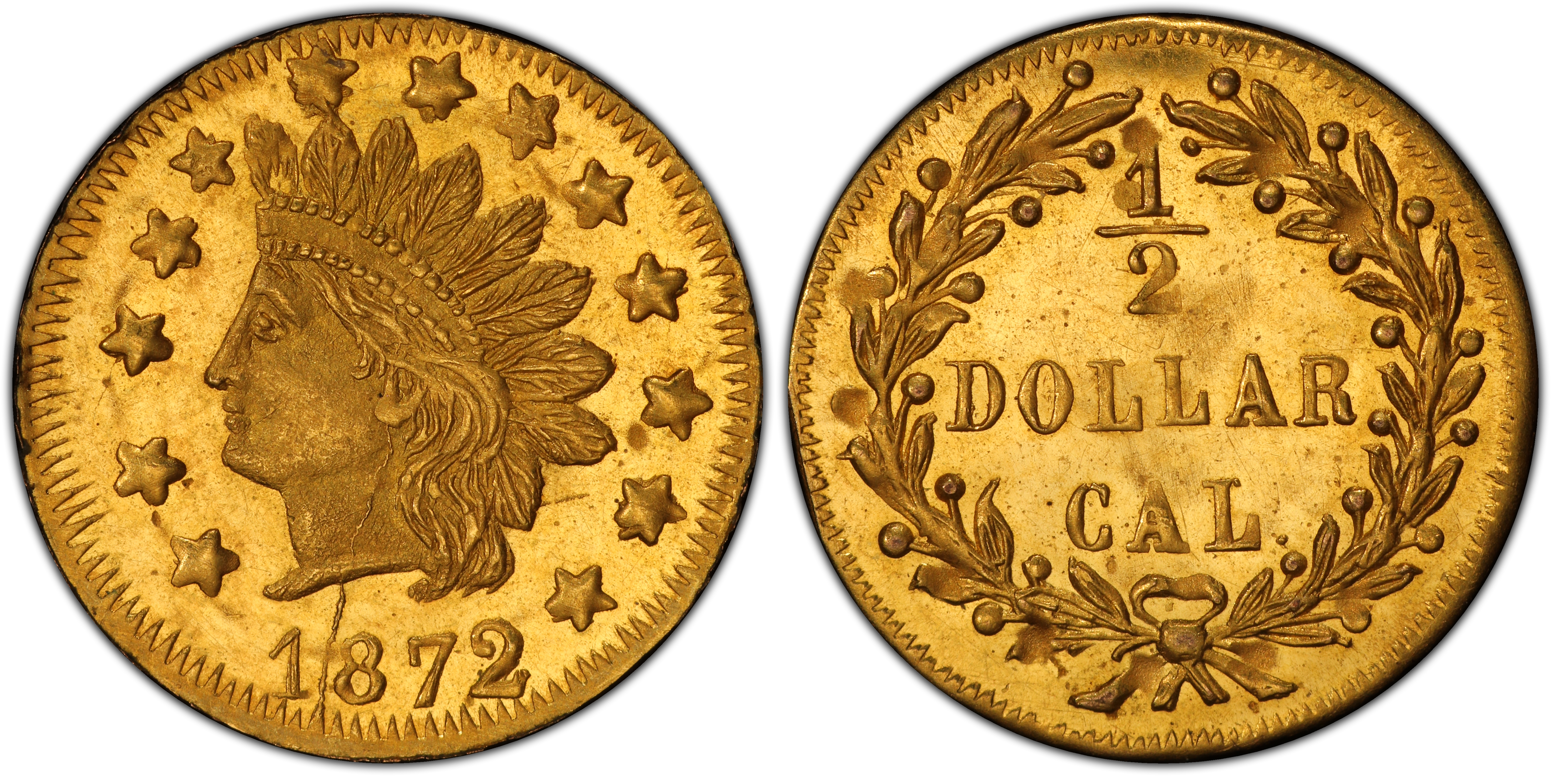
Obverse & Reverse
The 1872 BG-1049 50 Cents piece is a quintessential example of a 'Period Two' California Fractional Gold coin. Unlike the 'Period One' issues (1852-1857), which were struck out of genuine commercial necessity to alleviate a chronic shortage of small change in Gold Rush California, the Period Two issues served a different purpose. By the 1870s, the San Francisco Mint was in full operation, producing ample quantities of federal coinage for the West Coast. The need for private fractional gold had evaporated. Instead, local jewelers like Christopher Ferdinand Mohrig, a prolific producer operating in San Francisco, recognized a burgeoning market for these tiny gold pieces as souvenirs, keepsakes, and jewelry items. Tourists and residents alike were captivated by the romanticism of the Gold Rush, and these miniature gold coins were an affordable and tangible link to that exciting era. The Act of 1864 had made private coinage illegal, but enforcement by the Secret Service was lax until the early 1880s, allowing men like Mohrig to continue production. These 'jeweler's issues' were typically struck with a lower intrinsic gold value compared to their face value, rendering them profitable tokens rather than true currency. Their production quality was often high, with many featuring attractive, Prooflike surfaces to enhance their appeal as novelties. The BG-1049, with its classic Indian Head design, was a popular motif of the period, emulating federal coinage designs to lend an air of legitimacy and familiarity. Mohrig's operation was eventually shut down by the Secret Service, and his dies were confiscated, which partly explains the rarity of many of his issues. Today, the BG-1049 is not just a collectible coin but a historical artifact representing the commercial evolution of San Francisco from a frontier boomtown into a sophisticated city with a thriving tourist trade, where the memory of the Gold Rush itself had become a valuable commodity.
Associated EventPost-Gold Rush California Commerce
Reason For MintingPrimarily struck for sale as souvenirs and keepsakes to tourists and locals, capitalizing on the romanticism of the Gold Rush.
Minter HistoryChristopher Ferdinand Mohrig was a prominent San Francisco jeweler and one of the most prolific producers of 'Period Two' California Fractional Gold. He created a wide variety of denominations and designs from the late 1860s through the mid-1870s. His operation was ultimately targeted by the U.S. Secret Service for violating the Private Coinage Act of 1864. In August 1876, Mohrig was arrested, and his dies and remaining coin stock were confiscated and destroyed, contributing to the scarcity of many BG-varieties attributed to him.
Historical SignificanceThe coin is significant not as a circulating medium of exchange, but as a representation of the commercialization of the Gold Rush legacy. It marks a shift from necessity-driven private coinage to souvenir-driven numismatic production, reflecting California's economic maturation and the development of a tourism industry.
BG-1049
Denomination50 Cents
Minting Period1872
Assayer/MinterChristopher Ferdinand Mohrig
Geographic OriginSan Francisco, California
Obverse DescriptionFeatures a stylized head of a Native American chief facing left, wearing a feathered war bonnet. The portrait is surrounded by thirteen six-pointed stars, representing the original colonies. The date '1872' is positioned below the bust.
Obverse Inscription1872
Reverse DescriptionA wreath of leaves and berries, open at the top, encircles the denomination. The wreath is tied with a bow at the bottom. Inside the wreath, the fraction '1/2' is prominent, with the word 'DOLLAR' below it.
Reverse Inscription1/2 DOLLAR
CompositionGold
Stated Fineness Actual FinenessFineness varied in Period Two issues, often between 14 and 22 karats, and was intentionally less than face value.
Weight0.25 grams
Diameter10.00 mm
EdgePlain
Unknown
Survival Estimate75-125 coins across all grades.
Rarity ScaleR-4
This variety appeals to collectors due to its classic Indian Head design, its connection to the famous minter C. F. Mohrig, and its status as a representative 'Period Two' souvenir issue. Its R-4 rarity makes it scarce but obtainable for dedicated specialists.
Key VarietiesThe most significant variety is a dramatic mint error, a BG-1049 that was double-struck in the collar on the reverse. The second strike is rotated approximately 20 degrees, resulting in two clear impressions of '1/2 DOLLAR'. This error is noted in the Breen-Gillio reference and is considered extremely rare, possibly unique.
Authentication TipsGenuine examples are very thin and lightweight. Counterfeits are often thicker and feel heavier than expected. The strike on genuine pieces can be uneven, with areas of softness, particularly on the high points of the hair and the details of the wreath. Replicas often have a soapy, uniform look and may feature incorrect design details, like a bear on the reverse, which is not found on genuine 19th-century issues. Compare the die characteristics—specifically the star and date placement—to known genuine examples.
Shopping ConsiderationsA premium quality example for its grade will exhibit sharp details on the Indian's hair and the feathers of the bonnet, as well as clear definition in the leaves of the reverse wreath. Many survivors are found in high grades (MS62-MS65) and often possess flashy, prooflike (PL) or deep mirror prooflike (DMPL) surfaces from being struck on polished planchets; this attribute carries a significant premium. Avoid examples that have been harshly cleaned, which strips the original skin and luster. Also, be wary of coins that have been used as jewelry, looking for evidence of removed solder or mounting marks on the edge or rims.
A coin's grade is its condition, rated on a 1-70 scale. For rare coins, this is the most critical factor in determining value, as a tiny difference in preservation can mean a huge difference in price.
Relevant Grade TypesOriginal period issues of BG-1049 were business strikes, although they were not intended for long-term circulation and were often sold as souvenirs. Thus, they are found in both Circulated (1-58) and, more commonly, Mint State (MS, 60-70) grades. No true Proofs were struck during the original period of issue. However, because they were struck on polished planchets to enhance their appeal, many Mint State examples exhibit Prooflike (PL) or Deep Mirror Prooflike (DMPL) characteristics, which are special designations noted by grading services and are distinct from an actual Proof striking.
Mint State CharacteristicsUncirculated examples are defined by their luster. High-grade specimens typically display vibrant, satiny or mirrored luster from the original polished planchets. The strike can be variable; a well-struck coin will show full detail in the hair above the eye and in the wreath's bow, while average strikes may be soft in these areas. As these were made of soft gold and handled as novelties, even high-grade uncirculated coins may show minor handling marks or 'cabinet friction' on the highest points.
Circulated Wear PatternsFor the few examples that circulated, wear first appears on the high points of the design: the cheek and feathers of the Indian princess, and the tops of the leaves in the wreath on the reverse. As wear progresses, the finer details of the hair and the bow on the reverse will become flat and indistinct. In lower grades, the date and stars will begin to merge with the fields.
Key Factors For ValueThe primary value drivers are grade and surface quality. A high-grade Mint State coin (e.g., MS64 or higher) commands a significant premium over circulated examples. The presence of Prooflike (PL) or Deep Mirror Prooflike (DMPL) surfaces dramatically increases value and eye appeal. Original, uncleaned surfaces with attractive reddish-gold or orange-peel toning are highly prized by specialists. Any specimen with a CAC sticker will command a strong premium, as it confirms the quality and originality for the assigned grade.
PCGS Price Guide
| Grade | Price | Population |
|---|---|---|
| 58 | $250.00 | 2 |
| 58+ | $275.00 | N/A |
| 60 | $300.00 | N/A |
| 61 | $350.00 | 2 |
| 62 | $425.00 | 16 |
| 62+ | $450.00 | N/A |
| 63 | $475.00 | 34 |
| 63+ | $500.00 | N/A |
| 64 | $550.00 | 28 |
| 64+ | $700.00 | N/A |
| 65 | $1,500.00 | 5 |
| 66 | N/A | N/A |
| 67 | N/A | N/A |