1873/2 G$1 BG-1121 (Regular Strike)
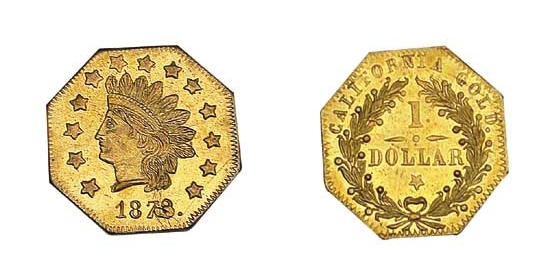
Obverse & Reverse
The 1873/2 G$1 BG-1121 is a quintessential example of 'Period Two' California Fractional Gold. The history of these fascinating pieces is bifurcated into two distinct eras. 'Period One' (1852-1857) issues were born of necessity, privately minted by jewelers to alleviate a severe shortage of small-denomination coinage during the chaotic early years of the California Gold Rush. These pieces, often of relatively high gold content, actively circulated and served a vital economic function. However, by 1858, the San Francisco Mint was in full operation, producing sufficient federal silver and gold coinage to meet the demands of local commerce. This rendered the fractional gold pieces obsolete as circulating currency. Recognizing a new market, savvy jewelers transitioned to producing what are now known as 'Period Two' (1858-1882) issues. The BG-1121 falls squarely into this category. These coins were not intended for circulation but were instead created as souvenirs and keepsakes for tourists, merchants, and those captivated by the romance of the Gold Rush. They were often of a lower weight and fineness than their Period One predecessors. The BG-1121 was struck by Christopher Ferdinand Mohrig, a San Francisco jeweler who was a prolific producer of these souvenir tokens during the 1870s. This specific variety is an overdate, created when Mohrig repurposed an 1872-dated obverse die by crudely punching a '3' over the '2'. This economical measure, likely undertaken to use up old dies after a small number of strikes, resulted in a fascinating and extremely rare variety. Mohrig's career as a private minter came to an abrupt end on August 10, 1876, when he was arrested by the U.S. Secret Service for violating the Private Coinage Act of 1864. While the law was not strictly enforced against souvenir issues for many years, a crackdown in the mid-1870s led to the confiscation and destruction of Mohrig's dies and stock, contributing directly to the rarity of many of his issues, including the BG-1121. Today, it stands as a tangible link to the entrepreneurial spirit of post-Gold Rush San Francisco and a prized numismatic rarity.
Associated EventCalifornia Gold Rush (Post-Rush Souvenir Period)
Reason For MintingTo serve the growing market for souvenirs and keepsakes related to the California Gold Rush, rather than to circulate as money.
Minter HistoryChristopher Ferdinand Mohrig was a San Francisco-based jeweler and a significant producer of 'Period Two' California Fractional Gold tokens. Active primarily in the 1870s, he created a wide variety of these popular souvenir coins. His operations were halted on August 10, 1876, when he was arrested by the Secret Service for violating private coinage laws. The subsequent confiscation and destruction of his equipment is a primary reason for the rarity of many of his surviving pieces.
Historical SignificanceThe BG-1121 is historically significant not as a circulating coin, but as a cultural artifact representing the commercialization of the Gold Rush legend. It showcases the transition from utilitarian private coinage to souvenir tokens and highlights the resourcefulness of its minter through the use of an overdated die. Its extreme rarity, partly due to government intervention, makes it a key variety for specialists in the series.
K-N/A
Denomination$1
Minting Period1873
Assayer/MinterChristopher Ferdinand Mohrig
Geographic OriginSan Francisco, California
Obverse DescriptionThe obverse features a large, stylized bust of a Native American princess facing left, wearing a feathered headdress. The portrait is encircled by thirteen five-pointed stars. The date, '1873', is positioned below the bust, with the '3' clearly punched over a '2'.
Obverse Inscription1873
Reverse DescriptionThe reverse design consists of the denomination '1 DOLLAR' arranged in two lines, enclosed within a continuous, ornate wreath of leaves and berries. The words 'CALIFORNIA GOLD' appear in an arc above the wreath, following the octagonal border of the coin.
Reverse InscriptionCALIFORNIA GOLD 1 DOLLAR
CompositionGold
Stated Fineness Actual Fineness EdgePlain
Extremely low; mintage is unknown but presumed to be minuscule.
Survival Estimate12-14 pieces known in all grades.
Rarity ScaleR-7-
The 1873/2 BG-1121 is highly sought after for its extreme rarity, its status as a dramatic overdate, and its connection to the well-documented minter Christopher Ferdinand Mohrig. As a 'Period Two' dollar, it is one of the largest denominations in the fractional series, and its octagonal shape adds to its classic pioneer appeal. It represents a trophy coin for advanced collectors of California Fractional Gold.
Key VarietiesThe primary variety is the 1873/2 overdate itself. It was struck from the same die pair as the BG-1120 (dated 1872), but with the date altered. No other major varieties from the original minting period are known. Unlike some other numismatic series, there are no known official restrikes, patterns, or trial pieces associated with the BG-1121. Any later pieces resembling California gold are typically modern replicas or 'tokens' and are not considered part of the original Breen-Gillio series.
Authentication TipsAuthentication requires careful examination of the overdate. The '3' is crudely formed and sits atop a clearly visible underlying '2'. The style of the Indian Head portrait and the wreath on the reverse should be compared to known genuine examples. The surfaces should exhibit characteristics of a period strike, not the uniform, sterile look of modern replicas. Many fakes are brass or gold-plated and lack the denomination 'DOLLAR', a key feature of genuine Period Two issues. Due to its high value and rarity, third-party authentication from PCGS or NGC is strongly recommended.
Shopping ConsiderationsA 'premium quality' example for its grade will exhibit a sharp, well-defined strike, particularly on the details of the headdress and the leaves of the wreath. Many specimens were struck with a 'medal turn' alignment and have prooflike or semi-prooflike surfaces; coins that retain this original reflectivity are highly desirable. Look for attractive, original 'sun-gold' or reddish-gold toning. Common problems to avoid include harsh cleaning, which dulls the luster and imparts hairline scratches, and previous use as jewelry, which can result in solder marks, tooling, or excessive rim damage. Minor planchet flaws or retained laminations, as seen on some known examples, are often considered 'as made' and may be more acceptable to specialists.
A coin's grade is its condition, rated on a 1-70 scale. For rare coins, this is the most critical factor in determining value, as a tiny difference in preservation can mean a huge difference in price.
Relevant Grade TypesOriginal period issues of BG-1121 were business strikes, although created for souvenir purposes, and are found in Circulated (1-58) and Mint State (MS, 60-70) grades. Despite their souvenir nature, they were not struck as collector Proofs in the modern sense. The finest known examples are sometimes described as 'prooflike' due to the quality of their strike and preparation, but they are designated as MS by grading services. No later-date Proof restrikes are known to exist.
Mint State CharacteristicsUncirculated examples of BG-1121 are characterized by a sharp strike and often exhibit reflective, prooflike fields. The luster is typically bright and satiny. Due to the nature of their production, even Mint State examples may show minor planchet imperfections or weak areas. Contact marks, when present, are often found on the high points of the design, such as the cheek of the Indian princess and the highest leaves in the wreath.
Circulated Wear PatternsOn circulated examples, wear first appears on the high points of the Indian princess's cheekbone, brow, and the feathers of the headdress. On the reverse, the highest parts of the wreath and the letters in 'DOLLAR' will show initial friction and loss of detail. On lower-grade examples, the stars and date on the obverse will become faint, and the finer details of the wreath will merge.
Key Factors For ValueFor the BG-1121, value is driven primarily by its rarity and grade. Surface quality is paramount; an example with original, uncleaned surfaces and attractive luster will command a significant premium over a cleaned or damaged coin of the same grade. The sharpness of the strike and clarity of the 1873/2 overdate are critical. Eye appeal, encompassing toning and the absence of distracting marks, plays a major role. Given the small surviving population, any certified example is valuable, but those with a CAC sticker, indicating premium quality for the grade, are prized and bring the highest prices at auction.
PCGS Price Guide
| Grade | Price | Population |
|---|---|---|
| 50 | $1,100.00 | 1 |
| 50+ | $1,150.00 | N/A |
| 53 | $1,200.00 | N/A |
| 53+ | $1,250.00 | N/A |
| 55 | $1,300.00 | 1 |
| 55+ | $1,350.00 | N/A |
| 58 | $1,450.00 | 3 |
| 58+ | $1,500.00 | N/A |
| 60 | $1,750.00 | N/A |
| 61 | $2,250.00 | 2 |
| 62 | $3,000.00 | 6 |
| 62+ | $3,750.00 | N/A |
| 63 | $4,250.00 | 2 |
| 63+ | $4,500.00 | N/A |
| 64 | $4,750.00 | 2 |