1873 G$1 BG-1123 (Regular Strike)
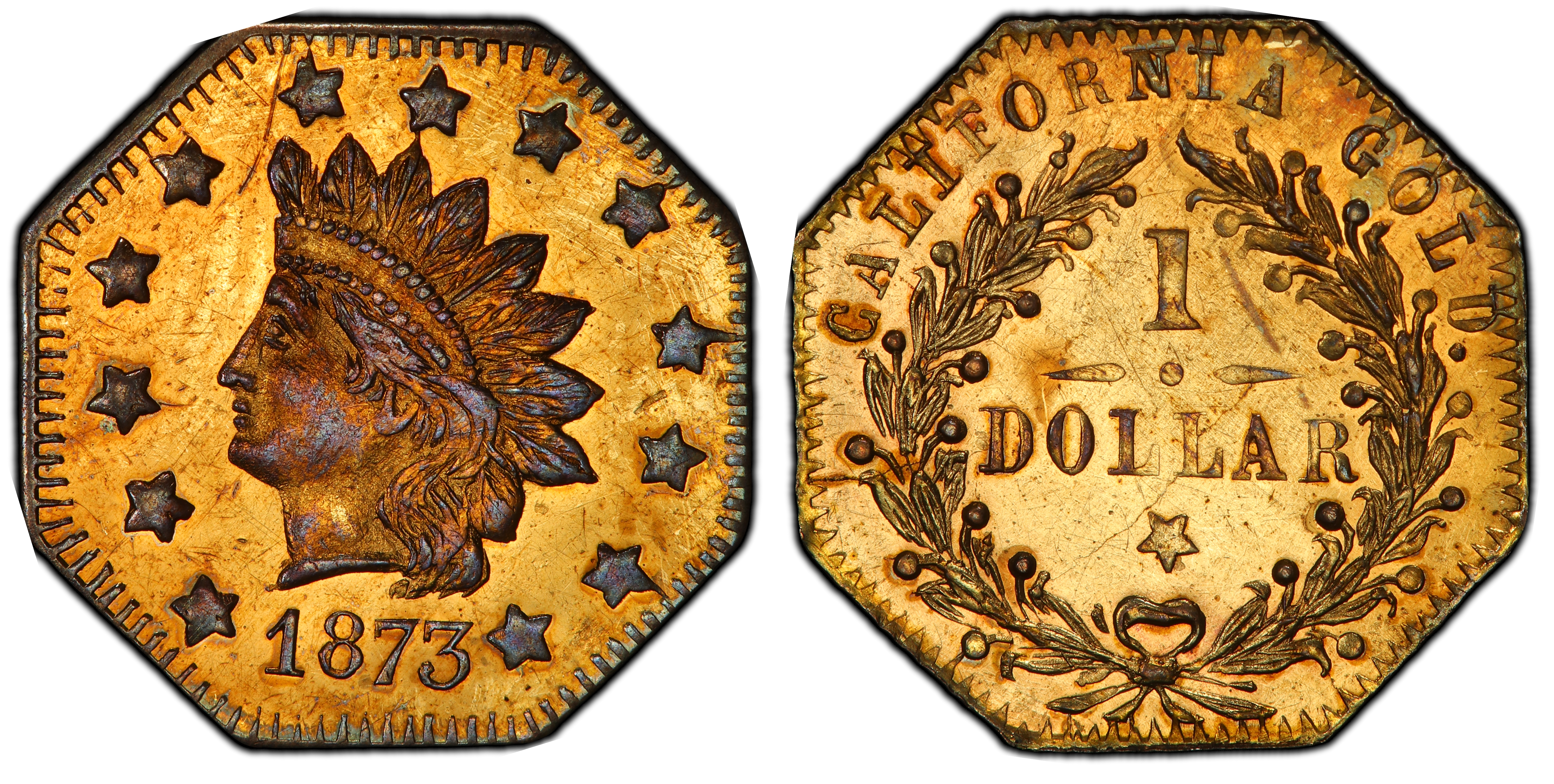
Obverse & Reverse
The 1873 G$1 BG-1123 is a quintessential example of 'Period Two' California Fractional Gold. The history of these fascinating pieces is bifurcated into two distinct eras. 'Period One' (1852-1858) pieces were struck out of genuine commercial necessity. The California Gold Rush had flooded the region with gold dust and large denomination coins, but created a severe shortage of small change for everyday transactions. Private minters, mostly jewelers, stepped in to fill this void, producing quarter, half, and one-dollar gold pieces that, while often underweight, were generally accepted in local commerce. However, by the late 1850s, the official San Francisco Mint was in full operation, producing sufficient quantities of federal silver and gold coins, rendering the private issues obsolete for their original purpose. This marked the beginning of 'Period Two' (1859-1882), during which the production of fractional gold coins transformed. They were no longer primarily instruments of commerce but rather souvenirs and jewelry items, catering to tourists, miners wanting a keepsake, and a growing collector base. The BG-1123, dated 1873, falls squarely into this souvenir period. These pieces were often struck with more creative and less uniform designs compared to their Period One predecessors. The minters, typically anonymous San Francisco jewelers, were not bound by the need for their coins to resemble federal issues for acceptance. Instead, they produced a wide variety of attractive designs, such as the Indian Head motif of BG-1123, often on both round and octagonal planchets. The legal status of these pieces was ambiguous; the Coinage Act of 1864 banned private coinage, but enforcement was lax until the Secret Service finally cracked down in 1883, ending the era of legitimate, denominated fractional gold production.
Associated EventCalifornia Gold Rush (Later Souvenir Period)
Reason For MintingPrimarily created as a souvenir or keepsake of the California Gold Rush era, rather than for circulation.
Minter HistoryThe specific minter of BG-1123 is unknown, a common characteristic for 'Period Two' issues. During this era (1859-1882), production was dominated by numerous, often anonymous, San Francisco jewelers and artisans. Unlike the Period One minters who sometimes initialed their work (e.g., 'FD' for Frontier & Deviercy), Period Two makers rarely identified themselves on their products, likely due to the legally dubious nature of producing items denominated as 'Dollars' after the 1864 private coinage ban. These jewelers operated small-scale, often hand-powered presses, leading to significant variability in strike quality even among coins from the same dies.
Historical SignificanceThe BG-1123 represents the commercial evolution of private minting in California, from a utilitarian response to a coinage shortage to a market-driven production of nostalgic souvenirs. It is a tangible artifact of the enduring legacy and romanticism of the Gold Rush, demonstrating how the region's gold continued to be monetized in creative ways long after the initial fever had subsided. Numismatically, it is a key variety within the extensive and popular series of California Fractional Gold, prized for its distinct Indian Head design and octagonal shape.
BG-1123
Denomination$1
Minting Period1873
Assayer/MinterUnknown Jeweler(s)
Geographic OriginSan Francisco, California
Obverse DescriptionA stylized head of Liberty facing left, wearing a feathered headdress. The portrait is commonly referred to as an 'Indian Head'. Thirteen stars encircle the portrait, representing the original colonies.
Obverse Inscription[No Inscription]
Reverse DescriptionThe denomination '1' and the word 'DOLLAR' are enclosed within a decorative wreath of leaves and berries. The date '1873' is positioned below the wreath, and the abbreviation 'CAL.' is above.
Reverse InscriptionCAL. / 1 / DOLLAR / 1873
CompositionGold
Stated Fineness Actual FinenessVariable, typically lower than federal coinage of the era.
EdgePlain
Unknown
Survival Estimate13-30 (Highly Scarce)
Rarity ScaleR-6
This variety is highly sought after due to its classic Indian Head design, octagonal shape, and significant rarity. As a 'Period Two' issue, it appeals to collectors who appreciate the souvenir and jewelry aspect of the series. The challenge of acquiring a well-struck, problem-free example makes it a notable prize for specialists in territorial and private gold.
Key VarietiesThe BG-1123 is a specific die marriage. Within the broader 1873 octagonal dollar series, collectors may seek out other Breen-Gillio varieties with different die characteristics, but for BG-1123 itself, no major sub-varieties are widely recognized. Some examples are found with prooflike (PL) surfaces, which are not a separate variety but a desirable manufacturing characteristic that commands a premium. No later-date restrikes are known.
Authentication TipsGenuine pieces exhibit sharp, albeit sometimes uneven, details from the dies. The stars and letters should be well-formed, not mushy or rounded as often seen on cast counterfeits. The surfaces should have original mint luster, which can range from satiny to prooflike; fakes are often unnaturally bright or have incorrect texture. Many modern replicas exist, often made of brass or thinly plated gold; weight and specific gravity tests can be conclusive. Authentication by a major grading service (PCGS or NGC) is highly recommended, as they reference the Breen-Gillio photographic plates.
Shopping ConsiderationsA premium quality example for its grade will possess a sharp, well-centered strike, especially on the high points of the Indian's cheek and the details of the wreath. Look for pieces with clean, original surfaces that have not been harshly cleaned, polished, or used in jewelry. Small planchet flaws or strike-throughs are common and can be acceptable, but significant distracting marks will lower the value. Eye appeal is paramount; coins with deep prooflike fields or attractive original reddish-gold toning are especially prized. Avoid examples with evidence of solder, tooling, or significant rim damage from being mounted as jewelry.
A coin's grade is its condition, rated on a 1-70 scale. For rare coins, this is the most critical factor in determining value, as a tiny difference in preservation can mean a huge difference in price.
Relevant Grade TypesOriginal period issues were business strikes, although as they were intended as souvenirs rather than for commerce, many survive in high grades. They are found in Circulated (1-58) and Mint State (MS, 60-70) grades. No true Proofs were struck during the original period of issue. However, many Period Two pieces were struck on polished planchets with polished dies, resulting in a mirrored or 'Prooflike' (PL) surface, a designation which adds significant value.
Mint State CharacteristicsUncirculated examples of BG-1123 often display a sharp but not perfectly uniform strike due to the use of hand-operated presses. The luster can range from satiny to deeply prooflike. The fields are the most susceptible area for contact marks, although the softness of the gold means any contact can leave a mark. The central devices, particularly the Indian's face and the details of the wreath, should be frosty on PL examples. Weakness is sometimes seen on the peripheral stars or letters if the strike was off-center or uneven.
Circulated Wear PatternsFor circulated examples, wear first appears on the highest points of the design. On the obverse, this is the cheek of the Indian portrait and the highest feathers in the headdress. On the reverse, the high points of the wreath's leaves and bow will show flatness and loss of detail first. On lower-grade pieces, the stars on the obverse will begin to merge with the fields, and the date and 'CAL.' on the reverse will become faint.
Key Factors For ValueThe primary value drivers for an 1873 G$1 BG-1123 are rarity and grade. Beyond the numerical grade, surface quality is critical; an example with original, undisturbed luster and minimal marks will always command a premium over a cleaned or abraded coin of the same grade. Strike sharpness is also key, with well-detailed examples being favored. Finally, eye appeal, which includes the quality of the luster (especially if prooflike) and any pleasing coloration, plays a major role. A CAC sticker indicating superior quality for the grade will add a significant premium for this scarce and desirable issue.
PCGS Price Guide
| Grade | Price | Population |
|---|---|---|
| 40 | $500.00 | 1 |
| 45 | $575.00 | N/A |
| 45+ | $650.00 | N/A |
| 50 | $700.00 | 2 |
| 50+ | $725.00 | N/A |
| 53 | $775.00 | 1 |
| 53+ | $825.00 | N/A |
| 55 | $875.00 | 8 |
| 55+ | $950.00 | N/A |
| 58 | $1,050.00 | 7 |
| 58+ | $1,250.00 | N/A |
| 60 | $1,400.00 | 1 |
| 61 | $1,500.00 | 5 |
| 62 | $1,650.00 | 17 |
| 62+ | $1,900.00 | N/A |
| 63 | $2,650.00 | 10 |
| 63+ | $3,000.00 | N/A |
| 64 | $3,500.00 | 6 |
| 64+ | $3,750.00 | N/A |
| 65 | $4,750.00 | 5 |
| 65+ | $6,000.00 | N/A |
| 66 | $9,000.00 | 1 |