1875/3 G50C BG-1058 (Regular Strike)
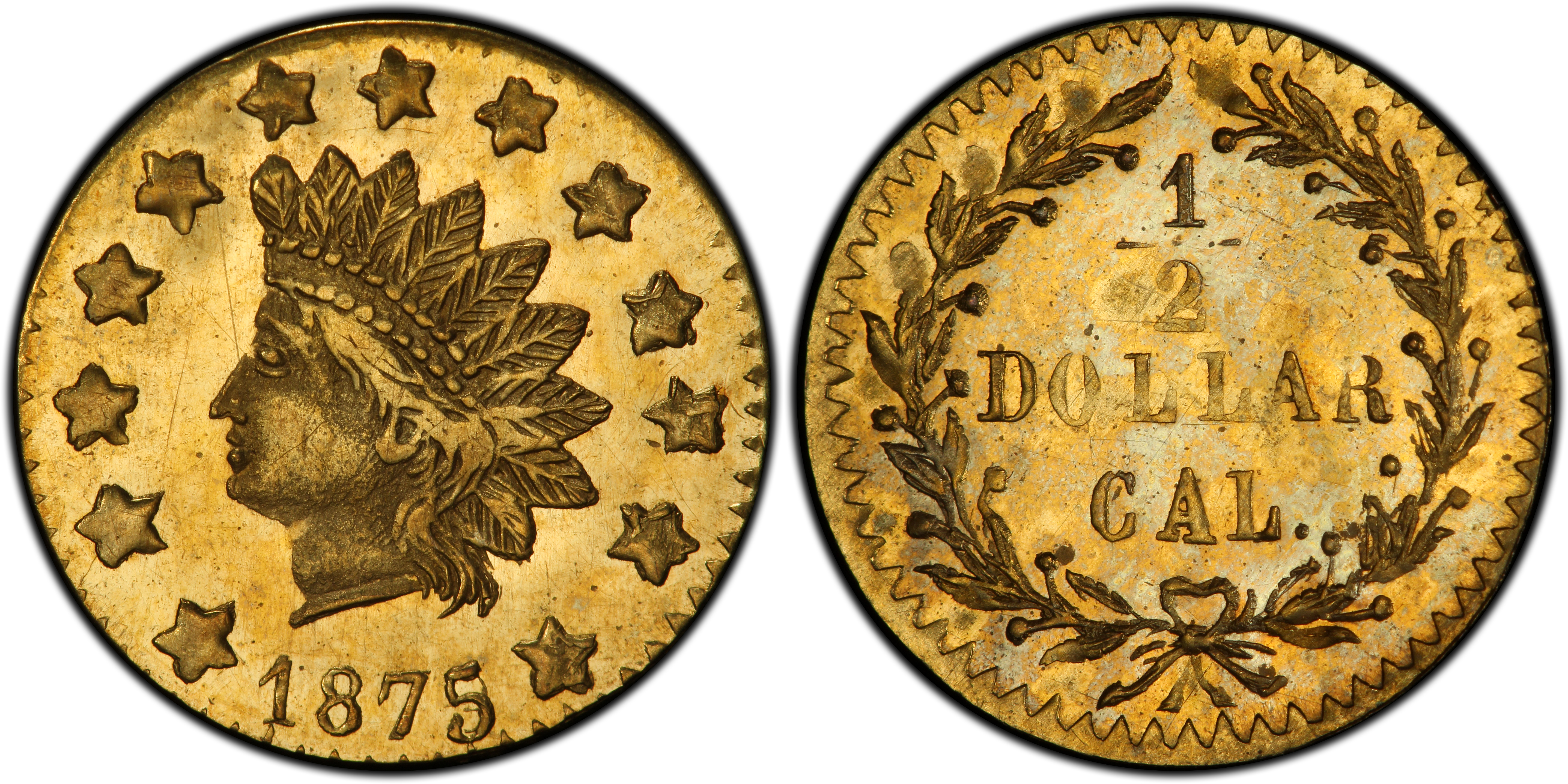
Obverse & Reverse
The 1875/3 BG-1058 Fifty Cent piece is a quintessential example of a 'Period Two' California Fractional Gold coin. The history of these fascinating private issues is bifurcated into two distinct eras. 'Period One' (1852-1857) pieces were struck out of genuine commercial necessity. The massive influx of population during the Gold Rush created a vibrant economy, but the United States Mint could not supply enough small denomination coinage for daily transactions. Gold dust was impractical for small purchases, leading private jewelers and assayers in San Francisco to strike their own quarter, half, and one-dollar gold pieces. These early issues, while not legal tender, contained a substantial portion of their face value in gold and were generally accepted in local commerce. However, by 1856-1857, the new San Francisco Mint was in full operation, producing ample federal silver and gold coins, which obviated the need for private fractional currency. This led to the 'Period Two' (1859-1882) issues, to which the BG-1058 belongs. The character of these later pieces changed dramatically; they were no longer intended for circulation but were instead produced as souvenirs, keepsakes, and jewelry items for tourists and locals nostalgic for the Gold Rush days. This specimen, dated 1875, was struck using a die that was altered from an 1873 die, a common practice among private minters to save on costs. As souvenirs, Period Two coins were intentionally made smaller and with less gold content than their face value would imply, making them profitable for their manufacturers and affordable for purchasers. The Coinage Act of 1864 made all private coinage illegal, but it was not strictly enforced against these small tokens until the early 1880s, allowing their production to continue for nearly two decades. The BG-1058, with its popular Indian Head motif, represents the final chapter of this uniquely American series, a tangible link to the romanticism of the California Gold Rush long after its commercial necessity had faded.
Associated EventPost-Gold Rush California Economy
Reason For MintingPrimarily struck as a souvenir or keepsake for the tourist trade rather than for monetary circulation.
Minter HistoryThe specific minters of most 'Period Two' California Fractional Gold pieces, including the BG-1058, are unknown. They were typically produced by jewelers in San Francisco who had the skills and equipment for die-sinking and coining. Unlike the earlier 'Period One' assayers who sometimes marked their coins, the makers of these later souvenir pieces remained anonymous, likely due to the questionable legal standing of their products after the Coinage Act of 1864.
Historical SignificanceThis coin is significant not as a medium of exchange, but as a cultural artifact. It demonstrates the continued romantic allure of the Gold Rush and the entrepreneurial spirit of San Francisco craftsmen who created a market for nostalgic mementos. It is a product of an era transitioning from the raw frontier economy to a more established and commercialized society that capitalized on its own recent history.
N/A
Denomination50 Cents
Minting Period1875
Assayer/MinterUnknown Private Minter
Geographic OriginSan Francisco, California
Obverse DescriptionAn Indian Head motif facing left, stylistically similar to contemporary U.S. coinage but cruder in execution. The portrait is surrounded by thirteen stars, representing the original colonies. The date, 1875, is positioned below the bust. Diagnostic for the BG-1058 variety is the clear repunching of the 5 over a 3.
Obverse Inscription1875
Reverse DescriptionA wreath composed of two branches tied with a ribbon at the bottom. Inside the wreath, the denomination '50 CENTS' is inscribed. Above the denomination, the word 'CALIFORNIA' is sometimes present on similar issues, but on this variety, the value is the central element.
Reverse Inscription50 CENTS
CompositionGold
Stated Fineness Actual FinenessVariable, often between 14 and 22 karats. Period Two issues are known to be debased and contain significantly less gold than their stated face value would imply.
Weight0.25 grams
Diameter10.00 mm
EdgePlain
Unknown
Survival EstimateFewer than 500
Rarity ScaleR-3 (Scarce)
The BG-1058 is popular due to its classic Indian Head design, clear overdate (1875/3), and its status as a representative of the widely collected California Fractional Gold series. Its affordability relative to Period One issues makes it an accessible entry point for collectors wanting a tangible piece of Gold Rush-era history.
Key VarietiesThe primary variety is the 1875/3 overdate itself. Within the broader California Fractional Gold series, there are hundreds of Breen-Gillio (BG) varieties, differing by date, denomination, shape (round or octagonal), and design. No special collector issues like proofs or patterns are known for BG-1058 from the original minting period.
Authentication TipsAuthentication requires comparison to known genuine examples, ideally using the Breen-Gillio reference, 'California Pioneer Fractional Gold.' Key diagnostics include the precise position and shape of the date and legends, the style of the Indian portrait, and the presence of die flaws or cracks specific to the BG-1058 variety. Genuine pieces often have a slightly crude, hand-made appearance from being hammer-struck. Counterfeits are common; many are brass replicas or modern fantasies. Be wary of pieces with designs not cataloged by Breen-Gillio, especially those featuring bears, which were not used on genuine historical issues.
Shopping ConsiderationsA premium quality example for its grade will exhibit a bold, centered strike, which is uncommon for hammer-struck pieces. Look for sharpness on the high points of the headdress feathers and the details of the wreath. Original, lustrous surfaces are highly desirable and command significant premiums; many surviving examples have been cleaned or used as jewelry, impairing their surfaces. Avoid coins that are bent, holed, or show signs of tooling or solder removal. The clarity of the '5 over 3' overdate is a key feature, and well-defined examples are sought after. Given the minute size, even minor marks can be distracting, so eye appeal is paramount.
A coin's grade is its condition, rated on a 1-70 scale. For rare coins, this is the most critical factor in determining value, as a tiny difference in preservation can mean a huge difference in price.
Relevant Grade TypesAll original 1875/3 BG-1058 coins were business strikes intended for sale as souvenirs, not for circulation. They are found in Circulated grades (1-58), though this wear is often from handling or use in jewelry, and Mint State (MS, 60-70) grades. No Proofs were struck during the original period. However, because some dies were polished to a high sheen to create flashy souvenirs, some specimens exhibit 'Prooflike' (PL) or 'Deep Mirror Prooflike' (DMPL) surfaces, which are business strikes with reflective fields and are highly prized by collectors.
Mint State CharacteristicsUncirculated examples of BG-1058 often show weakness in the strike, particularly on the highest points of the design due to the nature of manual hammer striking. Luster is typically bright and flashy, sometimes with a slightly brassy yellow color depending on the gold alloy. Due to their small size and method of production, they are susceptible to planchet flaws and adjustment marks. Contact marks, even small ones, can be very noticeable and will significantly impact the grade and eye appeal.
Circulated Wear PatternsWear first appears on the highest points of the design. On the obverse, this includes the cheek and the feathers of the headdress. On the reverse, the leaves and ribbon of the wreath will show the first signs of friction. On lower grade examples, the stars and legends will begin to weaken and merge with the fields.
Key Factors For ValueFor the BG-1058, value is driven by several factors. First is the certified grade. Second, sharpness of the strike is critical; a well-struck coin with full details is worth much more than a weakly struck coin of the same grade. Third, surface quality is paramount. An example with original, undisturbed luster and minimal marks (strong 'eye appeal') will command a substantial premium over a cleaned, scratched, or otherwise impaired coin. Finally, the clarity and boldness of the 1875/3 overdate can influence desirability and value among specialists.
PCGS Price Guide
| Grade | Price | Population |
|---|---|---|
| 40 | $185.00 | 2 |
| 45 | $190.00 | 1 |
| 45+ | $200.00 | N/A |
| 50 | $210.00 | 2 |
| 50+ | $220.00 | N/A |
| 53 | $230.00 | 1 |
| 53+ | $240.00 | N/A |
| 55 | $260.00 | 21 |
| 55+ | $265.00 | N/A |
| 58 | $290.00 | 37 |
| 58+ | $295.00 | N/A |
| 60 | $325.00 | 7 |
| 61 | $350.00 | 9 |
| 62 | $375.00 | 53 |
| 62+ | $475.00 | N/A |
| 63 | $625.00 | 49 |
| 63+ | $750.00 | N/A |
| 64 | $950.00 | 12 |
| 64+ | $1,100.00 | N/A |
| 65 | $1,500.00 | 6 |
| 65+ | $2,000.00 | N/A |
| 66 | $2,500.00 | 1 |