1874 G50C BG-1055 (Regular Strike)
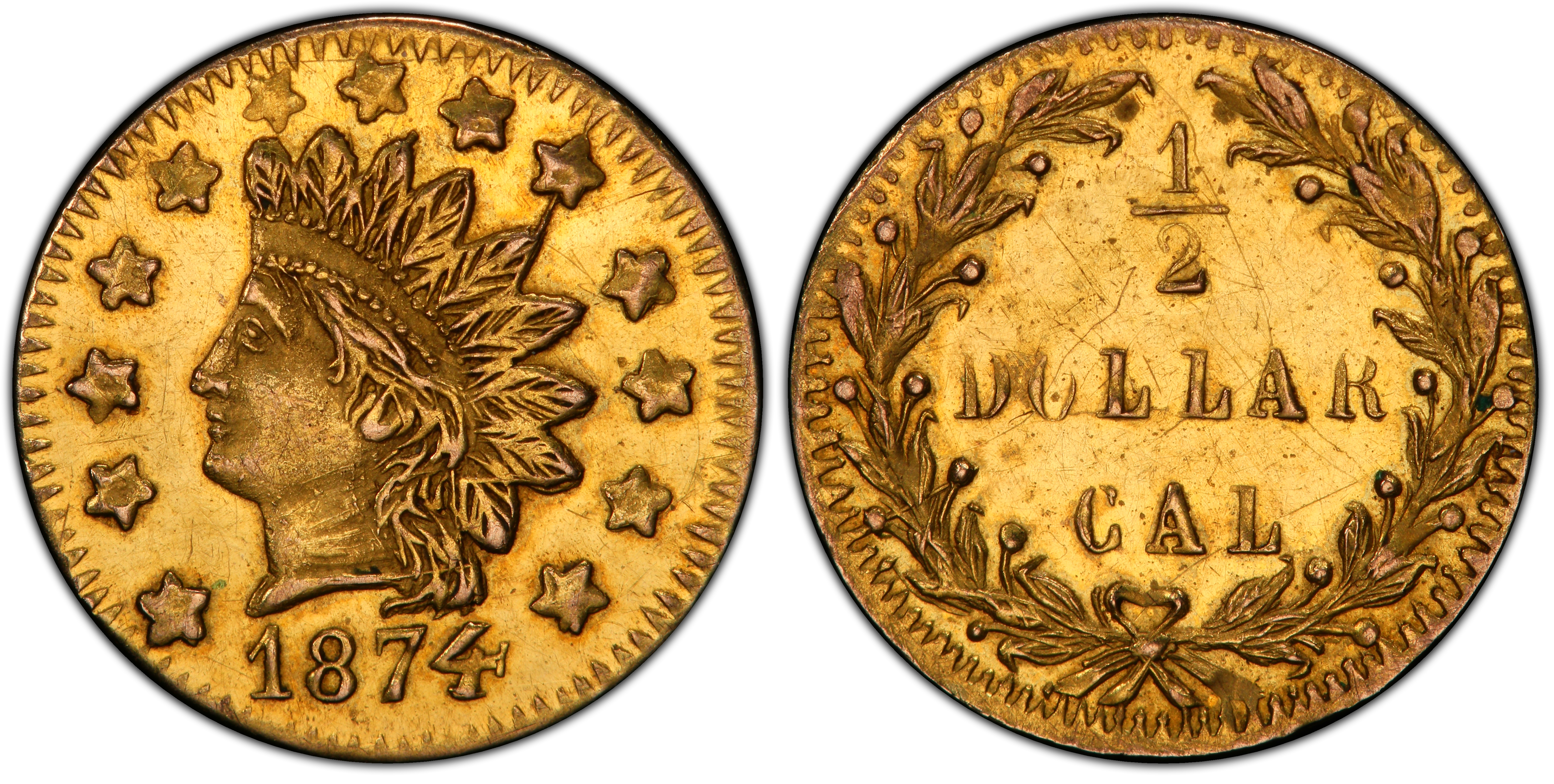
Obverse & Reverse
The 1874 BG-1055 50 Cents represents the later period of California Fractional Gold production, a fascinating and complex chapter in American numismatics born out of necessity and entrepreneurial spirit. Following the initial frenzy of the California Gold Rush, the region experienced a chronic shortage of circulating small change. The smallest denomination U.S. coin was the silver half dime, which was scarce on the West Coast, and the massive influx of gold dust created an awkward economic environment where transactions for everyday goods were difficult. Jewelers and assayers began striking small, privately issued gold coins in 25-cent, 50-cent, and one-dollar denominations to fill this void starting in 1852. These pieces were not legal tender but were widely accepted due to their intrinsic gold value and the desperate need for a convenient medium of exchange. By the 1870s, the initial, urgent need had subsided as U.S. Mint coins became more plentiful. However, a new market emerged: souvenirs and keepsakes for tourists and residents captivated by the Gold Rush legacy. The coins produced during this 'Period Three' (1872-1882) were often made by jewelers like Robert B. Gray & Co. of San Francisco. They were typically thinner and lighter than their earlier counterparts, containing less gold value relative to their face value, and were marketed more as novelties than as circulating currency. The BG-1055 is a classic example of this era. While it bears a date and denomination, its primary function was as a memento. The passage of the Act of April 22, 1864, which prohibited private coinage, was largely ignored in the isolated West, but federal authorities finally cracked down in the early 1880s, effectively ending the production of these charming and historic pieces.
Associated EventPost-California Gold Rush Economic Development
Reason For MintingPrimarily created to serve as souvenirs and novelties for the tourist trade, capitalizing on the romanticism of the Gold Rush.
Minter HistoryWhile definitive attribution is often impossible for Period Three issues, the die work, planchet characteristics, and style of the BG-1055 are strongly associated with Robert B. Gray & Co., a prominent San Francisco jewelry firm. Gray and his contemporaries were not clandestine minters in the traditional sense but rather manufacturers of gold novelties that resembled coins. They operated openly, advertising their products as charms and keepsakes. Their work is characterized by specific design elements, such as the particular style of the 'Indian Princess' head, and consistent metallurgical properties across known examples.
Historical SignificanceThe BG-1055, like other California Fractional Gold pieces, is a tangible link to the private enterprise that addressed economic needs unmet by the federal government in the American West. It represents the transition of these coins from utilitarian currency substitutes to popular souvenirs, reflecting California's burgeoning tourism industry and the mythologizing of the Gold Rush era even as it was still within living memory. It is a testament to a period of numismatic freedom that ended as federal control over currency became absolute.
N/A
Denomination50 Cents
Minting Period1874
Assayer/MinterUnknown, likely Robert B. Gray & Co.
Geographic OriginSan Francisco, California
Obverse DescriptionA beaded border encircles a right-facing portrait of an Indian Princess. She wears a feathered headdress, with the letters of LIBERTY incuse on the headband, though often weakly struck and illegible. Thirteen stars surround the portrait, seven to the left and six to the right.
Obverse InscriptionLIBERTY
Reverse DescriptionA beaded border encircles a wreath composed of two olive branches tied with a bow at the bottom. The denomination '50 CENTS' is within the wreath, and the date '1874' is below the bow.
Reverse Inscription50 CENTS 1874
CompositionGold
Stated Fineness Actual FinenessApproximately .500 to .600 fine (12-14 karat gold), typical for souvenir issues of the period.
Weight0.25 grams
Diameter10.10 mm
EdgePlain
Unknown
Survival Estimate500-750
Rarity ScaleR-3
This issue is highly popular with collectors due to its affordability relative to earlier issues, classic 'Indian Princess' design, and its status as a genuine artifact of the post-Gold Rush era. It serves as an accessible entry point into the fascinating world of California Fractional Gold.
Key VarietiesThe primary variety is the Regular Strike business issue (BG-1055). No known original proof strikings exist. However, collectors must be aware of 'restrikes' made by other parties long after 1882, and modern replicas. The key is to seek original pieces from the 1874 period, identified by their specific die characteristics and planchet fabric. The BG-1055 has a known die state where a crack appears on the reverse, running from the rim through the 'S' in CENTS.
Authentication TipsAuthentic BG-1055 examples have a specific 'look' to their surfaces, often with a slightly granular or satiny texture rather than the glassy fields of modern fakes. The details, while sometimes softly struck, should not be mushy or indistinct like cast counterfeits. The style of the portrait and the font used for the legends are key diagnostic points. The weight should be very close to 0.25 grams. Any piece that is significantly overweight, underweight, or has a soapy, tool-marked, or unusually reflective surface should be considered suspect. Third-party grading is highly recommended.
Shopping ConsiderationsA premium quality example for its grade will exhibit a sharp strike, particularly on the details of the headdress and the word LIBERTY, which is almost always weak. Look for pleasing, original surfaces with some remnant luster. Avoid coins that have been harshly cleaned, polished, or mounted for jewelry, as evidenced by rim damage, solder, or deep, parallel scratches. A small planchet flaw or a light, honest circulation mark is acceptable and often expected. Eye appeal is paramount; a choice, original coin will always command a significant premium over a processed or damaged specimen.
A coin's grade is its condition, rated on a 1-70 scale. For rare coins, this is the most critical factor in determining value, as a tiny difference in preservation can mean a huge difference in price.
Relevant Grade TypesOriginal period issues were business strikes intended for circulation or sale as souvenirs. They are found in Circulated grades (AG-3 to AU-58) and Mint State (MS-60 to MS-70). No proofs were struck during the original period of issue. Any piece described as a 'Proof' is almost certainly a later restrike, replica, or fantasy piece and should not be confused with the original 1874-dated issue.
Mint State CharacteristicsUncirculated examples of BG-1055 often exhibit a soft, satiny luster rather than a hard, frosty one. The strike is a key issue; most examples are softly struck, especially on the word LIBERTY on the headband and the centers of the wreath on the reverse. A coin that is sharply struck for the issue is highly desirable. Small, inherent planchet flaws or adjustment marks are not uncommon and may not detract significantly if they are minor. Contact marks are common due to the softness of the low-karat gold.
Circulated Wear PatternsWear first appears on the high points of the design: the cheek and jawline of the Indian Princess, the feathers in the headdress, and the leaves and bow of the wreath on the reverse. On moderately worn examples (VF-XF), the letters in LIBERTY will be completely obliterated, and the finer details of the feathers will be merged. In lower grades (F and below), the portrait becomes flat, the stars begin to merge with the rim, and the legends become difficult to read.
Key Factors For ValueFor the BG-1055, the primary value drivers are grade and surface quality. An example with original, uncleaned surfaces and some remaining mint luster will be worth significantly more than a cleaned or polished coin of the same technical grade. Strike quality is the next most important factor; a well-struck piece with a visible (even if partial) LIBERTY is a major rarity and commands a substantial premium. Finally, eye appeal, which encompasses toning (a lovely reddish-gold hue is prized) and the absence of distracting marks or flaws, plays a huge role. Certification by a top-tier service like PCGS or NGC is essential for market acceptance, and a CAC sticker on a certified coin indicates premium quality for the grade, adding a further premium.
PCGS Price Guide
| Grade | Price | Population |
|---|---|---|
| 55 | $260.00 | 3 |
| 55+ | $265.00 | N/A |
| 58 | $275.00 | 6 |
| 58+ | $285.00 | N/A |
| 60 | $300.00 | 1 |
| 61 | $325.00 | 2 |
| 62 | $375.00 | 25 |
| 62+ | $435.00 | N/A |
| 63 | $525.00 | 15 |
| 63+ | $675.00 | N/A |
| 64 | $900.00 | 8 |
| 64+ | $1,150.00 | N/A |
| 65 | $2,150.00 | N/A |