1870 G$1 BG-1203 (Regular Strike)
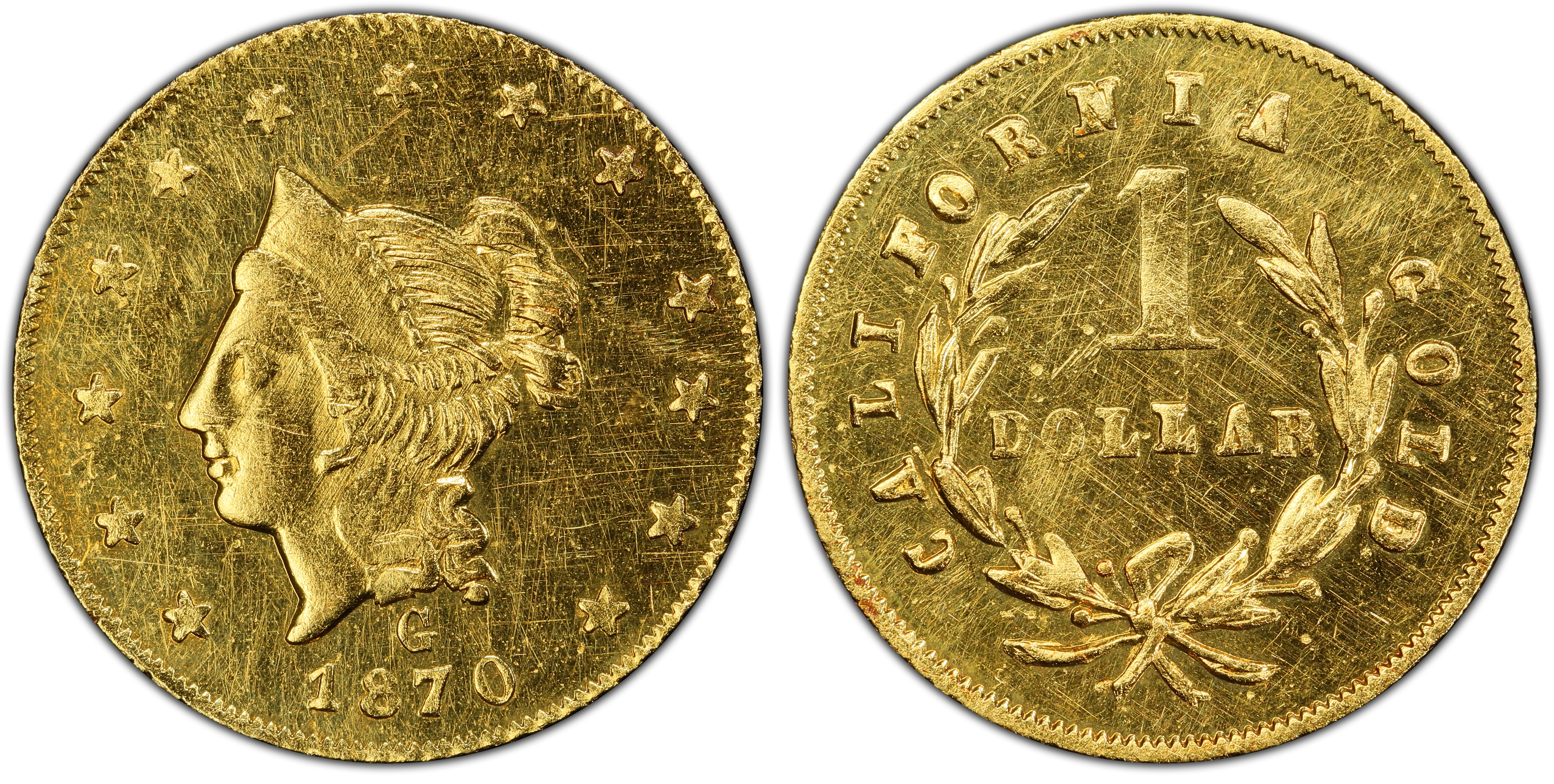
Obverse & Reverse
The 1870 BG-1203 one-dollar piece emerges from the second major period of California Fractional Gold production (1859-1882), a fascinating and complex chapter in American monetary history. Following the initial California Gold Rush, the region was plagued by a chronic shortage of small-denomination coinage for everyday transactions. The first period (1852-1857) saw private minters, mostly jewelers, strike small quarter, half, and one-dollar gold pieces to fill this void, mirroring the designs of official U.S. coinage. However, the Coinage Act of April 22, 1864, officially outlawed all private currency. This federal legislation, intended to standardize the nation's money, created a new reality for the producers of California's gold 'smalls.' Rather than cease production, the practice became clandestine. The second period, to which the BG-1203 belongs, is characterized by these 'suppressed' or 'jeweler's issues.' To circumvent the law, minters often omitted their identifying marks and frequently used earlier, pre-1864 dates. The use of an 1870 date on this piece is somewhat bold, as federal enforcement, while inconsistent, was a known risk. These pieces were no longer primarily intended to circulate as money, as Greenbacks and official federal coinage were becoming more common. Instead, their role shifted. They became popular keepsakes and souvenirs, miniature symbols of the California dream, easily sent in letters to relatives back East. This shift in purpose also led to a general decrease in their intrinsic gold value relative to their face value; they were, in essence, becoming tokens. The BG-1203, with its classic Liberty Head motif, represents this transitional phase, embodying both the lingering need for a tangible representation of gold's allure and the legal pressures that pushed private minting into the shadows. Its very existence is a testament to the persistent entrepreneurial spirit of California's artisans and the enduring mystique of the Gold Rush.
Associated EventPost-Gold Rush California Commerce
Reason For MintingPrimarily created as a souvenir and keepsake during a period when the legality of private minting was suppressed.
Minter HistoryThe minters of 'Period Two' California Fractional Gold are largely anonymous, a direct consequence of the 1864 Coinage Act that made their activities illegal. They were typically skilled jewelers and metalsmiths operating in San Francisco. Unlike the Period One minters who sometimes initialed their work (e.g., 'D.N.' for Deriberpe and Nouizillet), the makers of coins like BG-1203 deliberately avoided identifying marks to evade prosecution. Their work is characterized by established designs, often using stock dies, but with a notable decline in weight and fineness compared to the earlier issues, reflecting the coins' new primary role as novelties rather than circulating currency.
Historical SignificanceThe BG-1203 is significant as a tangible artifact of the post-1864 era of clandestine private minting in California. It illustrates the evolution of fractional gold from a necessary circulating medium to a popular souvenir, and it represents the defiance of federal monetary laws by private entrepreneurs who continued to meet a commercial demand for these historic keepsakes.
BG-1203
DenominationG$1
Minting Period1870
Assayer/MinterUnknown San Francisco Jeweler
Geographic OriginSan Francisco, California
Obverse DescriptionA beaded border surrounds a fairly crude rendering of the Liberty Head portrait, facing left. Thirteen stars encircle the head.
Obverse Inscription[No Inscription]
Reverse DescriptionA beaded border surrounds a wreath of two olive branches tied with a bow at the bottom. The denomination '1' and 'DOLLAR' are in the center, with the date '1870' below the wreath.
Reverse Inscription1 DOLLAR 1870
CompositionGold
Stated Fineness Actual Fineness EdgePlain
Unknown
Survival Estimate31-75 (per R-5 rating)
Rarity ScaleR-5
This coin is prized by collectors for its direct connection to the romantic 'Old West' and the California Gold Rush era. As a 'suppressed issue,' it tells a story of clandestine production. Its small size, gold composition, and classic design make it an accessible and historically rich entry point into the specialized field of territorial gold.
Key VarietiesThere are no major recognized varieties of BG-1203 from the original minting period. This issue was a business strike. No Proofs, restrikes, or patterns are known or recorded for this specific variety.
Authentication TipsGenuine examples of BG-1203 are often characterized by a 'soft' or weak strike, particularly in the center of the obverse and reverse. The details of Liberty's hair and the wreath may lack sharpness. Surfaces can range from slightly prooflike to satiny. Look for the correct die markers and compare against known genuine examples. Modern counterfeits are plentiful and often appear too sharp or have incorrect luster, weight, or specific gravity. Third-party grading by PCGS or NGC is highly recommended for authentication.
Shopping ConsiderationsA premium quality example for its grade will exhibit a stronger-than-average strike and pleasing, original surfaces. Many surviving examples are cleaned or have been used in jewelry; avoid pieces with harsh cleaning lines, polishing, or evidence of solder or mounting. Look for minimal and well-hidden contact marks. Luster is a key value determinant; coins with deep, reflective prooflike surfaces or a rich, satiny original skin command significant premiums. Eye appeal is paramount for this issue, so prioritize well-struck coins with clean surfaces over those with higher technical grades but distracting flaws.
A coin's grade is its condition, rated on a 1-70 scale. For rare coins, this is the most critical factor in determining value, as a tiny difference in preservation can mean a huge difference in price.
Relevant Grade TypesOriginal examples of BG-1203 were business strikes intended for sale as souvenirs, not circulation. They are found in Circulated grades (AU-50 to AU-58, typically from light handling) and, more commonly, in Mint State (MS, 60-70) grades. No Proofs were struck during the original period of issue, and there are no known later-date collector restrikes.
Mint State CharacteristicsUncirculated examples are defined by their luster, which can range from a soft, satiny glow to semi-prooflike or fully prooflike fields. A sharp strike is atypical for this issue; most examples exhibit some softness on Liberty's hair and the wreath's details. Contact marks from bag or handling are common, but high-grade pieces will have minimal and well-placed marks that do not detract from the central design. The overall eye appeal, combining luster, strike, and surface preservation, is critical.
Circulated Wear PatternsOn circulated examples, wear first appears on the highest points of the design. On the obverse, this includes Liberty's cheek, the hair above the eye, and the ear. On the reverse, the high points of the bow and the leaves in the wreath will show the first signs of friction and flattening. In lower grades (VF and below, which are scarce for this issue), the finer details of the hair and wreath would begin to merge.
Key Factors For ValueFor the BG-1203, value is driven by three main factors: 1) Surface Quality: An example with original, uncleaned surfaces and attractive luster will always be worth more than a cleaned or polished coin of the same grade. 2) Strike: A coin with an unusually sharp strike for the variety, showing clear details in the hair and wreath, will command a significant premium. 3) Eye Appeal: Coins that are visually pleasing, free of distracting marks or unsightly toning, are highly sought after. A CAC sticker, indicating premium quality for the grade, adds a substantial premium for this issue.
PCGS Price Guide
| Grade | Price | Population |
|---|---|---|
| 20 | $1,000.00 | 1 |
| 25 | $1,075.00 | N/A |
| 30 | $1,125.00 | N/A |
| 35 | $1,200.00 | 1 |
| 40 | $1,225.00 | 1 |
| 45 | $1,250.00 | 3 |
| 45+ | $1,300.00 | N/A |
| 50 | $1,325.00 | 4 |
| 50+ | $1,350.00 | N/A |
| 53 | $1,375.00 | 2 |
| 53+ | $1,425.00 | N/A |
| 55 | $1,475.00 | 6 |
| 55+ | $1,525.00 | N/A |
| 58 | $1,575.00 | 7 |
| 58+ | $1,800.00 | N/A |
| 60 | $2,200.00 | 3 |
| 61 | $2,750.00 | 4 |
| 62 | $4,250.00 | 7 |
| 62+ | $4,750.00 | N/A |
| 63 | $5,250.00 | 8 |
| 63+ | $6,000.00 | N/A |
| 64 | $8,500.00 | 3 |