1868 G$1 BG-1105 (Regular Strike)
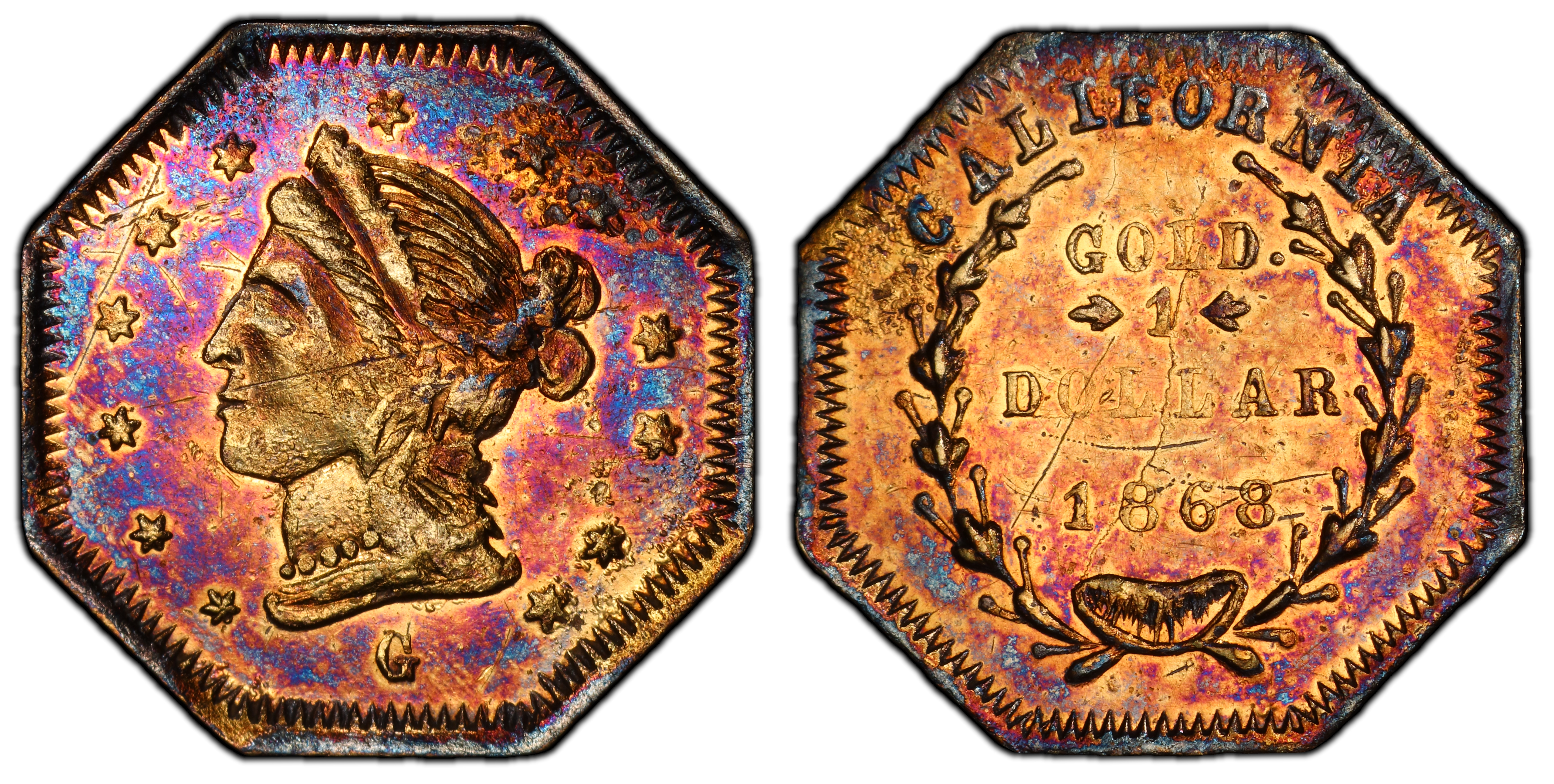
Obverse & Reverse
The 1868 G$1, cataloged as Breen-Gillio 1105, is a quintessential example of a 'Period Two' California Fractional Gold piece. These fascinating and diminutive coins emerged not from the initial chaotic scramble for a circulating medium that characterized the 'Period One' issues (1852-1857), but from a more mature and commercialized environment in post-Gold Rush San Francisco. By the late 1860s, the acute shortage of small change had been largely alleviated by the steady output of the official U.S. Branch Mint in the city. The purpose of fractional gold had thus pivoted from a utilitarian necessity to a popular and profitable trade in souvenirs and keepsakes. San Francisco was becoming a tourist destination, and visitors from the East Coast and Europe were eager to acquire miniature gold coins as mementos of the famous Gold Rush. Jewelers and private minters, like Robert B. Gray & Co., astutely met this demand. These 'jeweler's issues' were typically underweight for their stated face value, functioning more as tokens than true coinage, a fact tacitly understood in commerce. Their production was technically in violation of the Private Coinage Act of 1864, but federal enforcement was lax until the U.S. Secret Service began a concerted crackdown in the early 1880s. The BG-1105, with its distinctive 'Necklace Bust' Liberty and maker's initial 'G', was part of this lucrative trade. Struck by hand using the hammer method, where dies were struck with a sledgehammer, these coins exhibit considerable variation in strike quality. Their continued production into the 1870s attests to their enduring popularity as curios until the government finally suppressed their manufacture, cementing their status as a finite and historically significant numismatic series.
Associated EventPost-Gold Rush California Commerce
Reason For MintingPrimarily struck to be sold as souvenirs and curios to tourists and locals in San Francisco, capitalizing on the romanticism of the Gold Rush.
Minter HistoryRobert B. Gray & Co. was a prominent San Francisco manufacturing jeweler active in producing fractional gold between approximately 1858 and 1871. In late 1858 or 1859, Gray shrewdly purchased the business and equipment—including dies, hubs, and punches—of another established fractional gold maker, Antoine Louis Nouizillet. Gray initially used Nouizillet's old dies before creating his own, which are distinguished by his hallmark 'G' initial, as seen on the BG-1105. His pieces are noted by numismatists for often being of higher weight and intrinsic value compared to many other Period Two issues. In 1871, Gray sold his interests to the California Jewelry Co., which was operated by the Levison Brothers, who continued the tradition of striking fractional gold pieces.
Historical SignificanceThe BG-1105 is significant not as a coin born of monetary necessity, but as a cultural artifact representing the commercialization of the Gold Rush legacy. It marks a transition in private minting from fulfilling a transactional need to creating a nostalgic commodity, reflecting San Francisco's own evolution from a chaotic boomtown to a more established metropolis and tourist center.
BG-1105
Denomination$1
Minting Period1868
Assayer/MinterRobert B. Gray & Co.
Geographic OriginSan Francisco, California
Obverse DescriptionLiberty Head facing left, her hair tied in a bun with a trailing ribbon. She wears a coronet and a distinctive beaded necklace, giving this variety the nickname 'Necklace Bust'. Thirteen stars encircle the portrait. The initial 'G' for the minter, Robert B. Gray, is located below the bust truncation.
Obverse InscriptionLIBERTY [on coronet]
Reverse DescriptionThe denomination '1 DOLLAR' and date '1868' are inscribed within a wreath of two olive branches joined at the bottom by a bow. The legend 'CALIFORNIA GOLD' appears at the top, outside the wreath.
Reverse InscriptionCALIFORNIA GOLD / 1 DOLLAR 1868
CompositionGold
Stated Fineness Actual FinenessPeriod Two issues are known to vary widely, typically from 14 to 22 carats (.583 to .917 fine).
Weight1.51 grams
Diameter9.60 mm
EdgePlain
Unknown
Survival Estimate75-100
Rarity ScaleHigh R-5
This variety is highly sought after for its attractive and unique 'Necklace Bust' design, clear attribution to the important minter Robert B. Gray via the 'G' initial, and its octagonal shape, which is emblematic of the series. Its status as a scarce, denominated one-dollar piece from Period Two makes it a key collectible.
Key VarietiesThe BG-1105 is a specific die marriage and no major varieties are recognized under this catalog number. However, minor variations in die state, such as the presence and progression of reverse die breaks, are noted on some specimens and can be of interest to specialists. No official restrikes or patterns are known for this variety.
Authentication TipsGenuine BG-1105 examples will be thin and often weakly struck, particularly in the centers of both the obverse and reverse. The surfaces are frequently semi-prooflike or reflective. Look for the correct placement of the 'G' initial below the bust. Counterfeits are common in the Cal Gold series; fakes are often thicker, have a soapy or cast-like texture, incorrect letter/numeral fonts, or a 'bear' on the reverse (which is never found on genuine Period Two issues). All genuine Period Two pieces must have a denomination (e.g., 'DOLLAR').
Shopping ConsiderationsWhen acquiring an 1868 G$1 BG-1105, prioritize examples with a sharp strike on the Liberty head and the date, as these areas are often weak. Premium quality examples exhibit bright, flashy luster and minimal distracting contact marks. The 'skin' of the coin is paramount; examples with original, uncleaned surfaces and attractive reddish or greenish-gold toning command significant premiums. Avoid coins that have been harshly cleaned, polished, or used as jewelry, as this severely impacts value. Pay close attention to auction descriptions mentioning reverse die breaks, as these can be interesting identifiers but may also be viewed as impairments by some collectors.
A coin's grade is its condition, rated on a 1-70 scale. For rare coins, this is the most critical factor in determining value, as a tiny difference in preservation can mean a huge difference in price.
Relevant Grade TypesOriginal issues of BG-1105 were business strikes produced for commercial sale, not circulation in the traditional sense, and are found in Circulated (1-58) and, more commonly, Mint State (MS, 60-70) grades. Due to their nature as souvenirs, many were preserved in high grade. No true Proofs were struck during the original minting period. The semi-prooflike and reflective surfaces seen on many Mint State examples are a characteristic of the planchet preparation and striking process, not an indication of a special Proof striking.
Mint State CharacteristicsUncirculated examples are defined by their luster, which is typically bright and flashy, often with semi-prooflike or deep mirror prooflike (DMPL) fields. The strike is a critical factor; most known examples are softly struck in the center, with weakness on Liberty's hair and the 'DOLLAR' inscription. A well-struck example with full central details is exceptionally rare and desirable. Small, scattered contact marks are common due to the softness of the gold and the hand-striking process.
Circulated Wear PatternsOn circulated examples, wear first appears on the highest points: Liberty's cheek, the hair above the ear, and the coronet. On the reverse, the leaves in the wreath and the numerals of the date will show the first signs of friction. In lower grades (VF and below), the beaded necklace and the legends will become soft and begin to merge with the fields.
Key Factors For ValueThe primary value drivers for a BG-1105 are grade and surface quality. An example with original, lustrous surfaces will always be worth more than a cleaned or polished one of the same grade. Strike sharpness is the next key factor; a coin with a bold strike on the central devices can command a significant premium over a typically weak example. Eye appeal, enhanced by attractive original toning, also adds value. For this series, certification by a top-tier service (PCGS or NGC) is essential for authenticity and liquidity, and a CAC sticker indicates premium quality for the grade, adding a further premium.
PCGS Price Guide
| Grade | Price | Population |
|---|---|---|
| 50 | $550.00 | 4 |
| 50+ | $560.00 | N/A |
| 53 | $575.00 | 2 |
| 53+ | $585.00 | N/A |
| 55 | $600.00 | 5 |
| 55+ | $625.00 | N/A |
| 58 | $650.00 | 2 |
| 58+ | $675.00 | N/A |
| 60 | $700.00 | N/A |
| 61 | $875.00 | 5 |
| 62 | $1,200.00 | 14 |
| 62+ | $1,325.00 | N/A |
| 63 | $1,500.00 | 11 |
| 63+ | $1,850.00 | N/A |
| 64 | $2,650.00 | 7 |