1876 G$1 BG-1115A (Regular Strike)
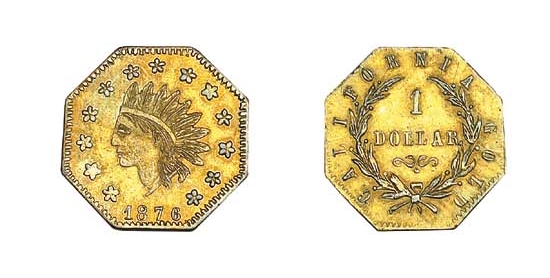
Obverse & Reverse
The 1876 G$1 BG-1115A is a product of the second period (1859-1882) of California Fractional Gold production, a fascinating and complex chapter in American numismatics. Unlike the earlier 'Period One' issues, which were struck out of genuine commercial necessity to alleviate a shortage of small change during the initial Gold Rush, the Period Two pieces were created in a different economic climate. By the 1870s, the U.S. Mint in San Francisco was in full operation, producing ample federal coinage for the region. The urgent need for private fractional gold had subsided. Instead, these later issues, often called 'jeweler's pieces,' catered to a burgeoning market for souvenirs, keepsakes, and curiosities. The year 1876 was particularly significant as it marked the Centennial of American Independence, celebrated with great fanfare at the Philadelphia Centennial Exposition. This event spurred a nationwide interest in historical and souvenir items. Enterprising jewelers and private minters, primarily in San Francisco, capitalized on this sentiment by producing vast quantities of these attractive, miniature gold coins. They were popular with locals, tourists, and people back East who wanted a tangible piece of the romanticized California Gold Rush. Although they bore a date and denomination, their intrinsic gold value was typically far less than their face value, and they were not intended for widespread circulation in the same manner as the earlier issues. The production of these pieces operated in a legal gray area. The Coinage Act of 1864 had prohibited private coinage, but enforcement was lax, and the small size and souvenir nature of these pieces allowed their production to flourish. It wasn't until a Secret Service crackdown in 1883 that the era of California Fractional Gold truly came to an end, cementing the status of pieces like the BG-1115A as relics of a uniquely entrepreneurial and transitional period in California's history.
Associated EventPhiladelphia Centennial Exposition & Post-Gold Rush Souvenir Market
Reason For MintingPrimarily struck to be sold as souvenirs and keepsakes, not for general circulation, capitalizing on the romanticism of the Gold Rush.
Minter HistoryThe specific minter of BG-1115A, like many Period Two fractionals, is unrecorded and likely lost to history. These pieces were often produced by jewelers who did not place their own identifying marks on their products. Prominent makers of the era included Frontier, Deviercy & Co., and Antoine Louis Nouizillet, but a direct attribution for this variety is not possible. The manufacturing process was typically crude by U.S. Mint standards, often involving a sledgehammer to strike a gold planchet between two hand-cut dies.
Historical SignificanceThe BG-1115A is significant not as a circulating coin but as a cultural artifact. It represents the commercialization of the Gold Rush mythos and the transition of fractional gold from a practical necessity to a popular souvenir item. Its existence highlights a period of lax federal oversight on private minting and the robust market for mementos in late 19th-century America.
BG-1115A
DenominationG$1
Minting Period1876
Assayer/MinterUnknown Private Minter
Geographic OriginSan Francisco, California (presumed)
Obverse DescriptionFeatures a stylized Indian Head facing left, a popular motif in the 1870s. The portrait is typically rendered with a feathered headdress. Thirteen stars, representing the original colonies, encircle the portrait along the octagonal border.
Obverse InscriptionNo textual inscription; design consists of the Indian Head and 13 stars.
Reverse DescriptionA simple wreath design encircles the denomination and date. The wreath is typically composed of two branches tied with a bow at the bottom. The date '1876' is prominently displayed within the wreath.
Reverse Inscription1 DOLLAR 1876
CompositionGold
Stated Fineness Actual FinenessVariable, often ranging from .500 to .800 fine. Period Two issues are known for being underweight and of lower purity than their stated value would imply.
Weight0.50 grams
Diameter11.00 mm
EdgePlain
Unknown
Survival EstimateFewer than 15 known
Rarity ScaleR-7 (Very Rare)
This variety is highly sought after due to its extreme rarity and attractive octagonal Indian Head design. As a dated Centennial year issue, it also carries historical appeal. Its status as a 'Period Two' souvenir piece makes it an essential component for specialists seeking to tell the complete story of California's private gold coinage.
Key VarietiesThe primary catalog number is BG-1115A. No major varieties from the original minting period are widely recognized. Unlike some federal issues, there are no known patterns, trial pieces, or official restrikes. Collectors should be aware that a vast number of modern replicas and outright counterfeits of California Fractional Gold exist, but these are not considered numismatic varieties.
Authentication TipsGenuine examples are very thin and struck on planchets of relatively uniform thickness. The strike is often somewhat soft in areas, especially on the high points of the feathers and wreath, which is a characteristic of hammer striking, whereas counterfeits are often sharply and uniformly struck. Look for a natural, aged-gold patina; bright, brassy-looking pieces are suspect. The style of the numerals in the date and the lettering should match known genuine examples precisely. Any piece with a cast appearance (soapy details, seam on the edge) is a forgery. Authentication by a top-tier third-party grading service (PCGS or NGC) is highly recommended.
Shopping ConsiderationsFor a premium quality example, seek a specimen with a sharp strike for the issue, especially on the central Indian Head and the 'DOLLAR' inscription. Original, undisturbed surfaces are paramount; many surviving pieces have been cleaned, polished, or used in jewelry. Look for lustrous, prooflike surfaces, which are sometimes encountered on this variety and command a significant premium. Avoid examples with edge bumps, rim filing, or evidence of having been removed from a bezel. A CAC sticker on a certified holder indicates superior quality and eye appeal for the assigned grade and is particularly desirable for this series.
A coin's grade is its condition, rated on a 1-70 scale. For rare coins, this is the most critical factor in determining value, as a tiny difference in preservation can mean a huge difference in price.
Relevant Grade TypesOriginal issues were business strikes, although their intended purpose was for sale as souvenirs rather than circulation. They are found in Circulated (1-58) grades, though this is less common, and more frequently in Mint State (MS, 60-70). No official Proof (PR/PF) examples were struck during the original period. The term 'Prooflike' (PL) is often applied to Mint State examples that exhibit deeply mirrored fields, a common characteristic of fresh dies used on these issues.
Mint State CharacteristicsUncirculated examples of BG-1115A are defined by their luster. High-grade pieces may have a vibrant, almost prooflike luster from polished dies. Strike quality is a key differentiator; many are softly struck in the center of the obverse and reverse. A coin with a bold strike on the headdress and wreath details is considered superior. Due to the minting process and soft gold, even high-grade specimens will typically show minor planchet imperfections or light handling marks.
Circulated Wear PatternsOn circulated examples, wear first appears on the high points of the design. On the obverse, check the cheek, brow, and the highest feathers of the headdress. On the reverse, the highest leaves of the wreath and the bow will show the first signs of friction and flattening. In lower grades (VF and below), the finer details of the feathers will merge and the stars will begin to lose their points.
Key Factors For ValueRarity is the primary driver of value for this issue. After that, surface preservation is critical. An example with original, uncleaned surfaces and attractive luster will always be worth more than a harshly cleaned coin of the same grade. Strike quality is the next factor; a well-struck coin with full details is highly desirable. Finally, eye appeal, which encompasses toning and overall aesthetic, plays a significant role. A CAC sticker confirms the quality for the grade and adds a substantial premium.
PCGS Price Guide
| Grade | Price | Population |
|---|---|---|
| 60 | N/A | N/A |
| 62 | $30,000.00 | N/A |