1854 G50C BG-1304A - Restrike (Regular Strike)
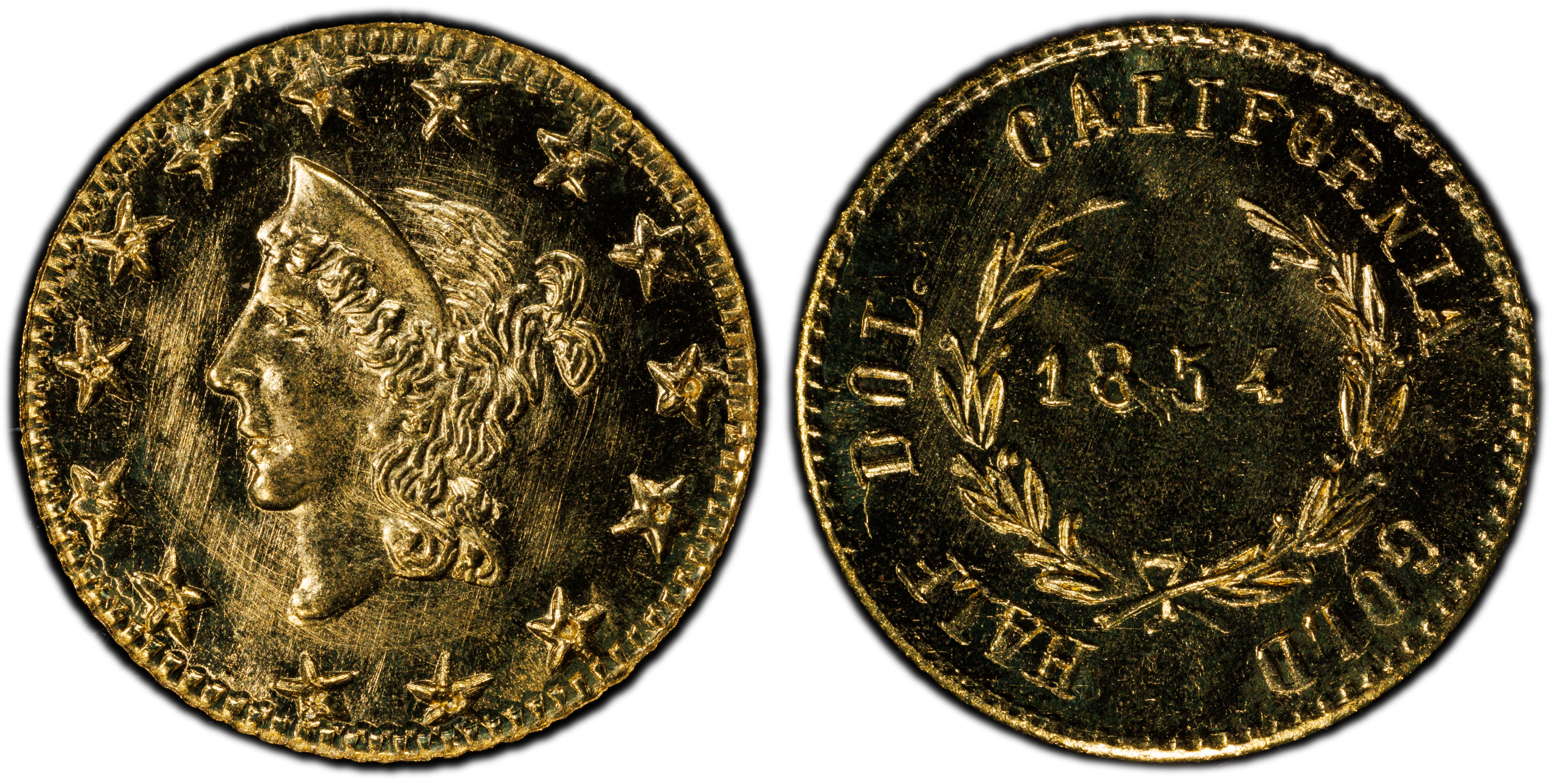
Obverse & Reverse
The 1854 G50C BG-1304A is not a product of the California Gold Rush, but rather a fascinating echo of it, belonging to what numismatists classify as 'Period Three' of California Fractional Gold. The original pieces, struck from 1852 to 1857 ('Period One'), were born of a critical shortage of small denomination coinage in the gold fields. Miners and merchants, awash in gold dust but lacking cents and dimes, struggled with daily transactions. Private minters, often jewelers, stepped into this void, producing quarter, half-dollar, and dollar pieces from native gold. These tiny coins, though often underweight, served a vital economic function. By the late 1850s, the San Francisco Mint was producing enough federal coinage to alleviate the shortage, and the purpose of fractional gold shifted. 'Period Two' (1859-1882) pieces were largely made as souvenirs for a burgeoning tourist trade and for use in jewelry. Federal anti-private-coinage laws, though passed in 1864, were not strictly enforced until 1883, ending this era. The BG-1304A emerges decades later from the workshop of Herman Kroll, a New York City jeweler. Around the turn of the 20th century, a wave of nostalgia for the 'Old West' created a new market for Gold Rush memorabilia. Kroll, possibly having acquired original dies or tooling, began producing copies and mules of earlier fractional gold designs to sell to collectors and jewelers. These 'Period Three' pieces, including the BG-1304A, are properly classified as restrikes or tokens. The BG-1304 and its variant BG-1304A are direct copies of the authentic 'Period One' BG-428 half dollar, but Kroll anachronistically dated them '1854'. These pieces never circulated and were created purely for the collector market, representing an early 20th-century reflection on a vibrant 19th-century numismatic episode. Their existence speaks to the enduring romance of the California Gold Rush and the birth of a collector market dedicated to its artifacts.
Associated EventPost-Gold Rush Nostalgia / Early Numismatic Collector Market
Reason For MintingTo satisfy a growing collector and jewelry market for nostalgic replicas of California Gold Rush-era coins.
Minter HistoryHerman Kroll was a New York City jeweler active in the late 19th and early 20th centuries. He is the most well-documented producer of 'Period Three' California Fractional Gold pieces. He created a variety of replica coins, often using earlier dates to enhance their appeal. He was not a Gold Rush-era minter, but rather a commercial producer for the secondary numismatic and souvenir market. His dies survived him, leading to even later restrikes by other parties in the mid-20th century, which can complicate attribution.
Historical SignificanceThe BG-1304A is significant not as a coin of the Gold Rush, but as a marker of the commercialization of its memory. It represents a class of numismatic objects created specifically for collectors, illustrating the transition of these items from functional currency to historical collectibles. It is an important piece for specialists studying the entire lifecycle and market evolution of the California Fractional Gold series.
N/A
Denomination50 Cents
Minting Periodcirca 1906-1908
Assayer/MinterHerman Kroll
Geographic OriginNew York, New York
Obverse DescriptionA small Liberty Head facing left, crudely rendered, surrounded by 13 five-pointed stars. The portrait style is a coarse imitation of the federal gold dollar designs of the 1850s. The date 1854 is below the bust. The BG-1304A is struck from a distinct obverse die that differs slightly from the BG-1304.
Obverse Inscription1854
Reverse DescriptionA wreath composed of two branches tied with a bow at the bottom. Within the wreath, the denomination '1/2' is present. The word CALIFORNIA appears at the top periphery, and GOLD appears at the bottom. A beaded circle encloses the denomination.
Reverse InscriptionCALIFORNIA GOLD 1/2
CompositionGold
Stated Fineness Actual FinenessVaries, often of a lower fineness than Period One originals, but some Kroll restrikes are found in higher-karat gold.
Weight0.25 grams
Diameter10.00 mm
EdgePlain
Unknown
Survival EstimateModerately scarce; likely a few hundred exist.
Rarity ScaleR-3 to R-4
This piece appeals to specialists in California Fractional Gold who seek to build a complete collection of Breen-Gillio varieties, including the historically significant restrikes. Its allure lies in its connection to the famous Herman Kroll and its status as an early 20th-century collectible based on Gold Rush history.
Key VarietiesThe primary variety is the BG-1304, which uses a different obverse die. The BG-1304/A itself is a variety of the original Period One BG-428, differing primarily in the date. Later restrikes of Kroll's dies were made in the mid-20th century, often with different metallic compositions or strike characteristics, and represent another layer of collecting complexity.
Authentication TipsAuthenticity is paramount. Genuine Kroll restrikes have a distinct 'look' compared to modern fakes. The strike is often softer and less uniform than modern machine-made copies. The gold color and luster can vary. The lettering and stars, while crude, should match the die characteristics known for BG-1304A. Compare with high-resolution images from major grading services. Modern counterfeits are often brassy, have incorrect weights, and may exhibit casting signs like bubbles or seams. True Kroll pieces are die-struck.
Shopping ConsiderationsA premium quality example will be well-centered and sharply struck for the issue, as strike quality can vary. Look for clean, lustrous surfaces free of distracting marks, cleaning, or jewelry mounting evidence. Because these were not made for circulation, signs of wear are unusual and may indicate post-striking damage or handling. Certification by a major grading service (PCGS or NGC) is highly recommended, as they will correctly attribute it as a BG-1304A restrike.
A coin's grade is its condition, rated on a 1-70 scale. For rare coins, this is the most critical factor in determining value, as a tiny difference in preservation can mean a huge difference in price.
Relevant Grade TypesAll original Kroll BG-1304A pieces were struck as business strikes, although they were intended for collectors and not circulation. Therefore, they are found in Mint State (MS, 60-70) grades. It is highly unlikely any circulated examples (1-58) exist that are not simply impaired or damaged Mint State coins. No proofs (PR/PF) were struck during the original Kroll period for this variety.
Mint State CharacteristicsIn uncirculated condition, the BG-1304A typically displays a soft, satiny luster. The strike is often weak in the centers, particularly on the highest points of Liberty's hair and the wreath. Planchet quality can be inconsistent, with minor striations or adjustment marks sometimes visible. Contact marks are common due to the softness of the gold and years of storage alongside other pieces. High-grade examples (MS-64 and above) will have minimal marks and a strong strike for the issue.
Circulated Wear PatternsAs these coins were not intended for circulation, true wear is almost never encountered. If a piece were to circulate, wear would first appear on the high points of Liberty's hair, cheek, and the leaves of the wreath. However, any such piece should be carefully examined, as it is more likely to be a damaged or improperly handled Mint State specimen rather than a coin that saw genuine commercial use.
Key Factors For ValueThe primary value drivers are grade and surface quality. A high Mint State grade (MS-63 or better) commands a significant premium. Eye appeal is crucial; collectors favor sharply struck examples with clean surfaces and original, attractive luster. The premium for a CAC sticker is significant, as it confirms premium quality for the assigned grade. Proper attribution as a BG-1304A restrike by a top-tier grading service is essential for establishing its identity and market value.
PCGS Price Guide
| Grade | Price | Population |
|---|---|---|
| 62 | N/A | 1 |
| 63 | N/A | 1 |
| 64 | N/A | 13 |
| 65 | N/A | 19 |
| 66 | N/A | 12 |
| 66+ | N/A | 1 |