1857 G25C BG-1301A - Restrike (Regular Strike)
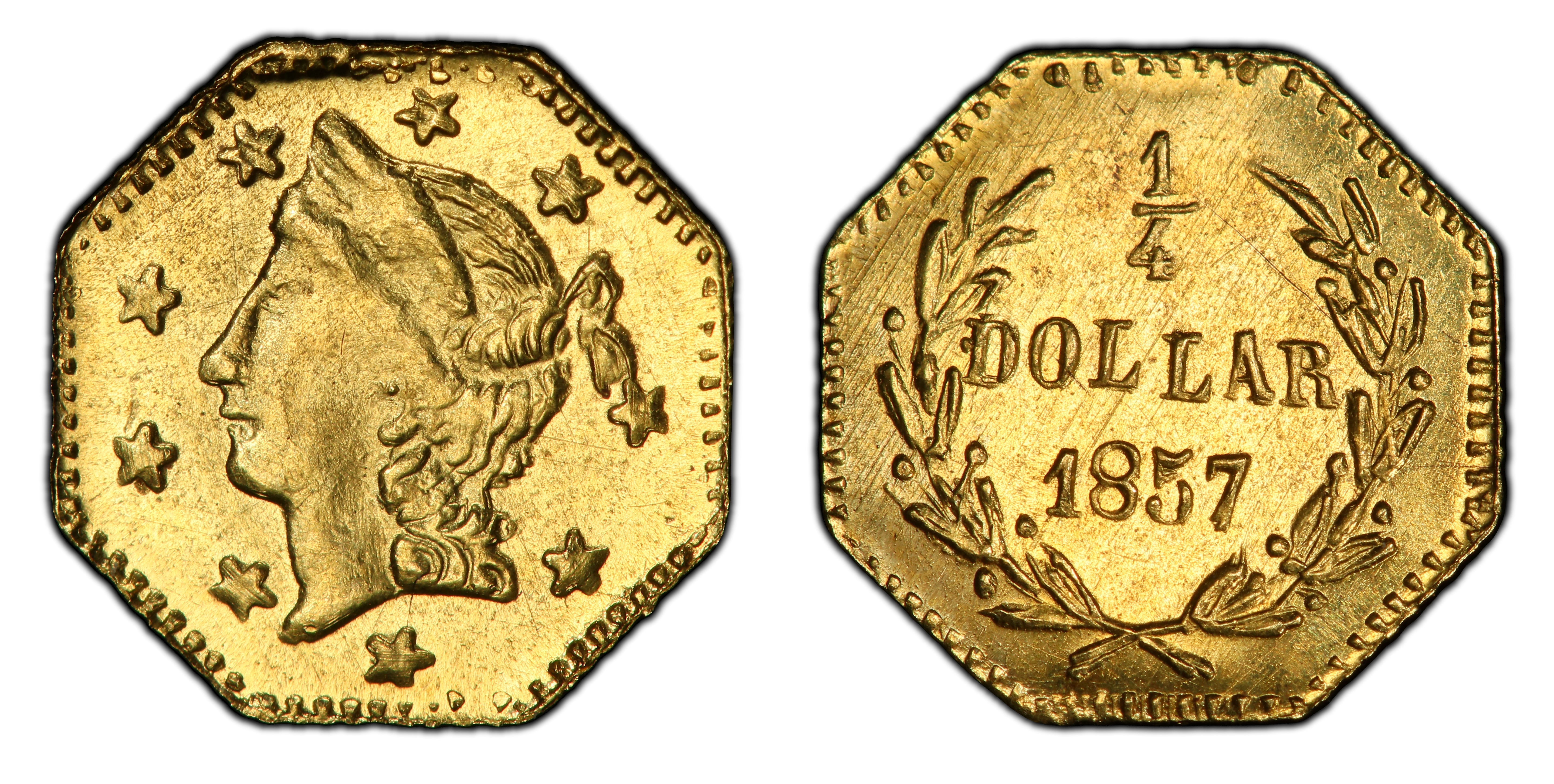
Obverse & Reverse
The BG-1301A represents a fascinating and complex chapter in American numismatics, existing as a 'restrike of a copy.' Its story begins not in the chaos of the California Gold Rush, but decades later, and is inextricably linked to the three distinct periods of fractional gold production. The first period (1852-1857) saw jewelers and private minters in San Francisco strike tiny 25c, 50c, and $1 coins out of genuine necessity to alleviate a severe shortage of small change. These pieces, though often underweight, circulated and served a vital economic function. The second period (1859-1882) saw production shift from utilitarian coinage to souvenirs, often with lower gold content, made for tourists and jewelers. The story of the BG-1301A belongs to the third period. After the U.S. government cracked down on private coinage in 1883, production ceased, but the dies and the allure remained. Around 1906, a New York City jeweler named Herman Kroll acquired or created a series of dies that copied earlier, rare California fractional gold pieces. One of these was designated BG-1301, a copy of the Period One rarity BG-111, but with the date altered to 1857. These Kroll pieces were made purely for collectors. The story takes another turn decades after Kroll's death in 1915. His dies resurfaced, and an unknown minter used the BG-1301 dies to produce a new series of restrikes, likely in the 1950s or 1960s. One retailer cites a specific strike date of 1968. These later strikings were designated BG-1301A in the Breen-Gillio reference. Unlike their Gold Rush-era predecessors, these pieces never circulated and were intended from their inception for the numismatic market. They are tangible links to the enduring legacy of the Gold Rush and the long history of collecting these miniature gold treasures.
Associated EventCalifornia Gold Rush (Legacy Collecting)
Reason For MintingThis piece was struck decades after the Gold Rush as a collectible restrike for the numismatic market.
Minter HistoryThe history of this piece involves two figures. The dies were created by Herman Kroll (c. 1903-1920s), a New York City jeweler who was the primary producer of 'Period Three' California fractional gold. Kroll created copies of earlier, rarer pieces, backdating them for collectors. He was not a Gold Rush-era minter. The actual minter of the BG-1301A restrikes is unknown; they acquired Kroll's dies and used them to produce these pieces decades after his death, likely in the mid-20th century.
Historical SignificanceThe BG-1301A is significant not as a Gold Rush artifact, but as a numismatic collectible that illustrates the multi-layered history of the series. It represents the transition of California fractional gold from emergency money to collectible curiosities, and finally to modern restrikes catering to a sophisticated collector base. Its existence as a restrike of a Kroll copy makes it a meta-numismatic item, valued for its story and connection to the history of the hobby itself.
N/A
Denomination25 Cents
Minting Periodc. 1950s-1960s (backdated 1857)
Assayer/MinterUnknown (from dies by Herman Kroll)
Geographic OriginUnited States (Dies from New York City)
Obverse DescriptionA Liberty Head facing left, similar in style to the contemporary U.S. gold coinage by James B. Longacre. The portrait is surrounded by thirteen stars, representing the original colonies.
Obverse Inscription(Thirteen stars surrounding Liberty Head)
Reverse DescriptionThe reverse features the denomination '1/4' and 'DOLLAR' within a simple wreath. The date '1857' is positioned below the wreath.
Reverse Inscription1/4 DOLLAR 1857
CompositionGold
Stated Fineness Actual FinenessOften higher than Period 1 or 2 issues, consistent with modern alloys.
Weight0.38 grams
Diameter10.00 mm
EdgePlain
Unknown
Survival EstimateUnknown, but believed to be very small.
Rarity ScaleNot independently rated; the parent BG-1301 is rated R-3 (Very Scarce, 201-500 known).
This coin appeals to specialists in California fractional gold who appreciate its complex backstory. It is an affordable way to own a piece struck from historic (though not original Gold Rush) dies. Its status as a 'restrike of a copy' is a numismatic curiosity in itself, attracting collectors who value the story behind the coin.
Key VarietiesThe BG-1301A is itself a key variety. The lineage is as follows: 1. **BG-111 (Original):** A rare Period One octagonal 25C piece. 2. **BG-1301 (Kroll Copy):** Herman Kroll's copy of BG-111, struck circa 1906, with the date changed to 1857. These are collectible Period Three issues. 3. **BG-1301A (Restrike of Copy):** The subject piece, struck from Kroll's BG-1301 dies decades later (c. 1950s-1960s). These are often distinguished by a sharper, more prooflike or business-strike quality compared to the sometimes cruder original Kroll pieces.
Authentication TipsAuthentication focuses on distinguishing it from modern fakes and, for specialists, from the original Kroll BG-1301 issue. The strike quality is often much sharper and more uniform than on crude modern replicas, which are often brass. Compared to the BG-1301, the BG-1301A may exhibit later die states, such as small cracks or polish lines not present on the earlier Kroll strikes. The luster is often bright and flashy, consistent with mid-20th-century minting techniques, rather than the softer, subdued luster of the 1906 Kroll pieces. Precise weight and dimensions are key; significant deviations are a red flag.
Shopping ConsiderationsA premium quality example for this issue is defined almost exclusively by its Mint State grade. As these were made for collectors, circulated examples are virtually nonexistent. Buyers should seek out sharply struck coins with brilliant, unimpaired luster. Look for crisp details on Liberty's hair and the leaves of the wreath. Common problems include handling marks, tiny rim bruises due to the coin's small size, or evidence of having been mounted in jewelry. A 'premium quality' specimen would be mark-free, well-centered, and possess vibrant eye appeal. Certification by PCGS or NGC is highly recommended to guarantee authenticity and grade.
A coin's grade is its condition, rated on a 1-70 scale. For rare coins, this is the most critical factor in determining value, as a tiny difference in preservation can mean a huge difference in price.
Relevant Grade TypesOriginal period issues of California Fractional Gold were business strikes intended for circulation, found in Circulated (1-58) and Mint State (MS, 60-70) grades. However, the BG-1301A is a special collector issue—a restrike. As such, these were never intended for circulation and are almost exclusively encountered in Mint State (MS) grades. No original Proofs were struck, but these later restrikes can sometimes have prooflike (PL) surfaces due to the polished dies used in their manufacture. These are not true Proofs but are desirable for their mirrored fields.
Mint State CharacteristicsIn uncirculated (MS) grades, the BG-1301A typically exhibits a sharp, full strike due to modern press technology being used on the old dies. The highest points, such as Liberty's hair details and the bow on the wreath, should be crisp. The luster is typically bright and satiny, sometimes bordering on prooflike. Being very small and made of soft gold, they are highly susceptible to contact marks from handling, even when new. A top-grade example will be virtually free of distracting marks and have superb eye appeal.
Circulated Wear PatternsAs a collector issue never intended for commerce, wear is not a factor one would expect to see. Any 'wear' would be the result of post-minting damage, such as being carried as a pocket piece or friction from jewelry mounting. In such a case, friction would first appear on the highest points: the cheek and hair curls of Liberty, and the high points of the wreath on the reverse.
Key Factors For ValueThe primary drivers of value for a BG-1301A are its grade and surface quality. A higher Mint State grade (e.g., MS-65 vs. MS-63) commands a significant premium. Eye appeal is crucial; examples with clean, brilliant surfaces and a sharp strike are highly prized. Conversely, coins with noticeable contact marks, subdued luster, or any sign of cleaning or damage will trade at a substantial discount. A CAC sticker for this issue would confirm premium quality for the assigned grade and add a further premium.
PCGS Price Guide
| Grade | Price | Population |
|---|---|---|
| 62 | N/A | 1 |
| 63 | N/A | 1 |
| 64 | N/A | 20 |
| 65 | N/A | 17 |
| 66 | N/A | 5 |
| 66+ | N/A | 1 |