1872 G$1 BG-1206 (Regular Strike)
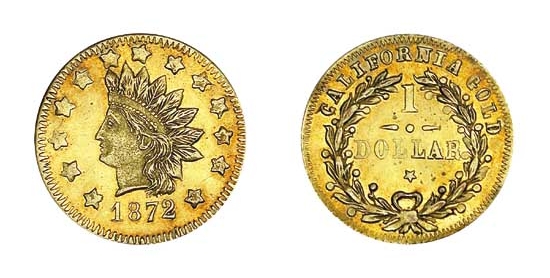
Obverse & Reverse
The 1872 G$1 BG-1206 is a product of the second period (1858-1882) of California Fractional Gold production. Unlike the 'Period One' issues (1852-1856), which were struck to alleviate a severe shortage of small change during the initial chaos of the Gold Rush, these later pieces were created primarily as souvenirs and keepsakes. By the 1870s, the San Francisco Mint was in full operation, supplying ample federal coinage for commerce. The acute need for private fractional gold had vanished. However, the allure of the Gold Rush had not. San Francisco had transformed into a major tourist destination, and visitors from the East Coast and Europe were eager for mementos of their journey to the land of gold. Enterprising jewelers, many of French origin, stepped in to meet this demand. They produced vast quantities of beautifully, and sometimes crudely, designed gold tokens in quarter, half, and dollar denominations. These pieces were intentionally struck with low gold content relative to their face value, making them profitable to produce and sell as trinkets. The BG-1206, with its classic Indian Head motif, was a popular design choice, echoing federal coinage but with a distinct private character. These pieces were never intended to serve as a primary medium of exchange but rather as novelty items, often incorporated into jewelry. The passage of the Coinage Act of 1864 made private coinage illegal, but the law was not strictly enforced against these small, low-value tokens until the Secret Service cracked down in 1883. This lax enforcement allowed for a flourishing two-decade period of souvenir production, of which the BG-1206 is an exceptionally rare surviving example.
Associated EventPost-Gold Rush California Tourism
Reason For MintingTo be sold as a souvenir or charm to tourists and locals in San Francisco, capitalizing on the romanticism of the Gold Rush.
Minter HistoryThe specific minter of BG-1206 is not definitively known, a common trait for many Period Two issues where dies were often unsigned. The work is attributed generally to the community of private jewelers operating in San Francisco during the era. These craftsmen, including firms like Deriberpe & Nouizillet and Frontier & Deviercy, created hundreds of die varieties for the souvenir market. The dies were often hand-cut, leading to slight variations, and sometimes muled with other existing dies, creating a complex and fascinating field of study. Without a specific maker's mark, BG-1206 is considered an anonymous issue from this vibrant but largely undocumented cottage industry.
Historical SignificanceThe BG-1206 represents a shift in the purpose of California Fractional Gold, from a necessary circulating medium to a commercial souvenir. Its existence speaks to the burgeoning tourism industry of post-Gold Rush California and the public's fascination with gold. As an object, it is a tangible link to the popular culture of the 1870s on the West Coast, where the reality of the gold fields had been transformed into a powerful and marketable legend.
BG-1206
DenominationG$1
Minting Period1872
Assayer/MinterUnknown San Francisco Jeweler
Geographic OriginSan Francisco, California
Obverse DescriptionA Native American portrait facing left, often referred to as an Indian Head. The portrait is somewhat crude in execution, typical of private issues, with less refined detail than its federal counterparts. The head is surrounded by 13 five-pointed stars, representing the original colonies. The date '1872' is positioned below the bust.
Obverse Inscription1872
Reverse DescriptionA wreath composed of two branches tied with a bow at the bottom. The wreath encircles the denomination '1 DOLLAR' and a small ornamental star below it. The legend 'CALIFORNIA GOLD' appears outside and above the wreath.
Reverse InscriptionCALIFORNIA GOLD / 1 DOLLAR / *
CompositionGold
Stated Fineness Actual FinenessVariable, but typically low for Period Two issues, ranging from 14 to 22 karats.
EdgePlain
Extremely low; likely less than 500.
Survival EstimateFewer than 10 known examples. The combined population reports of PCGS and NGC show only a handful of graded specimens.
Rarity ScaleHigh R-6 to R-7 (4-12 known)
This is a major rarity in the California Fractional Gold series. Its appeal lies in its extreme scarcity, the classic Indian Head design, and its status as a representative of the souvenir-driven Period Two issues. For the advanced specialist, acquiring a BG-1206 is a significant achievement.
Key VarietiesThe primary known diagnostic for this variety is a significant die rotation. At least one known specimen, graded AU-58 by PCGS, exhibits dies rotated by approximately 90 degrees. No other major varieties, patterns, or official restrikes are known to exist for the BG-1206 die pair.
Authentication TipsThe primary diagnostic is the known 90-degree die rotation on at least one specimen; any example should be checked for this. The overall strike will be softer and less uniform than on federal coinage. Look for crude, hand-cut features on the portrait and lettering. Modern replicas are extremely common in the Cal Gold series; they often have a soapy, cast-like appearance, incorrect weight, or may feature designs (like bears) not found on genuine denominated issues. Authentication by a top-tier grading service (PCGS or NGC) is essential due to the high rarity and prevalence of counterfeits.
Shopping ConsiderationsFor a coin of this rarity, any example is a major acquisition. A 'premium quality' specimen would be one that is well-centered and sharply struck for the issue, particularly on the date and the details of the headdress feathers. Look for original, undisturbed surfaces with some remaining luster; many Period Two issues were cleaned or used as jewelry, so examples with honest wear and no damage command a significant premium. Avoid coins with harsh cleaning, evidence of being removed from a bezel, or significant planchet flaws. Given the hammered striking process, a uniformly strong strike is rare; seek an example with the best possible combination of surface quality and strike detail.
A coin's grade is its condition, rated on a 1-70 scale. For rare coins, this is the most critical factor in determining value, as a tiny difference in preservation can mean a huge difference in price.
Relevant Grade TypesOriginal period issues were business strikes, although intended as souvenirs rather than for circulation. They are found in Circulated (1-58) and, more commonly for this period, Mint State (MS, 60-70) grades. Due to their nature as novelties, many were preserved in high grades. No official Proofs were struck during the original minting period, and no later-date Proof restrikes are known for this variety.
Mint State CharacteristicsUncirculated examples of BG-1206 often exhibit prooflike or semi-prooflike surfaces due to the polishing of the dies. Luster is typically bright and flashy rather than soft and satiny. The strike is a key differentiator; many are weakly struck in the center or on peripheral legends due to the crude hammered striking process. A superior Mint State coin will show sharp details on the highest points of the Indian's cheek and headdress, and full definition in the wreath on the reverse. Small, intrinsic planchet flaws or die polishing lines are common and generally accepted.
Circulated Wear PatternsWear first appears on the high points of the design: the cheekbone, the brow, and the feathers of the headdress on the obverse. On the reverse, the highest points of the wreath's leaves and the bow will show the first traces of friction. In lower grades (VF and below), the date and stars will begin to lose their sharpness, and the fine details of the wreath will merge.
Key Factors For ValueRarity is paramount for BG-1206. Beyond that, value is driven by surface preservation; an example with original, uncleaned surfaces and minimal distracting marks will command a substantial premium. Strike quality is the next major factor; a coin with a bold, centered strike is highly desirable. Finally, eye appeal, including any attractive reddish-gold toning that develops on the original planchet, enhances value. Given its rarity, a CAC sticker signifying premium quality for the grade would add a significant premium.
PCGS Price Guide
| Grade | Price | Population |
|---|---|---|
| 40 | $1,400.00 | 1 |
| 45 | $1,500.00 | N/A |
| 45+ | $1,550.00 | N/A |
| 50 | $1,650.00 | N/A |
| 50+ | $1,700.00 | N/A |
| 53 | $1,800.00 | N/A |
| 53+ | $2,000.00 | N/A |
| 55 | $2,350.00 | 3 |
| 55+ | $2,600.00 | N/A |
| 58 | $3,000.00 | 1 |
| 58+ | $3,500.00 | N/A |
| 60 | $4,750.00 | N/A |
| 61 | $6,000.00 | 2 |
| 62 | $8,500.00 | 2 |
| 62+ | $9,000.00 | N/A |
| 63 | $10,000.00 | 4 |