1874 G50C BG-1071 (Regular Strike)
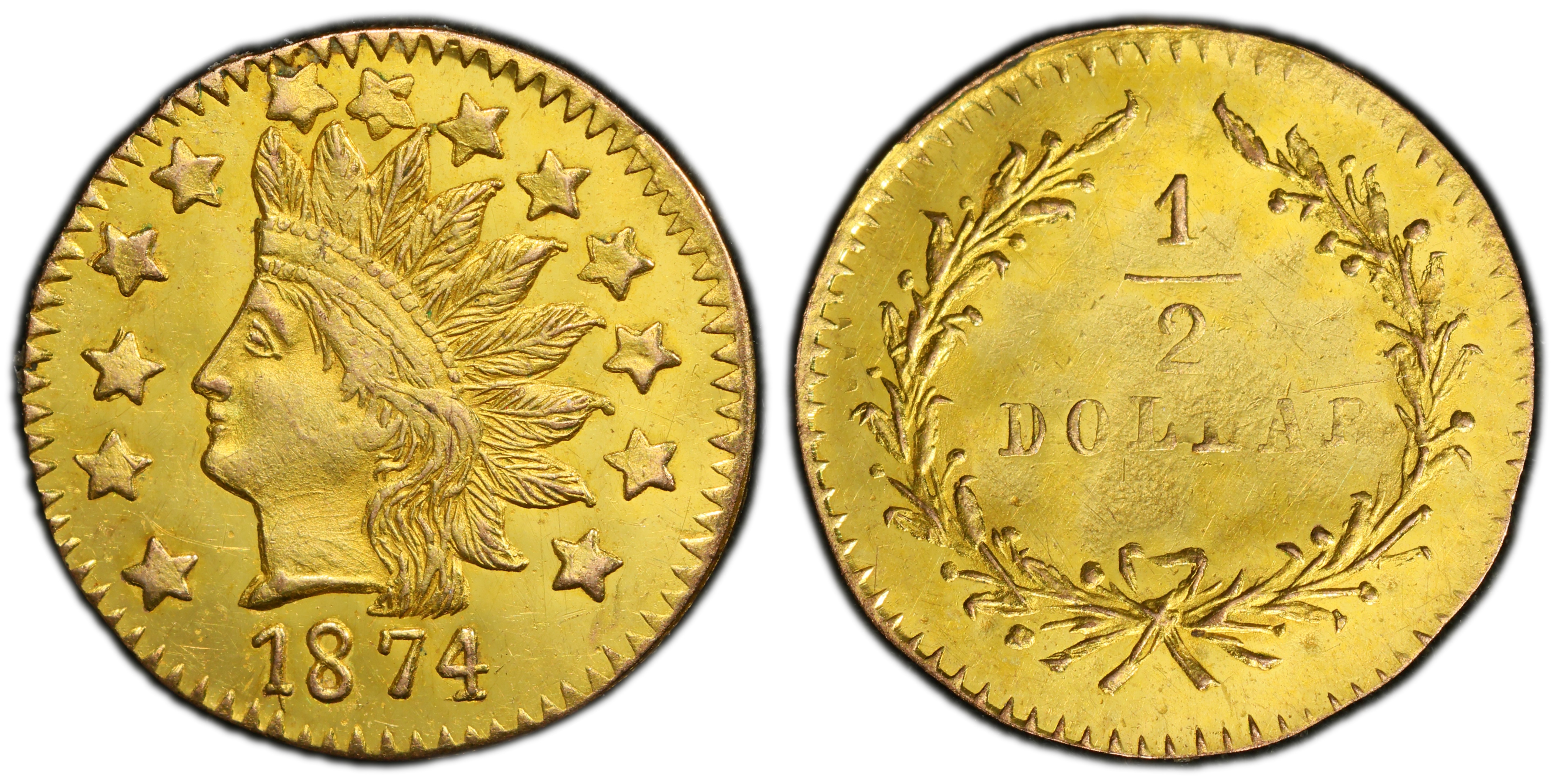
Obverse & Reverse
The 1874 G50C BG-1071 is a product of the second great era of California Fractional Gold production, often termed 'Period Two' (1859-1882) by numismatists like Walter Breen and Ronald J. Gillio. Unlike the 'Period One' issues, which were struck out of genuine commercial necessity to alleviate a severe shortage of small change during the initial Gold Rush, these later pieces served a different purpose. By the 1870s, the San Francisco Mint was in full operation, producing ample federal coinage for the region's economy. The acute need for privately-minted fractional gold had subsided. Instead, these small gold pieces evolved into popular souvenirs, keepsakes, and jewelry items for a burgeoning tourist trade and a populace still captivated by the romance of the Gold Rush. The Coinage Act of 1864 had explicitly outlawed private currency, forcing the producers of these 'jeweler's issues' to operate clandestinely. To avoid prosecution, they were often made without a minter's hallmark and frequently backdated, although the 1874 date on this issue appears to be contemporary. These pieces were typically underweight for their face value and varied in fineness, as their purpose was not to function as reliable currency but to be sold as novelties at a handsome profit. The BG-1071, with its Indian Head motif, tapped into the popular 19th-century romanticism of the American West. The extreme rarity of this specific variety today suggests a very small original production, likely struck by a San Francisco jeweler to test a new design or to fulfill a small, private order. Its survival is a tangible link to the post-Gold Rush era of California, a time of economic maturation where the memory of the '49ers was already being commodified and sold as legend.
Associated EventCalifornia Gold Rush aftermath and westward expansion tourism.
Reason For MintingPrimarily created as a souvenir or jewelry item for the tourist trade, not for general circulation, following the federal prohibition of private coinage.
Minter HistoryThe minter of BG-1071 is unknown, a common characteristic of 'Period Two' California Fractional Gold. After the Private Coinage Act of 1864, producers operated anonymously to avoid prosecution by the U.S. Secret Service. These minters were typically jewelers based in San Francisco who had the skills and equipment to strike these small, intricate pieces.
Historical SignificanceThis coin is significant not as a circulating medium, but as a numismatic artifact representing the transition of California's economy from a frontier society dependent on private money to a more integrated state. It embodies the commercialization of the Gold Rush legend and is a prime example of the 'jeweler's issues' that defied federal law to cater to a strong market for gold souvenirs.
N/A
Denomination50 Cents
Minting Period1874
Assayer/MinterUnknown Private Minter
Geographic OriginSan Francisco, California
Obverse DescriptionFeatures a stylized Indian Head facing left, wearing a feathered headdress. The portrait is surrounded by thirteen stars, which are noted in auction catalog descriptions as being unevenly spaced for this specific variety. The date '1874' is below the bust.
Obverse Inscription1874
Reverse DescriptionA simple wreath surrounds the denomination '1/2' and the word 'DOLLAR'. A key diagnostic for the BG-1071 variety is an incomplete or weak strike on the word 'DOLLAR'.
Reverse Inscription1/2 DOLLAR
CompositionGold
Stated Fineness Actual FinenessVaries, but typically lower than the .900 standard of federal coinage for Period Two issues.
EdgePlain
Extremely low; likely less than 20 pieces.
Survival EstimateFewer than 10 known. The NGC census reports grading 6 examples, and PCGS has graded at least 4. Allowing for resubmissions and crossovers, the true population is exceptionally small.
Rarity ScaleR-7 (4-12 known)
The BG-1071 is a classic rarity in the popular and complex field of California Fractional Gold. Its appeal lies in its extreme scarcity (R-7), attractive Indian Head design, and its status as a 'Period Two' jeweler's issue with a distinct story. It is a target for advanced specialists seeking the rarest varieties.
Key VarietiesThe BG-1071 is itself a key die variety. No major variations from its original minting period are known due to its rarity. No special collector restrikes or patterns are known to exist. Any similar piece with a bear on the reverse is a modern replica and not a genuine fractional gold piece.
Authentication TipsKey diagnostics for a genuine BG-1071 include the characteristic uneven spacing of the obverse stars and date. Crucially, the reverse should display a weak or incomplete strike on the word 'DOLLAR'. The overall fabric should be consistent with manually-operated press technology of the 1870s, not modern production. Most counterfeits are brass or gold-plated and often feature a bear motif, which is never present on genuine historical issues.
Shopping ConsiderationsFor a 'premium quality' BG-1071, a buyer should prioritize a sharp strike on the central devices of the Indian Head, even though some strike softness in the centers is considered normal for the issue. Given its purpose as a novelty, many survivors are in high grade (Mint State), but may have been previously mounted as jewelry; evidence of mounting, tooling, or harsh cleaning should be carefully looked for under magnification. Examples with original, deeply mirrored or prooflike (PL/DPL) surfaces command a significant premium, as they showcase the coin as the jeweler intended it to be seen. Given the coin's rarity and value, third-party certification from PCGS or NGC is essential for market acceptance and authenticity.
A coin's grade is its condition, rated on a 1-70 scale. For rare coins, this is the most critical factor in determining value, as a tiny difference in preservation can mean a huge difference in price.
Relevant Grade TypesOriginal period issues were business strikes, although not intended for widespread circulation. They are found in both Circulated (AU-50 to AU-58, though rarely lower due to their novelty status) and Mint State (MS, 60-70) grades. No true Proofs were struck during the original period. However, many high-grade examples exhibit Prooflike (PL) or Deep Prooflike (DPL) surfaces from being struck with polished dies on polished planchets to enhance their appeal as jewelry or souvenirs; these are not a separate striking type but a desirable surface characteristic.
Mint State CharacteristicsAn uncirculated BG-1071 is defined by full, unbroken luster. As is typical for the issue, some softness in the strike may be present on the highest points of the Indian's hair and the center of the wreath. Luster can range from satiny to deeply mirrored. High-grade examples are susceptible to tiny planchet flaws or die polishing lines, which are part of the manufacturing process and generally accepted by specialists. The surfaces are very soft and prone to contact marks, so a 'clean' example with minimal distracting marks is highly desirable.
Circulated Wear PatternsWear first appears on the high points of the design. On the obverse, this includes the cheek of the Indian Head and the details in the feathers of the headdress. On the reverse, the highest points of the wreath's leaves and bow will show the first signs of friction. In AU grades, the luster will be diminished in the fields as a result of light handling.
Key Factors For ValueFor the BG-1071, rarity is the primary value driver. Beyond that, surface quality is paramount. An example with original, undisturbed prooflike or deep prooflike surfaces will command a massive premium over a typical mint state piece. Eye appeal is critical; coins with a clean, mark-free appearance and a sharp strike for the variety are highly prized. A CAC sticker would provide strong confirmation of quality for the grade and would add a significant premium, as it indicates the coin is a superior example.
PCGS Price Guide
| Grade | Price | Population |
|---|---|---|
| 55 | $2,350.00 | 1 |
| 55+ | $2,500.00 | N/A |
| 58 | $2,650.00 | N/A |
| 58+ | $2,800.00 | N/A |
| 60 | $3,000.00 | N/A |
| 61 | $3,150.00 | N/A |
| 62 | $3,400.00 | 1 |
| 62+ | $3,650.00 | N/A |
| 63 | $3,900.00 | 2 |
| 63+ | $4,250.00 | N/A |
| 64 | $4,500.00 | 1 |