1873/2 G$1 BG-1122 (Regular Strike)
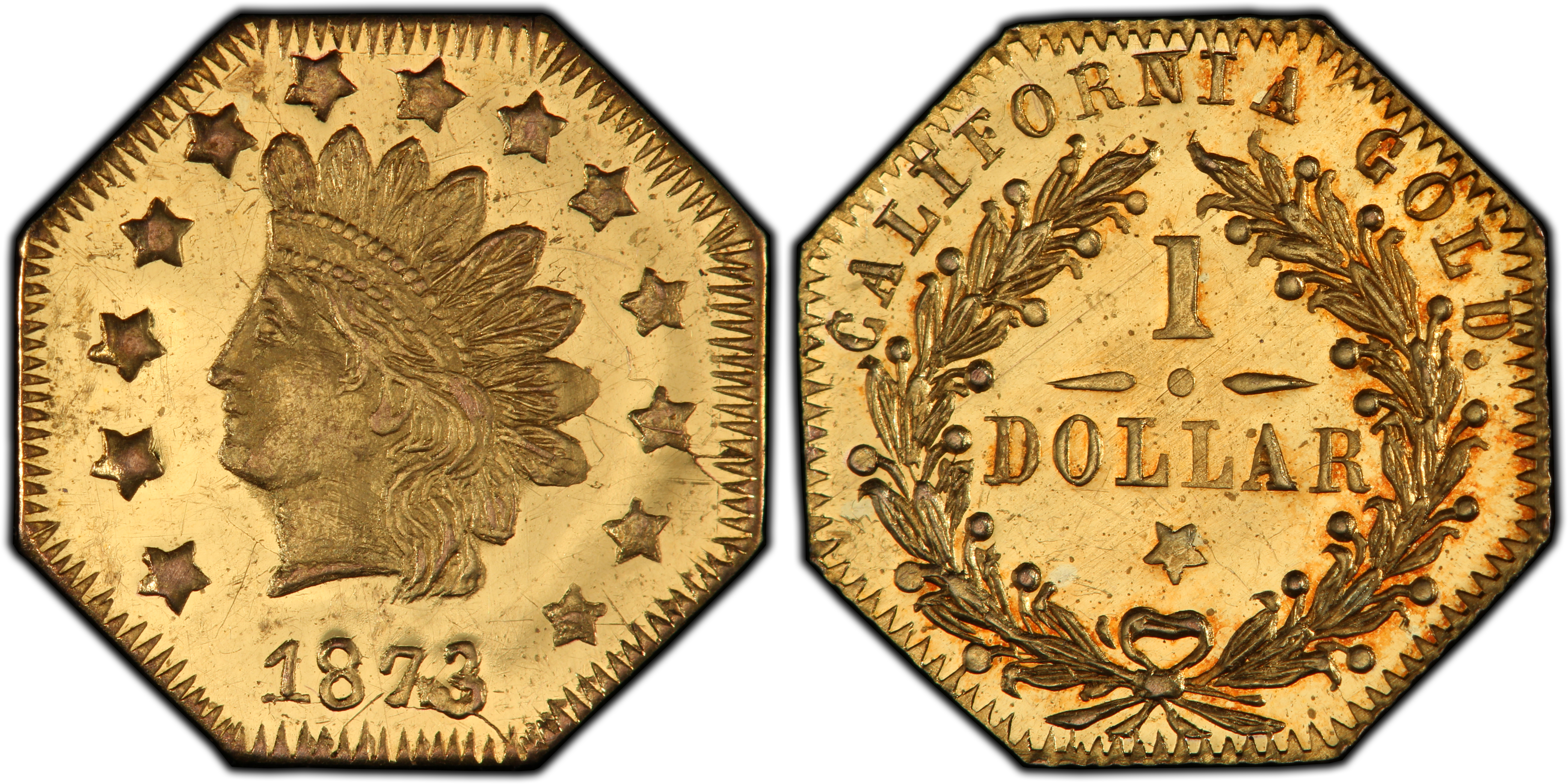
Obverse & Reverse
The 1873/2 BG-1122 one-dollar piece emerges from the second great period of California fractional gold production (1859-1882), a fascinating chapter in American numismatics that transitioned from necessity to novelty. The initial wave of fractional gold (1852-1856) was born of a genuine crisis: the California Gold Rush had flooded the region with gold dust and nuggets but left it starved for small-denomination coinage to conduct daily trade. Private minters filled this void by producing quarter, half-dollar, and dollar coins that, while often underweight, were indispensable for commerce. By the 1870s, however, the monetary landscape had changed. The establishment of the San Francisco Mint in 1854 and an increasing supply of federal coinage had largely solved the small-change problem. The continued production of fractional gold was driven by a different market: jewelers, like Christopher Ferdinand Mohrig, began creating these miniature gold pieces primarily as souvenirs and keepsakes. These 'jeweler's issues' were popular with tourists and locals alike, serving as mementos of the romanticized Gold Rush era. The BG-1122 is a quintessential example of this later period. It was not intended to circulate widely but to be sold as a novelty. The clear 3-over-2 overdate is a distinctive feature, likely resulting from the re-purposing of an older die to strike a new year's issue, a common cost-saving practice among private minters. This period of production operated in a legal gray area following the Private Coinage Act of 1864, which outlawed private currency. For years, the federal government largely ignored these souvenir pieces. However, this tolerance ended in the late 1870s and early 1880s when the Secret Service, concerned about potential for fraud, cracked down on the practice. Christopher Mohrig himself was arrested in August 1876, and his dies and stock were confiscated, a fact that contributes directly to the rarity of his later-dated issues. The BG-1122 thus represents the twilight of this uniquely Californian industry, a piece created not for the gritty reality of the mines, but for the nostalgic reflection upon it.
Associated EventCalifornia Gold Rush (Later Souvenir Period)
Reason For MintingPrimarily produced as a souvenir or keepsake for the jewelry trade, rather than to alleviate a currency shortage.
Minter HistoryChristopher Ferdinand Mohrig was a prominent San Francisco jeweler and one of the most prolific producers of 'Period Two' California fractional gold. Operating during the 1870s, his work is known for its quality and variety, including both Liberty and Indian head designs in round and octagonal shapes. His career as a private minter came to an abrupt end on August 10, 1876, when he was arrested by the U.S. Secret Service for violating the Coinage Act of 1864. His minting equipment and remaining coins were seized and destroyed, a pivotal event that cemented the rarity of many of his issues, particularly those from the mid-1870s. The 'BG' numbers from BG-790 through BG-1129 in the standard reference guide are attributed to his handiwork.
Historical SignificanceThe coin is significant as a product of the 'jeweler's era' of fractional gold, illustrating the transition from a functional currency to a collectible souvenir. Its rarity is a direct result of the U.S. government's eventual suppression of private coinage, making it a tangible artifact of the end of a numismatic era.
Not Applicable
Denomination$1
Minting Period1873
Assayer/MinterChristopher Ferdinand Mohrig
Geographic OriginSan Francisco, California
Obverse DescriptionFeatures a stylized Indian Head facing left, a popular motif for the era. The portrait is adorned with a feathered headdress. Thirteen stars, representing the original colonies, encircle the portrait along the octagonal border. The date, 1873, is positioned below the bust and prominently shows a 3 punched over a 2.
Obverse Inscription1873/2
Reverse DescriptionA wreath of leaves and berries, open at the top, dominates the reverse. The wreath is tied with a bow at the bottom. Inside the wreath, the denomination is expressed as '1' over 'DOLLAR'.
Reverse Inscription1 DOLLAR
CompositionGold
Stated Fineness Actual FinenessVariable, typically between 14 and 22 karats (.583 to .917 fine).
Weight1.10 grams
Diameter12.20 mm
EdgePlain
Unknown, but presumed to be very small.
Survival EstimateFewer than 30 believed to exist.
Rarity ScaleHigh R-6 (13-30 known)
The BG-1122 is highly sought after due to its combination of features: it is a scarce one-dollar denomination, an attractive octagonal shape, a popular Indian Head design, and a clear overdate. Its high rarity (R-6) and attribution to the historically significant minter C.F. Mohrig make it a prize for advanced collectors of the series.
Key VarietiesThe primary variety is the 1873/2 overdate itself. No other major varieties from the original minting period are known for BG-1122. Unlike some U.S. Federal series, there are no known patterns, trial pieces, or later-date restrikes associated with California Fractional Gold issues; all known examples are considered original business strikes from the period.
Authentication TipsAuthenticity is paramount. Genuine pieces exhibit sharp, well-defined details, even if softly struck in areas. The overdate should be clear under magnification, with the underlying '2' clearly visible beneath the '3'. The style of the Indian Head and wreath should precisely match known genuine examples cataloged in Breen-Gillio. Be wary of pieces with a 'gummy' or cast-like appearance, incorrect weight, or a suspicious surface color. Many modern replicas and fakes exist; comparison to high-resolution images from major auction houses is essential. Professional third-party authentication is highly recommended for any raw example.
Shopping ConsiderationsFor a premium quality example, look for a sharp strike, particularly on the feathers of the headdress and the details of the wreath. The overdate should be bold and unambiguous. Many surviving examples are found in high grades, and some exhibit highly reflective, prooflike surfaces; these command a significant premium. A coin with smooth, lustrous fields free of distracting marks, cleaning, or jewelry mounting is highly desirable. Given the handmade nature of these pieces, some minor planchet irregularities can be expected and do not necessarily detract if they are not distracting. Pay close attention to any signs of tooling or smoothing in the fields.
A coin's grade is its condition, rated on a 1-70 scale. For rare coins, this is the most critical factor in determining value, as a tiny difference in preservation can mean a huge difference in price.
Relevant Grade TypesOriginal period issues like the BG-1122 were business strikes, although many were sold as souvenirs and never circulated. They are found in Circulated (1-58) and, more commonly for this variety, Mint State (MS, 60-70) grades. No Proofs were struck during the original period of issue, and no later-date Proof restrikes exist. However, some Mint State specimens were struck on highly polished planchets with such care that they exhibit prooflike (PL) or deep prooflike (DMPL) surfaces, which are highly prized and noted by grading services.
Mint State CharacteristicsUncirculated examples are defined by their luster and strike. A typical piece may show some softness in the center of the design, a common characteristic of privately minted coins. The luster is often satiny, but can be deeply reflective and prooflike on exceptional specimens. Due to the softness of the gold and the minting process, even high-grade Mint State examples can have minor planchet flaws or tiny handling marks. A superior coin will have minimal marks, strong eye appeal, and a sharp strike.
Circulated Wear PatternsOn circulated examples, wear first appears on the highest points of the design. For the obverse, this would be the cheek of the Indian princess and the feathers in the headdress. On the reverse, the highest points of the leaves and the bow of the wreath would show the first signs of friction. In lower grades (VF and below), the finer details of the feathers will merge and the legends will begin to weaken.
Key Factors For ValueThe primary value drivers are grade and surface quality. An example with original, undisturbed luster and minimal contact marks will command a much higher price than a cleaned or circulated piece. The strength and clarity of the 1873/2 overdate are critical; a bold overdate adds to the appeal. Coins with prooflike (PL) or deep prooflike (DMPL) surfaces carry a significant premium. Finally, certification by a top-tier grading service (PCGS or NGC) is essential for market acceptance, and a CAC sticker indicating premium quality for the grade will further enhance its value.
PCGS Price Guide
| Grade | Price | Population |
|---|---|---|
| 53 | $825.00 | 1 |
| 53+ | $840.00 | N/A |
| 55 | $900.00 | 3 |
| 55+ | $1,000.00 | N/A |
| 58 | $1,200.00 | 2 |
| 58+ | $1,300.00 | N/A |
| 60 | $1,700.00 | N/A |
| 61 | $1,900.00 | 1 |
| 62 | $2,200.00 | 3 |
| 62+ | $2,750.00 | N/A |
| 63 | $4,250.00 | 4 |
| 63+ | $4,500.00 | N/A |
| 64 | $4,750.00 | N/A |
| 64+ | $5,250.00 | N/A |
| 65 | $6,000.00 | 1 |