1857 G25C BG-1301 (Regular Strike)
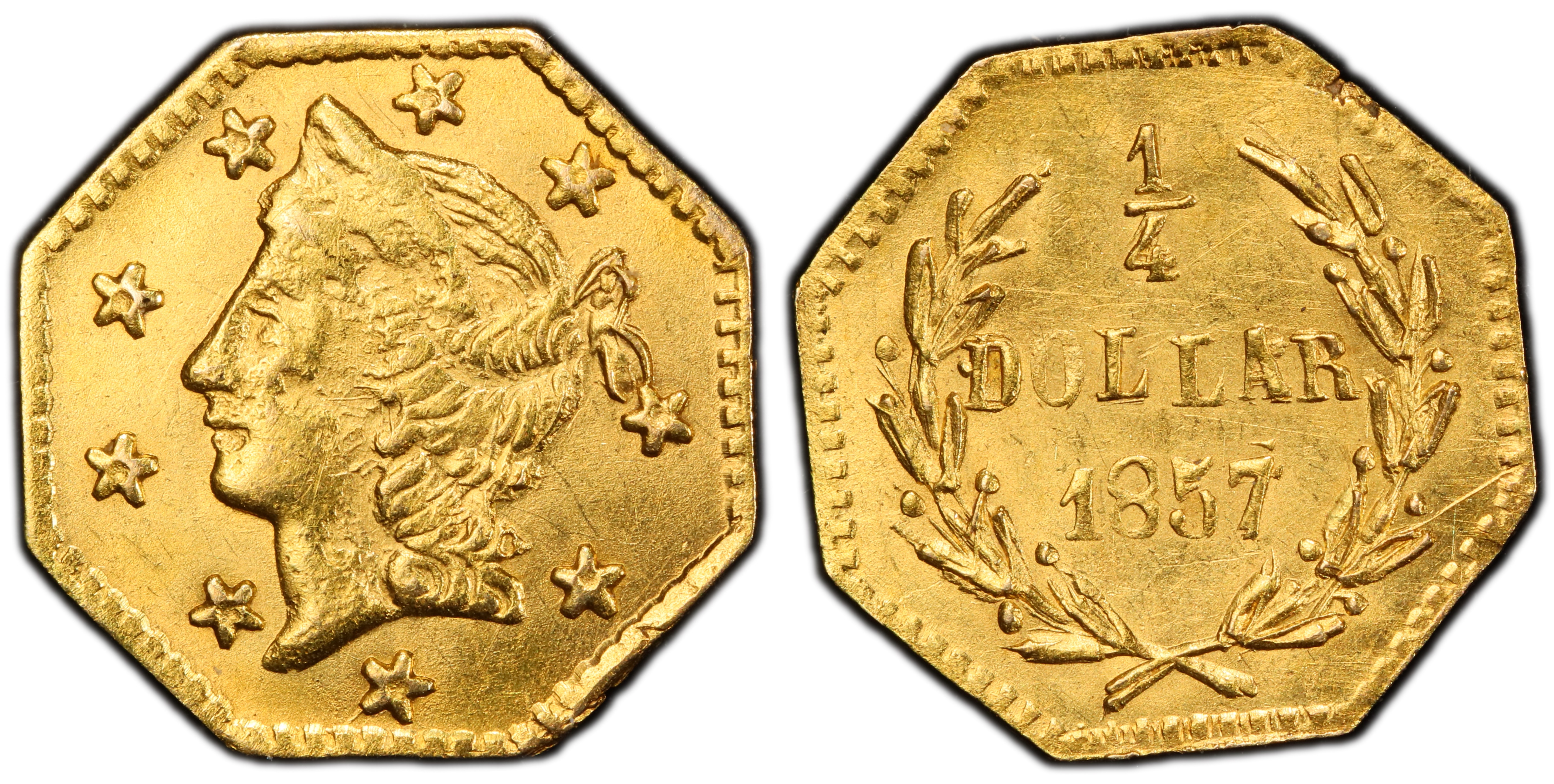
Obverse & Reverse
The California Gold Rush, ignited by James Marshall's 1848 discovery at Sutter's Mill, precipitated a massive influx of over 300,000 people to the region, creating a vibrant but chaotic economy. This explosive growth quickly outstripped the available supply of circulating coinage, particularly for small, everyday transactions. A 'pinch' of gold dust, notoriously inconsistent, was a common but problematic medium of exchange. To address this critical shortage, private jewelers and metallurgists in booming cities like San Francisco began striking their own coins in 1852. These 'California Fractional Gold' pieces, denominated as 25 cents, 50 cents, and one dollar, were born of commercial necessity. The BG-1301, an octagonal 25-cent piece dated 1857, belongs to what numismatists classify as 'Period One' (1852-1857). Coins from this era are believed to have genuinely circulated to facilitate trade, unlike many later 'Period Two' (1858-1882) issues which were primarily made as souvenirs. These early pieces were often crudely produced using a hammer-striking method, where dies were struck manually with a sledgehammer, leading to inconsistent strike quality even within the same variety. Though they served a vital economic function, these fractional coins contained significantly less gold than their face value would imply, effectively making them tokens. The opening of the official San Francisco Mint in 1854 began to alleviate the coin shortage, but the privately issued fractionals continued to fill a niche for several years. The Coinage Act of 1864 officially made private coinage illegal, though the law wasn't strictly enforced in the West until 1883, bringing an end to this fascinating chapter of American numismatic history. Today, the BG-1301 and its contemporaries are prized as tangible links to the freewheeling, entrepreneurial spirit of the Gold Rush.
Associated EventCalifornia Gold Rush
Reason For MintingTo alleviate a severe shortage of small-denomination coinage for daily commerce in California during the Gold Rush.
Minter HistoryThe specific minter for BG-1301 is not definitively known, a common trait for many fractional gold varieties. However, stylistic elements and historical context suggest a possible connection to various San Francisco jewelers of the period. One of the more prominent firms known to have produced fractional gold was Derbec & Co., run by Etienne Derbec. Like many minters, these were often jewelers by trade who saw a business opportunity in meeting the desperate local need for small change. They operated in a legally gray area, producing coins that were underweight for their face value but were accepted in commerce due to the lack of official alternatives. Their operations were typically small-scale, relying on manual presses or simple hammer-striking techniques. The anonymity of many minters was likely intentional, given the questionable legality and profitability of their ventures.
Historical SignificanceAs a 'Period One' issue, the BG-1301 represents a genuine 'coin of the realm' from the Gold Rush era, struck to address a real economic need before the San Francisco Mint could produce sufficient small change. It is a direct artifact of the region's self-reliant, ad-hoc economy and the challenges faced by its rapidly growing population.
BG-1301
Denomination25 Cents
Minting Period1857
Assayer/MinterUnknown, possibly Derbec & Co.
Geographic OriginSan Francisco, California
Obverse DescriptionA fairly crude depiction of a Liberty Head, facing left, with thirteen stars surrounding the portrait. The date '1857' is below the bust. The portrait details are often soft due to the minting process.
Obverse Inscription1857
Reverse DescriptionThe denomination '1/4 DOLLAR' is displayed within a beaded circle, surrounded by the inscription 'CALIFORNIA GOLD'. The lettering style is simple and functional.
Reverse InscriptionCALIFORNIA GOLD 1/4 DOLLAR
CompositionGold
Stated Fineness Actual FinenessVariable, typically ranging from 14 to 22 carats (.583 to .917 fine), but significantly below the .900 standard of federal gold.
Diameter10.00 mm
EdgePlain
Unknown
Survival EstimateFewer than 75; considered very scarce.
Rarity ScaleR-3 (Scarce), as per Breen-Gillio.
This coin is highly sought after as an authentic, circulating artifact from the peak of the California Gold Rush. Its octagonal shape, clear denomination, and status as a scarce 'Period One' variety make it a cornerstone for collectors of territorial and private gold.
Key VarietiesThe primary variety is the regular strike BG-1301. However, collectors must be aware of BG-1301A, which are restrikes produced in 1968 from the original dies. Additionally, researcher Mike Locke notes that some pieces attributed as BG-1301 may be contemporary copies made by Herman Kroll circa 1906, potentially using some original tooling; these Kroll pieces are themselves collectible but distinct from the original 1857 strikings. No original proof strikings are known.
Authentication TipsAuthentic pieces often show a softness of strike, particularly in the center of the obverse and reverse. The planchets can be crude and may show file marks or other preparation imperfections. The lettering style should be carefully compared to known genuine examples. Modern counterfeits are plentiful and are often gold-plated base metal; they typically have a soapy, artificial luster and incorrect weight. Genuine pieces have a distinct feel and color due to their specific gold alloy. Diagnostics for die state and any known cracks or clashes are critical for authentication.
Shopping ConsiderationsA premium quality example for this issue is defined by a sharp strike, minimal distracting marks, and original, uncleaned surfaces. Look for strength in the word 'DOLLAR' on the reverse and the stars on the obverse, as these areas are often weak. Original 'skin' often has a slightly reddish or mellowed gold hue, which is highly desirable and contrasts sharply with the bright, brassy look of a cleaned or dipped coin. Avoid examples with significant rim bumps, scratches, or evidence of tooling or smoothing in the fields. Given the crude manufacturing, some planchet roughness or adjustment marks can be acceptable and even serve as an indicator of authenticity.
A coin's grade is its condition, rated on a 1-70 scale. For rare coins, this is the most critical factor in determining value, as a tiny difference in preservation can mean a huge difference in price.
Relevant Grade TypesOriginal 1857 issues are business strikes intended for circulation and are found in Circulated (1-58) and Mint State (MS, 60-70) grades. No Proofs were struck during the original period of issue. Later-date restrikes, cataloged as BG-1301A, were produced as special collector issues and are typically found in high Mint State grades, but they are numismatically distinct from the 1857 originals.
Mint State CharacteristicsUncirculated examples of BG-1301 are rare. A typical Mint State piece will exhibit a soft, satiny luster rather than a hard, frosty one. The strike is almost never full; weakness on Liberty's hair and the central reverse lettering is common and expected. The planchets were often not perfectly flat, so slight waviness may be present. Small, scattered contact marks are the norm, and a truly 'clean' surface is exceptionally rare.
Circulated Wear PatternsWear first appears on the highest points: Liberty's cheek, hair details above the ear, and the letters of 'DOLLAR' on the reverse. On moderately circulated examples (VF-XF), the finer hair strands will merge, and the reverse lettering will show flattening. In lower grades (F and below), the date and stars will become weak and begin to merge with the fields, and the reverse legends will be difficult to read.
Key Factors For ValueFor the BG-1301, the primary value drivers are surface preservation and strike. An example with original, uncleaned surfaces commands a significant premium over one that has been cleaned or polished, even if the latter shows less wear. A sharper-than-average strike is highly prized and will bring a much higher price, grade for grade. Eye appeal is crucial; coins with a pleasing, mellow coloration and minimal distracting marks are most sought after. A CAC sticker for this issue indicates superior quality for the grade and adds a substantial premium.
PCGS Price Guide
| Grade | Price | Population |
|---|---|---|
| 58 | $325.00 | 2 |
| 58+ | $350.00 | N/A |
| 60 | $400.00 | N/A |
| 61 | $475.00 | 1 |
| 62 | $525.00 | 2 |
| 62+ | $600.00 | N/A |
| 63 | $800.00 | 4 |
| 63+ | $850.00 | N/A |
| 64 | $900.00 | 4 |