1876 G$1 BG-1117A (Regular Strike)
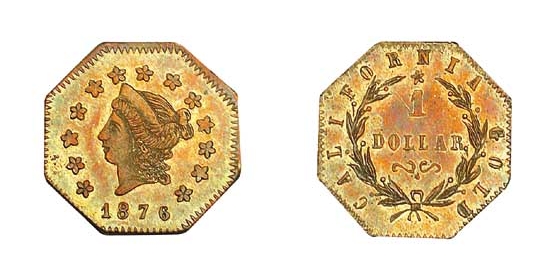
Obverse & Reverse
The 1876 G$1 BG-1117A is a numismatic artifact born from the twilight of America's private coinage era. By the mid-1870s, the initial impetus for California's fractional gold—a severe shortage of small circulating change—had long since evaporated with the robust output of the San Francisco Mint. The pieces being struck during this 'Period Two' (1858-1882) were largely jeweler's issues, created to satisfy a burgeoning market for souvenirs and keepsakes of the romanticized Gold Rush. These pieces were often underweight and not intended for vigorous circulation, but rather for sale to tourists and collectors. The minter of this specific variety was Herman J. Brand, a San Francisco jeweler who had been producing fractional gold since 1873. In 1875, Brand created a new, distinctive obverse punch featuring a large, somewhat bulbous portrait of Liberty, which collectors have since dubbed the 'Baby Head' type. For a brief period of about six months in 1876, Brand used this die to produce octagonal dollars. His production, however, came to an abrupt halt when a fellow jeweler was arrested for producing private coinage. Fearing legal repercussions from the Secret Service, which was beginning to enforce the Private Coinage Act of 1864 more strictly, Brand ceased striking his dollar pieces. This extremely short production window is the primary reason for the coin's legendary rarity. The BG-1117A represents the final evolution of Brand's dollar design before he terminated its manufacture, making it one of the last and rarest privately-issued gold dollars from the California series. Its existence is a direct reflection of a transitional period where private minting shifted from a necessary commercial enterprise to a legally gray souvenir trade, which was ultimately extinguished by federal enforcement.
Associated EventPost-Gold Rush Souvenir Trade
Reason For MintingPrimarily created as a collectible souvenir for the tourist trade, not to alleviate a currency shortage.
Minter HistoryHerman J. Brand was a San Francisco jeweler who arrived in the city around 1867. After working for or partnering with other jewelers, he began striking his own California Fractional Gold pieces in 1873. Initially, he used repurposed dies from other makers like Robert B. Gray, but in 1875 he created his own unique 'Baby Head' Liberty design. He produced fractional gold in various denominations but ceased production of his dollar coins in 1876 after another private minter was arrested, fearing federal prosecution.
Historical SignificanceThe BG-1117A is significant as one of the rarest and last privately struck gold dollars of the California Fractional Gold series. Its unique 'Baby Head' design and the story of its truncated production run provide a fascinating window into the final days of the private souvenir minting industry before federal laws were more stringently enforced.
BG-1117A
DenominationG$1
Minting Period1876
Assayer/MinterHerman J. Brand
Geographic OriginSan Francisco, California
Obverse DescriptionOctagonal planchet. Features a large, somewhat juvenile-appearing Liberty Head facing left, known to collectors as the 'Baby Head' type. Liberty wears a coronet inscribed LIBERTY. Thirteen large, five-pointed stars encircle the portrait, positioned far from the border.
Obverse InscriptionLIBERTY
Reverse DescriptionOctagonal planchet. A wreath composed of two branches tied with a bow at the bottom encircles the denomination. The inscription CALIFORNIA GOLD is outside the wreath at the top.
Reverse Inscription1 DOLLAR 1876 CALIFORNIA GOLD
CompositionGold
Stated Fineness Actual Fineness EdgePlain
Unknown (Extremely Small)
Survival Estimate2-3 known
Rarity ScaleR-8
This coin is a paramount rarity in the California Fractional Gold series. Its appeal stems from its R-8 rating, the distinctive and memorable 'Baby Head' design, its connection to a known minter (Herman J. Brand), and the compelling story of its extremely brief production period. It is a trophy piece for the most advanced collectors of territorial gold.
Key VarietiesThe primary distinction is between BG-1117 and BG-1117A. Both are 'Baby Head' types from 1876, but they are struck from different dies with subtle variations. The BG-1117A is the rarer of the two. No later-date restrikes or special collector issues of this specific variety are known to exist.
Authentication TipsAuthentication requires expert examination. Key diagnostics for BG-1117A include the characteristic 'Baby Head' portrait, the large obverse stars that are set unusually far from the border, and on the reverse, a high placement of the 'D' in 'DOLLAR'. The strike is often crude. As with all fractional gold, be wary of modern replicas which are common; genuine pieces have a specific fabric and strike character that copies struggle to emulate. Certification by a top-tier grading service is essential for this issue.
Shopping ConsiderationsAcquiring a BG-1117A is an infrequent event, typically occurring only at major auctions featuring landmark collections. A 'premium quality' example would be one that is well-struck for the issue, with clear details in Liberty's hair and the wreath. Given its rarity, any example, even one with impairments, is considered highly significant. Buyers should look for original, uncleaned surfaces and minimal distracting marks. Due to the crude manufacturing process, perfectly centered and sharply struck examples are not expected. Focus on eye appeal and the integrity of the planchet.
A coin's grade is its condition, rated on a 1-70 scale. For rare coins, this is the most critical factor in determining value, as a tiny difference in preservation can mean a huge difference in price.
Relevant Grade TypesAll known examples of BG-1117A are business strikes intended for sale as souvenirs, not for general circulation. They are found in both Circulated (1-58) and Mint State (MS, 60-70) grades, though few if any saw actual circulation. No proofs were struck during the original period of issue, and no later-date Proof restrikes are known.
Mint State CharacteristicsAn uncirculated example of this variety is defined by the presence of original mint luster. The strike is often somewhat soft, particularly on the highest points of the 'Baby Head' portrait and the wreath on the reverse. The fields may exhibit a slightly reflective or prooflike character, but this is often inconsistent across the surface. Small planchet flaws or adjustment marks are not uncommon and should be assessed for their impact on eye appeal. Given the extreme rarity, any Mint State example is a major prize.
Circulated Wear PatternsOn circulated examples, wear would first appear on the highest points of Liberty's cheek, hair above the eye, and the coronet. On the reverse, the high points of the wreath's leaves and the bow would show the first signs of friction. In lower grades, the finer details of the hair would merge and the legends would begin to weaken at their periphery.
Key Factors For ValueFor a classic rarity like the BG-1117A, the primary value driver is simply its existence and authenticity. Beyond that, value is determined by surface preservation and strike. An example with original, undisturbed surfaces free of cleaning, tooling, or damage will command a significant premium. A sharper strike that brings out more of Brand's 'Baby Head' design is highly desirable. Eye appeal, encompassing attractive original gold toning and a lack of distracting marks, is paramount. Given its status, a CAC sticker would provide strong confirmation of quality for the assigned grade and would be highly sought after.
PCGS Price Guide
| Grade | Price | Population |
|---|---|---|
| 50 | N/A | N/A |
| 55 | $7,000.00 | 1 |
| 55+ | $7,100.00 | N/A |
| 58 | $7,250.00 | 1 |
| 58+ | $7,500.00 | N/A |
| 60 | $7,750.00 | N/A |
| 61 | $8,000.00 | N/A |
| 62 | $8,500.00 | N/A |
| 62+ | $9,000.00 | N/A |
| 63 | $10,000.00 | 1 |