1881 G50C BG-1069 (Regular Strike)
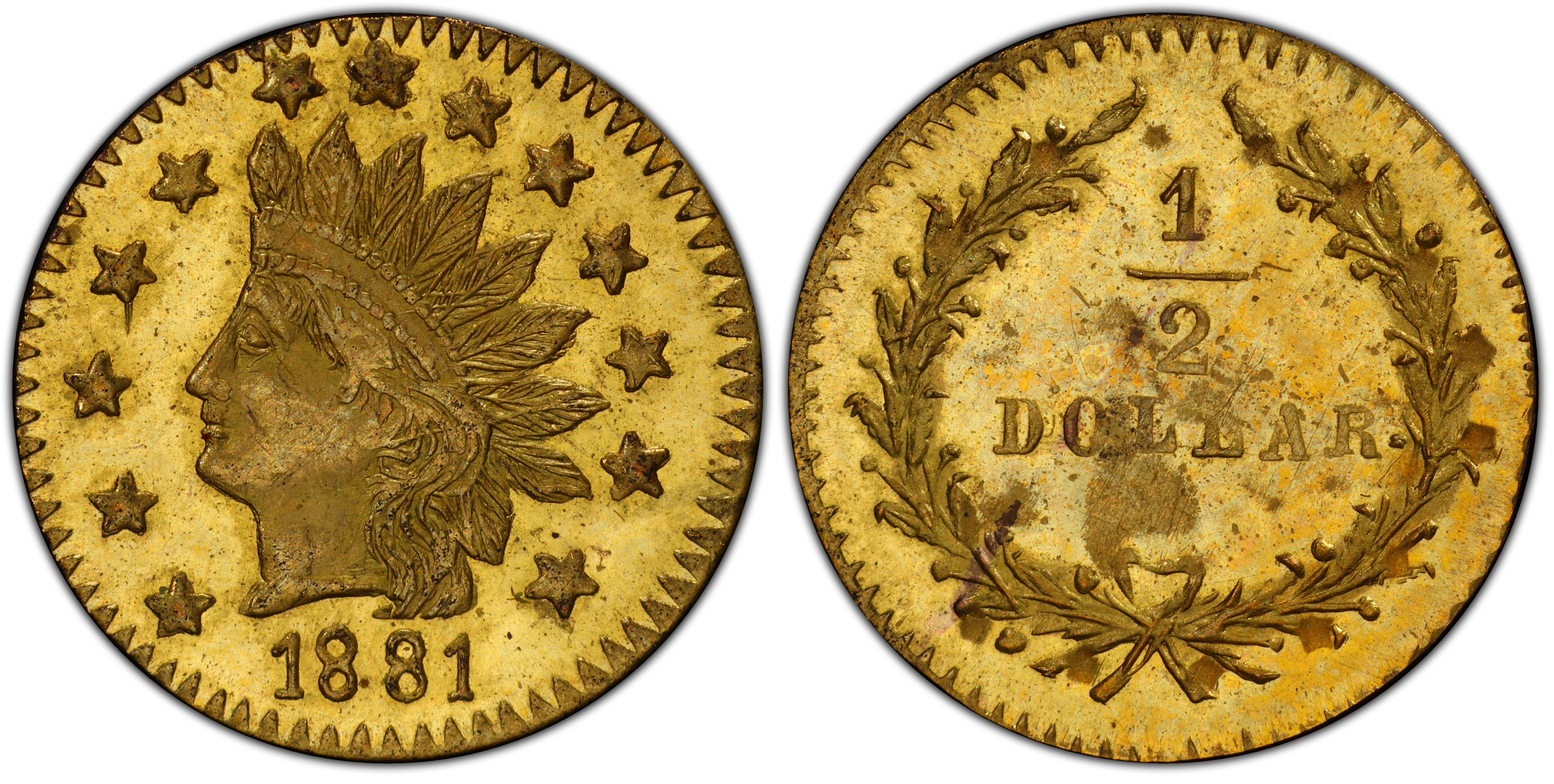
Obverse & Reverse
The 1881 BG-1069 50 Cent piece emerges from the twilight of the California Fractional Gold era, a period numismatists designate as 'Period Two' (1858-1882). Unlike the 'Period One' issues struck out of commercial necessity to alleviate the chronic shortage of small change during the initial Gold Rush, these later pieces served a different purpose. By the 1880s, the San Francisco Mint was in full operation, supplying ample federal coinage for the region's economy. The raison d'être for fractional gold had shifted from commerce to curiosity. These small, denominated gold tokens were now primarily manufactured by jewelers as souvenirs and keepsakes, romantic mementos of the Gold Rush that had transformed California three decades prior. The production quality of Period Two issues was often lower than their predecessors, with less gold content relative to their face value, solidifying their status as tokens rather than circulating currency. The Coinage Act of 1864 had prohibited private coinage, but the law was not aggressively enforced against these small, low-value pieces until the Secret Service, under Chief James J. Brooks, began a crackdown in the early 1880s, effectively ending their production by 1883. The 1881 BG-1069 was struck just before this final suppression. These pieces were sold to locals and tourists, often incorporated into jewelry or kept in wallets as lucky charms. Their diminutive size and affiliation with the romanticized 'Wild West' made them popular and affordable souvenirs. Today, they are not just collectibles but tangible links to the enduring legacy of the California Gold Rush and the entrepreneurial spirit of the jewelers who catered to a public fascinated by gold.
Associated EventCalifornia Gold Rush (Later Souvenir Period)
Reason For MintingPrimarily minted as a souvenir or keepsake for tourists and locals, not for general circulation which was by then filled by federal coinage.
Minter HistoryThe specific minter of BG-1069 is not definitively known, a common trait for many Period Two issues as makers often omitted identifying marks. However, production is attributed to the community of San Francisco jewelers who dominated this trade. Prominent firms active in this period included Robert B. Gray & Co., who had succeeded Antoine Nouizillet, and the California Jewelry Co. (Levison Brothers), which acquired Gray's interests in 1871. These firms and others produced a wide variety of fractional gold pieces, often using shared or stylistically similar dies. They operated as jewelers and manufacturers, creating these small gold tokens as a profitable sideline business catering to the robust market for Gold Rush memorabilia.
Historical SignificanceThe BG-1069 represents the final phase of private gold token production in California, marking the transition from necessity-driven coinage to commercial souvenir. Its existence highlights the sustained cultural and economic impact of the Gold Rush long after its peak, and its production ceased due to federal enforcement that solidified the government's monopoly on coinage.
Not Applicable
Denomination50 Cents
Minting Period1881
Assayer/MinterUnknown Jeweler (Possibly Robert B. Gray & Co. or successors)
Geographic OriginSan Francisco, California
Obverse DescriptionThe obverse features a small, stylized head of Liberty facing left, adorned with a feathered headdress, often referred to as an 'Indian Head'. She is surrounded by thirteen stars, representing the original colonies.
Obverse Inscription Reverse DescriptionThe reverse is dominated by a wreath of two olive branches tied with a ribbon at the bottom. The denomination '50 CENTS' is located in the center, and the date '1881' is positioned just below the denomination, inside the wreath.
Reverse Inscription50 CENTS 1881
CompositionGold
Stated Fineness Actual FinenessVariable, typically 14 to 22 karats. Period Two issues are known to be of lower fineness than stated value.
Diameter11.00 mm
EdgePlain
Unknown
Survival Estimate76-125 known
Rarity ScaleR-4+
This variety appeals to collectors due to its affordability relative to Period One issues, its classic Indian Head design, and its status as one of the last dated issues of the California Fractional Gold series before federal suppression. It is a popular type coin for those building a representative set of this fascinating numismatic category.
Key VarietiesThe primary variety is the Regular Strike BG-1069. No major varieties, patterns, or official restrikes are known to exist for this specific Breen-Gillio number. Collectors should be aware that the broader California Fractional Gold series includes hundreds of die varieties, including different dates, denominations, shapes (round and octagonal), and designs (Liberty and Indian Heads).
Authentication TipsGenuine pieces must be denominated; fakes often lack 'CENTS' or 'DOLLAR' or feature a bear on the reverse, a design never used on authentic 19th-century issues. The strike on genuine pieces can be uneven or weak in areas due to the manual hammer-striking process, a characteristic often absent on modern replicas. The fabric should appear correct for a 19th-century gold piece, not brassy or overly polished. Examine the style of the numerals and letters; they should match known genuine examples, as fakes often have incorrect fonts. Professional authentication by a major grading service (PCGS or NGC) is highly recommended.
Shopping ConsiderationsA premium quality example for its grade will exhibit a sharp strike on the high points of the Indian's headdress and the details within the wreath. Look for clean, lustrous surfaces without evidence of harsh cleaning, which will manifest as hairlines or a dull, lifeless appearance. Original, un-tooled surfaces are paramount. Many surviving examples have been damaged from use in jewelry; check carefully for evidence of mounting, soldering, or tooling in the fields. A coin with a bold date and clear denomination commands a premium. Eye appeal is critical; pieces with attractive, original reddish-gold toning are highly sought after.
A coin's grade is its condition, rated on a 1-70 scale. For rare coins, this is the most critical factor in determining value, as a tiny difference in preservation can mean a huge difference in price.
Relevant Grade TypesOriginal period issues were business strikes intended for sale as souvenirs, not circulation, and are found in both Circulated (1-58) and Mint State (MS, 60-70) grades. Due to their nature as keepsakes, many were preserved in high grades. No official Proofs were struck during the original period of issue, and no later-date Proof restrikes are known for this variety. Any piece described as 'Proof' should be viewed with extreme skepticism.
Mint State CharacteristicsUncirculated examples of BG-1069 often display a soft, satiny luster. The strike can be inconsistent; a well-struck piece will show clear definition in the feathers and the wreath's leaves, but some weakness, particularly in the center, is common and not always a detriment. Due to the softness of the gold and rudimentary production, even high-grade Mint State examples will typically show small planchet flaws or minor contact marks from handling and storage over the decades.
Circulated Wear PatternsWear first appears on the highest points of the design. On the obverse, this includes the cheek and the feathers of the headdress. On the reverse, the leaves and ribbon bow of the wreath will show the first signs of friction. On lower grade examples, the fine details of the feathers will merge, and the inscription will begin to soften.
Key Factors For ValueThe primary drivers of value for an 1881 BG-1069 are grade and surface quality. An example with original, undisturbed luster will always be worth more than a cleaned or polished one of the same grade. Strike quality is a major factor; a sharply struck coin with full details is far more desirable than a weakly struck counterpart. Eye appeal, encompassing toning and the absence of distracting marks, plays a significant role. Finally, certification by a top-tier grading service (PCGS or NGC) is essential for market acceptance, and a CAC sticker indicating premium quality for the grade will add a significant price premium.
PCGS Price Guide
| Grade | Price | Population |
|---|---|---|
| 45 | $210.00 | 1 |
| 45+ | $215.00 | N/A |
| 50 | $225.00 | N/A |
| 50+ | $235.00 | N/A |
| 53 | $250.00 | N/A |
| 53+ | $255.00 | N/A |
| 55 | $265.00 | 1 |
| 55+ | $275.00 | N/A |
| 58 | $285.00 | 4 |
| 58+ | $290.00 | N/A |
| 60 | $300.00 | 1 |
| 61 | $350.00 | 3 |
| 62 | $415.00 | 12 |
| 62+ | $450.00 | N/A |
| 63 | $650.00 | 18 |
| 63+ | $725.00 | N/A |
| 64 | $1,000.00 | 14 |
| 64+ | $1,050.00 | N/A |
| 65 | $1,100.00 | 2 |