(1854) G25C BG-224 (Regular Strike)
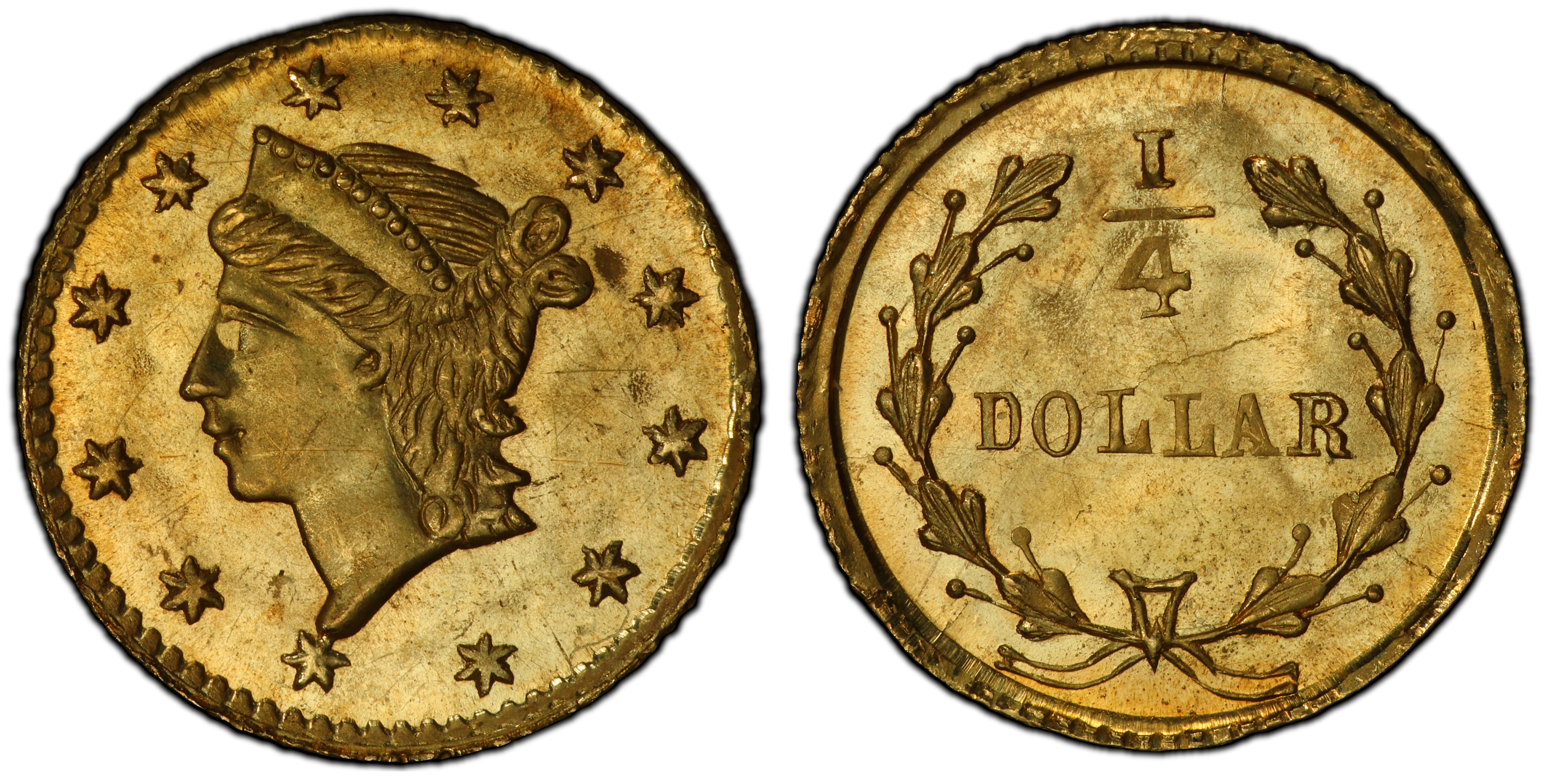
Obverse & Reverse
The BG-224 quarter dollar is a quintessential artifact of 'Period One' (1852-1857) California Fractional Gold production, a fascinating and historically significant chapter in American numismatics. In the chaotic, booming economy of Gold Rush San Francisco, the lack of official small-denomination coinage from the newly established U.S. Branch Mint created a severe bottleneck in daily commerce. Gold dust, while plentiful, was impractical for small transactions, and the smallest official coins were often hoarded or exported. Into this void stepped a number of manufacturing jewelers, many of French origin, who began striking their own tiny gold coins in quarter dollar, half dollar, and dollar denominations. These were not government-sanctioned issues but were tolerated out of sheer necessity and generally accepted by a commerce-starved public. The BG-224, attributed to the jeweler Antoine Louis Nouizillet, is a prime example of these utilitarian emergency issues. Unlike the later 'Period Two' pieces, which were often made as souvenirs, the BG-224 and its contemporaries were intended for and saw actual circulation. They were typically struck from native California gold, which had a high silver content, lending them a paler, brassy-gold color compared to federal issues. Critically, they were almost universally underweight; a federal gold dollar of the era contained 1.672 grams of .900 fine gold, meaning a quarter dollar should have weighed about 0.42 grams. The BG-224, weighing closer to 0.38 grams, was therefore intrinsically worth less than its face value, a fact overlooked in the inflated economy where any convenient medium of exchange was valued. The simple, dateless design, mimicking the official U.S. Liberty Head gold coinage, was likely intentional to foster public acceptance. The eventual increase in federal coinage from the San Francisco Mint rendered these private issues obsolete by 1857, ending the era of Period One fractionals and cementing their status as rare relics of a unique economic environment.
Associated EventCalifornia Gold Rush
Reason For MintingTo alleviate a severe shortage of small denomination coinage for daily commercial transactions in Gold Rush-era California.
Minter HistoryAntoine Louis Nouizillet was a French jeweler and one of the key figures in the production of Period One California Fractional Gold. He operated in San Francisco during the 1850s, a period when skilled artisans with knowledge of die sinking and metallurgy could fill the critical economic niche of providing desperately needed small change. Nouizillet is known to have partnered with other French jewelers, such as M. Deriberpe (forming D.N.) and the firm of Frontier & Deviercy. His independent issues, like the BG-224, are characterized by their simple, functional designs that emulated federal coinage. After the era of circulating fractional gold ended, Nouizillet sold his business to Robert B. Gray & Co. around 1859-60, who continued to produce souvenir pieces, sometimes using Nouizillet's old dies.
Historical SignificanceThe BG-224 is a tangible link to the primitive, ad-hoc economy of the California Gold Rush, representing a private solution to a government failure in supplying adequate coinage. Its existence and circulation, despite being underweight, highlight the unique economic pressures of the time. It is a prime example of the 'emergency money' that enabled commerce on the American frontier.
N/A
Denomination$0.25 (Quarter Dollar)
Minting Periodc. 1854
Assayer/MinterAntoine Louis Nouizillet
Geographic OriginSan Francisco, California
Obverse DescriptionA small, somewhat crudely rendered bust of Liberty facing left, her hair tied in a bun. She wears a coronet, and her effigy is surrounded by thirteen small, irregularly placed six-pointed stars near the denticled border.
Obverse Inscription Reverse DescriptionThe denomination is centrally located within a simple, open wreath composed of two branches tied with a bow at the bottom. The style is utilitarian and lacks the refinement of official U.S. Mint issues.
Reverse Inscription1/4 DOLLAR
CompositionGold (with native silver alloy)
Stated Fineness Actual FinenessTypically .800-.880, consistent with unrefined native California gold.
Weight0.38 grams
Diameter9.50 mm
EdgePlain
Unknown
Survival Estimate201-500
Rarity ScaleR-3 (Scarce)
The BG-224 is highly sought after as an accessible and representative example of a 'Period One' California Fractional Gold piece. Its appeal lies in its direct connection to the Gold Rush economy, its private minting origin, and its charmingly primitive design. It is one of the more available varieties, allowing collectors to own a genuine piece of circulating Gold Rush-era money without the price tag of the great rarities.
Key VarietiesThe primary issue is the business strike intended for circulation. There are no known proof strikes or major die varieties from the original minting period. However, a key point of interest for collectors is the provenance of certain examples. A number of BG-224 specimens were recovered from the wreck of the S.S. Central America, which sank in 1857. These examples, often certified with a special shipwreck pedigree, are considered a distinct and highly desirable subset of the surviving population.
Authentication TipsGenuine BG-224 pieces are tiny and very lightweight (around 0.38 grams). Counterfeits are common, but many are poorly made. Suspect pieces that are brassy, have a soapy or cast-like appearance, or incorrect weight and diameter. The strike on genuine examples is often crude but sharp in areas, whereas many fakes are universally soft. Real gold is not magnetic. The specific die markers, such as the exact placement of the stars relative to Liberty's profile and the wreath details, should be compared to high-resolution images of certified examples.
Shopping ConsiderationsA premium quality example for its grade will exhibit a bold strike for the issue, with clear details on Liberty's hair and the leaves of the wreath. Many examples are weakly struck, so well-defined specimens command a premium. Look for original, uncleaned surfaces; a pleasing light orange-gold or brassy-gold patina is often seen and is desirable. Avoid examples that have been harshly cleaned, polished, or used as jewelry, as this is common and significantly impairs value. Pay close attention to any edge damage or bending due to the coin's delicate nature. An S.S. Central America pedigree adds significant value and historical appeal.
A coin's grade is its condition, rated on a 1-70 scale. For rare coins, this is the most critical factor in determining value, as a tiny difference in preservation can mean a huge difference in price.
Relevant Grade TypesOriginal period issues of BG-224 were all business strikes intended for circulation and are found in Circulated (1-58) and Mint State (MS, 60-70) grades. No Proofs were struck during the original period of issue, and no later-date Proof restrikes are known to exist for this specific variety.
Mint State CharacteristicsAn uncirculated (MS) BG-224 typically displays a soft, satiny luster consistent with Period One fractionals. The strike is often somewhat uneven; it is common to see weakness in the central parts of the design, such as Liberty's cheek or the leaves in the wreath, even on high-grade examples. Planchet quality can be crude, sometimes showing adjustment marks or minor striations. Due to the softness of the gold and their method of production and handling, even mint state examples can have small contact marks.
Circulated Wear PatternsWear first appears on the highest points of the design. On the obverse, this includes Liberty's hair above the eye and ear, the coronet, and her cheekbone. On the reverse, the high points of the wreath's leaves and the bow will show the first signs of friction. On moderately circulated examples (VF-XF), the individual hair strands will be merged and the finer details of the leaves will be lost. In lower grades, the stars and legends become faint and begin to merge with the fields.
Key Factors For ValueBeyond the numerical grade, value is driven by strike and surface quality. A sharply struck coin with strong details is far more desirable than a weakly struck example of the same grade. Originality of the surface is paramount; examples with their natural 'skin' and luster are prized over those that have been cleaned or polished. Eye appeal, encompassing factors like the richness of the toning and the absence of distracting marks, plays a major role. Finally, a CAC sticker indicates a premium quality coin for the grade and will often result in a significant price premium for this issue.
PCGS Price Guide
| Grade | Price | Population |
|---|---|---|
| 50 | $200.00 | 1 |
| 50+ | $215.00 | N/A |
| 53 | $235.00 | N/A |
| 53+ | $245.00 | N/A |
| 55 | $260.00 | 9 |
| 55+ | $270.00 | N/A |
| 58 | $300.00 | 14 |
| 58+ | $315.00 | N/A |
| 60 | $335.00 | 6 |
| 61 | $360.00 | 19 |
| 62 | $395.00 | 79 |
| 62+ | $430.00 | 1 |
| 63 | $460.00 | 67 |
| 63+ | $500.00 | 1 |
| 64 | $575.00 | 30 |
| 64+ | $750.00 | N/A |
| 65 | $1,350.00 | 2 |