1875 G$1 BG-1127 (Regular Strike)
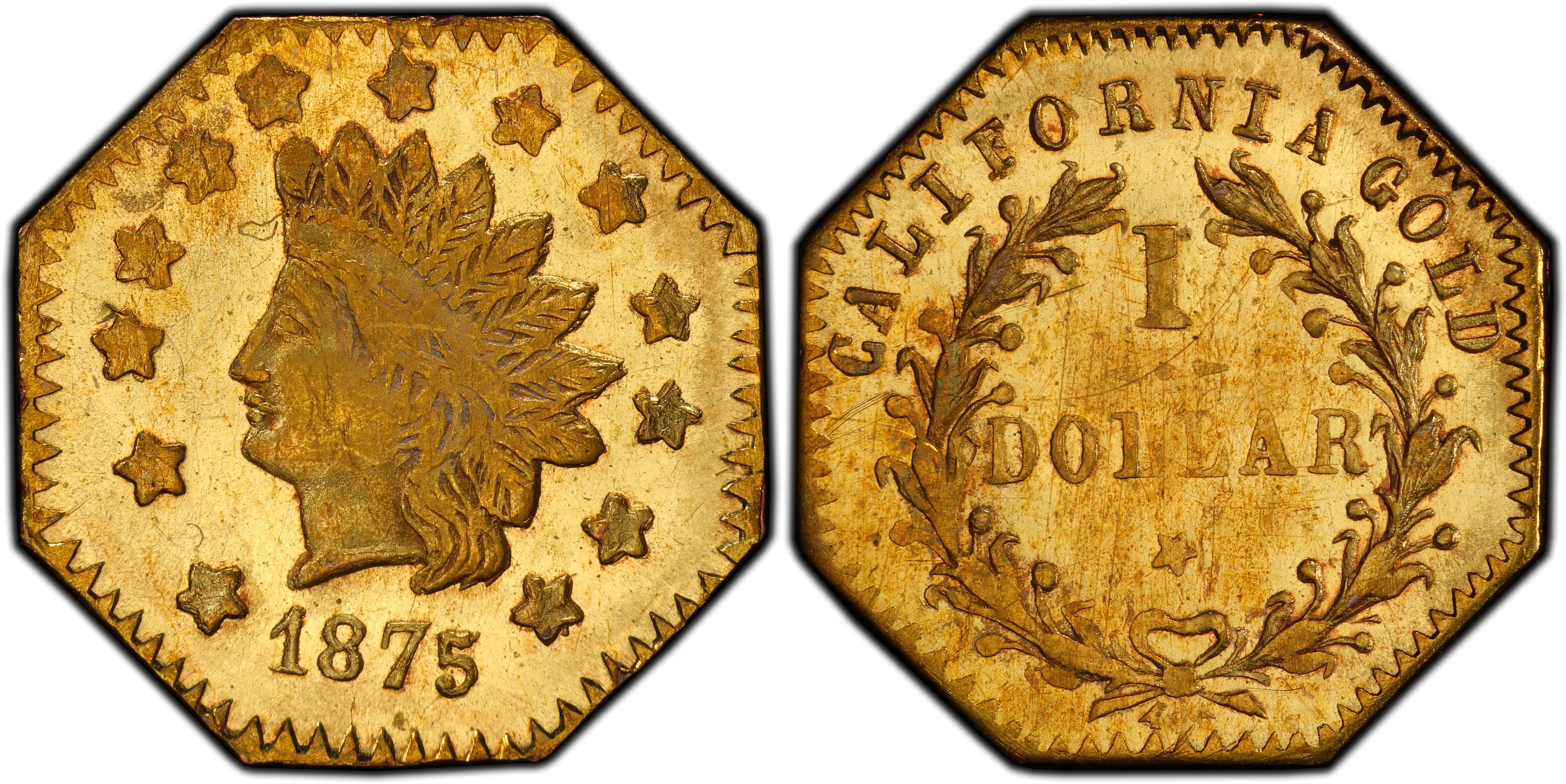
Obverse & Reverse
The 1875 BG-1127 octagonal gold dollar is a quintessential artifact of 'Period Two' of California's fascinating fractional gold series. By the mid-1870s, the initial, desperate need for circulating coinage that defined the Gold Rush's peak had subsided with the full-scale operation of the San Francisco Mint. The character of fractional gold production had fundamentally changed. The earlier 'Period One' issues (1852-1856) were struck by necessity and, while private, often attempted to conform to federal standards of weight and value. In contrast, the Period Two issues, including this 1875 piece, were primarily the work of jewelers and merchants responding to a different market demand. These pieces were often significantly underweight for their stated value, functioning more as profitable tokens or souvenirs than as true coinage meant to supplement the federal money supply. Minted long after the Coinage Act of 1864 explicitly forbade private currency, these 'jeweler's issues' operated in a legal gray area, often tolerated locally and eagerly purchased by a public still enamored with the allure of California gold. The BG-1127 was created in a San Francisco transformed from a chaotic boomtown into a sophisticated metropolis, yet one that still celebrated its gold-born identity. These small, intricate gold pieces served as affordable mementos, convenient for small transactions where federal silver was scarce or cumbersome, and as popular gifts. Their production was typically accomplished via the 'hammer strike' method, where dies were struck manually, resulting in considerable variation in strike quality from piece to piece. The anonymous nature of the minter is characteristic of this period, as jewelers sought to profit from the continued demand without attracting federal scrutiny. The BG-1127, therefore, represents not the monetary necessity of 1849, but the commercial ingenuity and romanticism of a maturing California, a tangible link to the enduring legacy of the Gold Rush.
Associated EventPost-Gold Rush Economic Expansion
Reason For MintingTo satisfy commercial and souvenir demand for small gold currency in a legally ambiguous but locally tolerated market.
Minter HistoryThe specific minter of BG-1127 is unknown, a common characteristic of Period Two 'jeweler's issues.' These pieces were produced anonymously by various San Francisco jewelers who possessed the necessary skills in die cutting and metallurgy. Unlike the named assayers of the Gold Rush's peak, these later minters avoided placing identifying marks on their products to evade potential prosecution under the Private Coinage Act of 1864, which was not strictly enforced in California until the early 1880s. Their business model relied on the high public demand for gold novelties and the persistent, if localized, utility of small gold pieces in commerce.
Historical SignificanceThe BG-1127 is historically significant as a representative of the later, commercial phase of private gold minting in California. It illustrates the transition of fractional gold from essential currency to a popular trade token and souvenir, reflecting the evolving economy and culture of San Francisco decades after the initial Gold Rush. Its existence underscores the long-lasting appeal of gold and the independent spirit of Californian commerce.
BG-1127
DenominationG$1
Minting Period1875
Assayer/MinterUnknown Private Minter (Jeweler)
Geographic OriginSan Francisco, California
Obverse DescriptionA stylized Native American head, often referred to as an 'Indian Head,' facing left. The portrait is somewhat crude, typical of jeweler's issues, with thirteen stars encircling the bust within the octagonal border. The date '1875' is positioned below the truncation of the neck.
Obverse Inscription1875
Reverse DescriptionThe reverse features the denomination '1 DOLLAR' and the abbreviation 'CAL' within a simple wreath composed of two branches tied with a bow at the bottom.
Reverse Inscription1 DOLLAR CAL
CompositionGold
Stated Fineness Actual FinenessTypically around .800 to .900, though it could vary as these were unregulated private issues.
Weight0.50 grams
Diameter11.50 mm
EdgePlain
Unknown
Survival Estimate75-125
Rarity ScaleR-5
The 1875 BG-1127 is highly sought after for its classic octagonal shape and Indian Head design, which are emblematic of the California Fractional Gold series. As a dated 'Period Two' piece, it offers a tangible connection to the post-Gold Rush era of San Francisco. Its relative scarcity and the challenge of finding well-struck, high-grade examples make it a favorite among specialists.
Key VarietiesNo major varieties of the BG-1127 are widely recognized from the original minting period. As a 'jeweler's issue,' no official patterns, trial pieces, or restrikes were created. All known examples are considered business strikes intended for local commerce or sale as souvenirs. Collectors should be aware of contemporary counterfeits and modern replicas, which are common for this series.
Authentication TipsAuthentic BG-1127 examples exhibit a specific die style with a somewhat 'primitive' or naive rendering of the Indian head and wreath. The numerals in the date have a distinct shape. Look for softness in the central devices, which is common even on high-grade pieces due to the hammer-striking process. Counterfeits often have incorrect letter/numeral fonts, a soapy or porous surface texture from being cast rather than struck, or incorrect weight and metallic composition. Comparison with high-resolution images of certified examples is the most effective authentication method.
Shopping ConsiderationsA premium quality BG-1127 will exhibit a bold, well-centered strike, which is uncommon. Look for sharpness in the stars, the details of the wreath, and the letters and numerals. Original, undisturbed surfaces with some remaining mint luster command a significant premium. Many examples have been cleaned, polished, or used as jewelry; avoid pieces with harsh abrasions, rim damage, or evidence of tooling. A soft strike is typical, but a coin that is both sharply struck and has clean surfaces is a true prize. Eye appeal, manifested as pleasing, slightly reddish-gold original toning, is highly desirable.
A coin's grade is its condition, rated on a 1-70 scale. For rare coins, this is the most critical factor in determining value, as a tiny difference in preservation can mean a huge difference in price.
Relevant Grade TypesOriginal period issues of BG-1127 were business strikes intended for circulation or as souvenirs and are found in Circulated (1-58) and Mint State (MS, 60-70) grades. There were no Proof (PR/PF) coins struck by the private minters during this period, and there are no known later-date Proof restrikes. Any piece described as a 'Proof' is likely a modern replica or has been misattributed.
Mint State CharacteristicsAn uncirculated BG-1127 will show original mint luster, which is typically soft and satiny rather than deeply frosty. The strike is a key determinant of quality; many Mint State examples are softly struck in the center of the obverse (the cheek) and reverse (the letters of 'DOLLAR'). Contact marks are common due to the softness of the gold and the casual handling these pieces received. A premium MS coin would be well-centered with an above-average strike and minimal, well-hidden contact marks.
Circulated Wear PatternsWear first appears on the highest points of the design. On the obverse, this includes the cheek, the eyebrow, and the tips of the feathers in the headdress. On the reverse, the high points are the leaves in the wreath and the bow at the bottom. On moderately worn examples (VF-XF), significant detail will be lost on the cheek and feathers, and the central letters of the reverse will show flattening. In lower grades, the legends and date will become weak, and the stars may merge with the rim.
Key Factors For ValueThe primary drivers of value for an 1875 BG-1127 are grade and surface quality. An example with original, uncleaned surfaces will always be worth more than a cleaned piece of the same grade. Strike quality is the next most important factor; a sharply struck coin can command a premium of 50% or more over a weakly struck contemporary. Eye appeal, encompassing attractive original color and a lack of distracting marks, is crucial. For this series, a CAC sticker carries significant weight, confirming both the accuracy of the grade and the quality of the surfaces for that grade.
PCGS Price Guide
| Grade | Price | Population |
|---|---|---|
| 40 | N/A | N/A |
| 45 | $550.00 | 1 |
| 45+ | $585.00 | N/A |
| 50 | $650.00 | 4 |
| 50+ | $675.00 | N/A |
| 53 | $700.00 | 4 |
| 53+ | $735.00 | N/A |
| 55 | $750.00 | 11 |
| 55+ | $785.00 | N/A |
| 58 | $825.00 | 18 |
| 58+ | $875.00 | N/A |
| 60 | $950.00 | N/A |
| 61 | $1,100.00 | 5 |
| 62 | $1,300.00 | 22 |
| 62+ | $1,450.00 | N/A |
| 63 | $1,750.00 | 16 |
| 63+ | $2,000.00 | N/A |
| 64 | $2,350.00 | 10 |
| 64+ | $2,750.00 | N/A |
| 65 | $3,750.00 | 2 |