1882 G50C BG-1077 (Regular Strike)
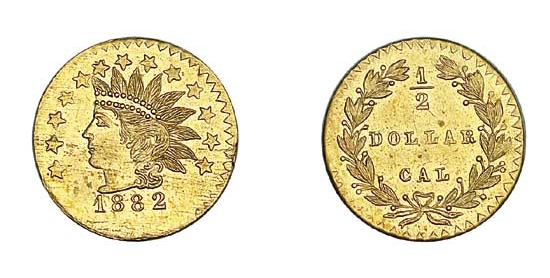
Obverse & Reverse
The 1882 BG-1077 half dollar represents the final death rattle of a fascinating and uniquely American series of private coinage. By 1882, the socio-economic conditions that had necessitated the original 'Period One' (1852-1857) California fractional gold pieces—a severe shortage of small-denomination circulating coinage in the wake of the Gold Rush—had long since vanished. The San Francisco Mint, opened in 1854, now produced ample federal coinage, rendering private issues obsolete for commerce. Yet, a market persisted, not for currency, but for novelty. The 'Period Two' issues (1858-1882) were produced almost exclusively by jewelers to satisfy a tourist and souvenir trade, romanticizing the now-legendary Gold Rush. These later pieces were typically underweight, containing less gold than their face value implied, and were viewed by authorities as a nuisance at best and illegal private coinage at worst. The BG-1077 was struck on the very precipice of the end. In 1883, the United States Secret Service, having long turned a blind eye, finally initiated a major crackdown on the remaining producers of these denominated 'coins', effectively terminating their manufacture. The jewelers at Nast, Greenzweig & Co., who are credited with this variety, were therefore among the last to ever produce such a piece. Their methods would have been typical for the era's jewelers: dies were hand-cut, and planchets were likely punched from gold strips and struck with a hammer press. This manual process resulted in significant variations in strike quality, a hallmark of the series. The BG-1077, therefore, is not just a coin but a historical artifact marking the end of a 30-year tradition of private minting that began in chaos and necessity, and ended as commercial memorabilia just as federal authority asserted its final, unequivocal control over the nation's money supply. Its rarity today is a direct consequence of its original status as a mere bauble, produced in small numbers for a niche market at the very end of its era.
Associated EventPost-Gold Rush California; Souvenir & Jeweler's Issues
Reason For MintingPrimarily struck for sale as souvenirs and curios for the tourist trade, not for general circulation.
Minter HistoryNast, Greenzweig & Co. was a San Francisco-based jewelry and watchmaking firm active in the latter part of the 19th century. Like many jewelers of the era, they participated in the lucrative business of creating souvenir gold 'coins' that recalled the height of the Gold Rush. Numismatic scholarship by Breen and Gillio attributes several late-period fractional gold varieties to them, including BG-799CC, BG-892, BG-966, and this final 1882-dated BG-1077. Their operations ceased in this field following the Secret Service crackdown of 1883, which ended the production of denominated private gold pieces.
Historical SignificanceThis coin is numismatically significant as one of the very last dated issues of California fractional gold, struck just before the federal government permanently halted the practice in 1883. It represents the final evolution of the series from a necessary circulating medium to a commercial souvenir.
BG-1077
DenominationG50C ($0.50)
Minting Period1882
Assayer/MinterNast, Greenzweig & Co.
Geographic OriginSan Francisco, California
Obverse DescriptionA small Indian Head facing left, wearing a feathered headdress. The portrait is encircled by 13 stars, representing the original colonies. The date '1882' appears below the bust.
Obverse Inscription[13 stars] 1882
Reverse DescriptionThe denomination '1/2 DOLLAR' is displayed within a continuous wreath of leaves and berries. The wreath is tied with a bow at the bottom.
Reverse Inscription1/2 DOLLAR
CompositionGold
Stated Fineness Actual FinenessVariable, but typical for Period Two jeweler's issues, often between .500 and .800 fine.
Diameter11.00 mm
EdgePlain
Unknown, but presumed to be very small.
Survival EstimateFewer than 20 known. The Breen-Gillio rarity is High R-6 (13-30 known), and as of late 2025, the combined NGC and PCGS population reports show fewer than 10 graded examples.
Rarity ScaleHigh R-6
The BG-1077 is highly sought after for its status as the 'last date' of the classic California Fractional Gold series. Its direct connection to the end of an era and its high rarity make it a trophy piece for specialists.
Key VarietiesThere are no known major varieties of the BG-1077 from the original minting period. No restrikes, patterns, or trial pieces are known to exist for this specific Breen-Gillio number.
Authentication TipsAuthentic examples are struck in gold, not brass or gilt base metal. The date and inscriptions should match known genuine examples precisely. A key diagnostic is the often-seen weakness in the strike; specifically, the wreath on the reverse tends to be incompletely brought up opposite the obverse stars. Fakes often have a soapy, cast-like appearance or incorrect design details. Any piece with a bear on the reverse is a modern replica. Authentication by a major third-party grading service is highly recommended.
Shopping ConsiderationsWhen acquiring a BG-1077, strike quality is a primary consideration. While weakness on the wreath is characteristic, a sharp strike on the Indian Head, stars, and date adds significant value and eye appeal. Look for lustrous, original surfaces; many surviving examples have been cleaned or used as jewelry. Avoid pieces with scratches, rim bumps, or evidence of tooling or repair. An example with original, undisturbed 'skin' and a bold obverse, even with the expected reverse weakness, would be considered premium quality for the grade.
A coin's grade is its condition, rated on a 1-70 scale. For rare coins, this is the most critical factor in determining value, as a tiny difference in preservation can mean a huge difference in price.
Relevant Grade TypesAll original 1882 BG-1077 issues are business strikes intended for sale as souvenirs; they were not intended for circulation, though some may have entered it briefly. They are found in Circulated (1-58) and, more commonly, Mint State (MS, 60-70) grades due to their souvenir nature. No Proof (PR/PF) examples were struck during the original period of issue, and no later-date Proof restrikes are known.
Mint State CharacteristicsAn uncirculated BG-1077 typically exhibits a soft, satiny luster. Strike is a key issue; it is customary for this variety to be weakly struck on the reverse wreath, particularly on the elements opposite the high-relief stars of the obverse. Conversely, a sharp strike on the Indian head and date is highly desirable. Due to the manufacturing process, small planchet flaws or adjustment marks may be present but should not be confused with post-strike damage. Contact marks are common but should be minimal for higher grades.
Circulated Wear PatternsOn circulated examples, wear first appears on the high points of the Indian Head, specifically the cheek, ear, and the feathers of the headdress. On the reverse, the leaves and the bow of the wreath will show initial friction and flattening. In lower grades (VF and below), the finer details of the feathers and the individual leaves will merge, and the legends will begin to soften.
Key Factors For ValueThe primary drivers of value for a BG-1077 are rarity and grade. Surface quality is paramount; an example with original, lustrous surfaces will command a significant premium over one that is cleaned, polished, or has been removed from jewelry. Strike sharpness on the obverse is a major determinant of eye appeal and value. While reverse weakness is expected, examples with a better-than-average reverse command a premium. The presence of a CAC sticker, indicating premium quality for the grade, adds a substantial premium for this rare and desirable issue.
PCGS Price Guide
| Grade | Price | Population |
|---|---|---|
| 53 | $800.00 | 1 |
| 53+ | $925.00 | N/A |
| 55 | $1,150.00 | 2 |
| 55+ | $1,250.00 | N/A |
| 58 | $1,500.00 | N/A |
| 58+ | $1,575.00 | N/A |
| 60 | $1,750.00 | 3 |
| 61 | $2,000.00 | 2 |
| 62 | $2,350.00 | 5 |
| 62+ | $2,650.00 | N/A |
| 63 | $3,000.00 | 4 |
| 63+ | $3,500.00 | N/A |
| 64 | $4,500.00 | N/A |