1855 G25C BG-1302 (Regular Strike)
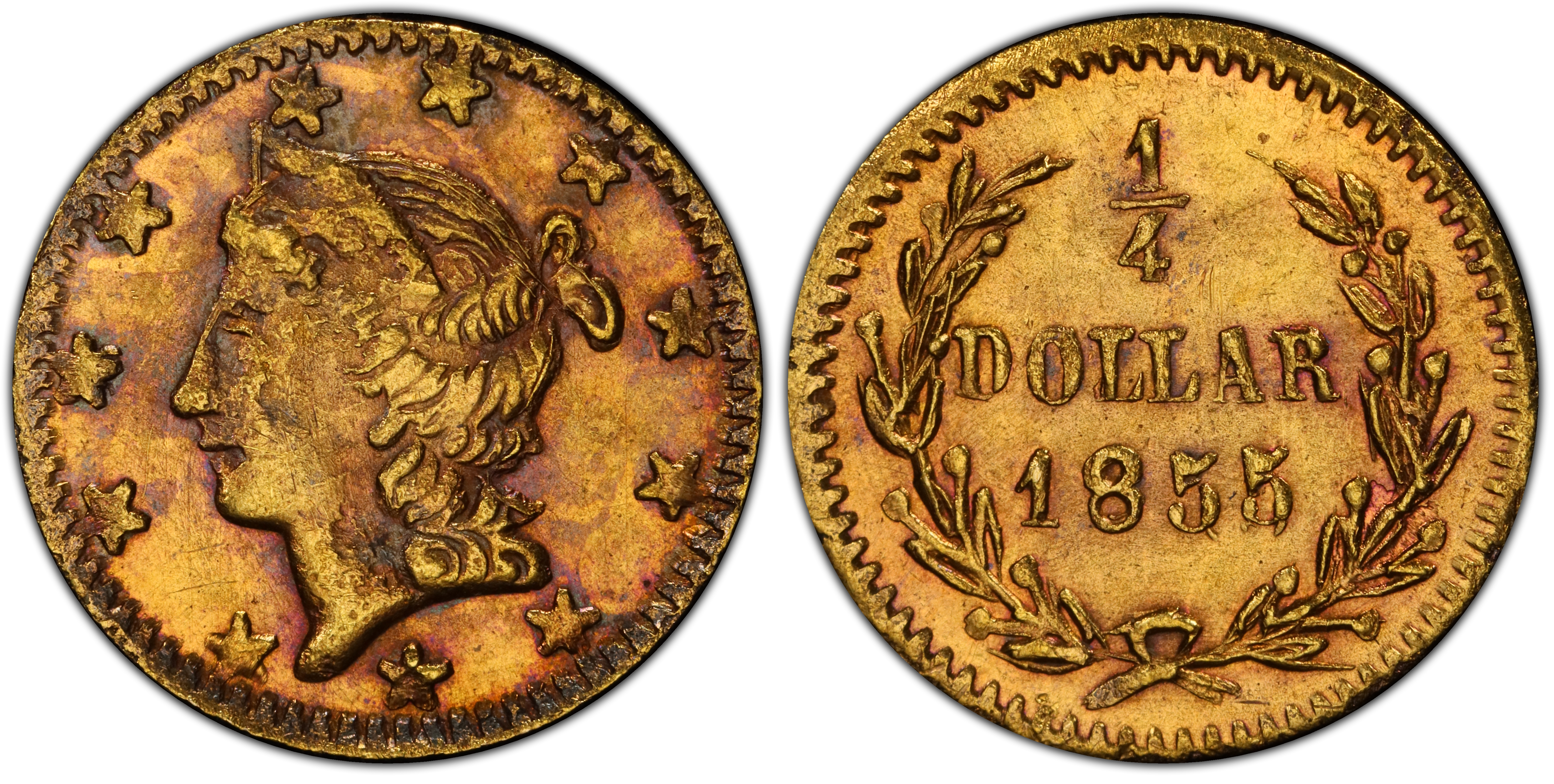
Obverse & Reverse
The 1855 BG-1302 is not a product of the California Gold Rush, but rather a numismatic echo from half a century later. Its story belongs to 'Period Three' of California Fractional Gold, a category of pieces struck privately long after the original need for them had vanished. The genuine 'Period One' issues, struck from 1852 to 1857, were a direct response to a severe shortage of small-denomination coinage in Gold Rush California. Before the San Francisco Mint began full-scale production in 1854-55, commerce was stifled, and jewelers and smiths like Antoine Louis Nouizillet and Frontier, Deviercy & Co. filled the void by minting their own tiny gold quarter dollars, half dollars, and dollars. These pieces, while often underweight, circulated out of necessity and are considered true territorial coins. By the late 1850s, an influx of federal coinage rendered them obsolete. The BG-1302, despite its 1855 date, is a copy of a genuine Period One coin, the BG-226. It was produced around 1906 by Herman Kroll, a New York-based maker of tokens and jewelry. Kroll acquired original dies or tooling and used them to strike backdated souvenir pieces for the burgeoning collector market. This was a common practice in the early 20th century, capitalizing on nostalgia for the 'Wild West' and the romance of the Gold Rush. These 'Kroll Hoard' pieces, as they came to be known, are distinct from their prototypes; they were never intended for circulation and were sold as curiosities. Numismatically, they represent a fascinating secondary market and an early form of replica production that has since become its own specialized collecting field. The BG-1302 is thus a token of remembrance, a piece made for collectors, whose story is not about the gritty reality of Gold Rush commerce, but about the creation of a collectible and the romantic memory of that era.
Associated EventPost-Gold Rush Nostalgia / Early 20th Century Coin Collecting
Reason For MintingTo create a collectible souvenir by copying a rare Gold Rush era coin for sale to the numismatic and tourist markets.
Minter HistoryHerman Kroll was a token and medal manufacturer active in New York City in the early 20th century. He is believed to have acquired original or slightly altered dies from the California Gold Rush period, which he used to produce a series of backdated 'restrikes' or copies. These pieces, often referred to as the 'Kroll Hoard,' are categorized as 'Period Three' California Fractional Gold. Unlike the original minters who were serving a commercial need, Kroll's operation was purely commercial in a different sense: catering to collectors and those interested in souvenirs of a bygone era. His productions are characterized by their backdating and sometimes by slight differences in planchet, composition, or strike quality compared to the originals.
Historical SignificanceThe BG-1302's significance lies not in its use during the Gold Rush, but in what it reveals about the development of the numismatic market. It is a tangible piece of evidence of the burgeoning collector demand for rare pioneer gold in the early 1900s. As a 'Period Three' issue, it highlights the practice of creating backdated copies for collectors, a phenomenon that complicates the study of the series but also adds a rich layer of history. It is a collectible in its own right, valued for its connection to Herman Kroll and its status as a vintage, numismatic-inspired token.
BG-1302
Denomination25 Cents
Minting Periodc. 1906-1910
Assayer/MinterHerman Kroll
Geographic OriginNew York, New York
Obverse DescriptionThe design copies the BG-226. It features a small, somewhat crude Liberty Head facing left, similar in style to the federal gold dollars of the period. The portrait is surrounded by thirteen five-pointed stars, representing the original colonies. The date '1855' is below the bust truncation.
Obverse Inscription1855
Reverse DescriptionA wreath of two branches tied with a bow at the bottom encircles the denomination. Within the wreath is '1/4 DOLLAR'. The legend 'CALIFORNIA GOLD' appears around the periphery, outside the wreath.
Reverse InscriptionCALIFORNIA GOLD 1/4 DOLLAR
CompositionGold
Stated Fineness Actual FinenessOften a lower fineness than Period One issues, sometimes as low as 14 karat.
Weight0.25 grams
Diameter9.50 mm
EdgePlain
Unknown
Survival EstimateExtremely Rare; Fewer than 10 believed to exist.
Rarity ScaleR-7 (NGC Census shows only 1 graded)
This coin appeals to specialists in California Fractional Gold, particularly those who focus on the intriguing and scarce 'Period Three' issues. Its extreme rarity in certified grade and its direct connection to the historical replica-maker Herman Kroll make it a significant prize for advanced collectors.
Key VarietiesThe BG-1302 is itself a variety, being a later-date issue or copy of the original Period One BG-226. There are no major varieties of the BG-1302 itself from its striking period. It is crucial for collectors to distinguish this Period Three striking from the original BG-226, which is a genuine 1855-dated territorial coin and much more valuable.
Authentication TipsAuthenticity is paramount. Genuine BG-1302s are very rare. Key diagnostics involve comparing the strike details to known genuine examples and to its BG-226 prototype. The fabric of the planchet, luster, and specific die markers (retained from or differing from the BG-226 dies) are critical. Most uncertified pieces offered as California Fractional Gold are modern fakes or souvenir tokens which often feature a bear on the reverse (a definitive sign of a replica) or lack a denomination like 'DOLLAR' or 'CENTS.' Professional authentication by a major third-party grading service is essential.
Shopping ConsiderationsGiven its rarity, any opportunity to purchase a BG-1302 is significant. A premium quality example would be one that is well-struck for the issue, as many Kroll pieces can be weakly impressed. Look for original, undisturbed surfaces with minimal marks. The single NGC-graded example is MS-61, setting the benchmark. Eye appeal is critical; a piece with pleasing original color and luster is far superior to a cleaned or overly marked specimen. Given that only one is professionally graded, any raw example should be viewed with extreme skepticism and purchased only from a highly reputable specialist dealer with a lifetime guarantee of authenticity.
A coin's grade is its condition, rated on a 1-70 scale. For rare coins, this is the most critical factor in determining value, as a tiny difference in preservation can mean a huge difference in price.
Relevant Grade TypesAll known examples of the BG-1302 are considered special collector issues, not business strikes intended for circulation. They are typically found and graded in Mint State (MS, 60-70) condition, as they were sold directly to collectors and not used in commerce. There are no known original-period Proofs (PR/PF) of this variety.
Mint State CharacteristicsAs a Kroll issue, the strike can be inconsistent. A high-quality Mint State example would exhibit a relatively sharp strike on the stars and Liberty's portrait details. The fields may show die polish lines or other minor imperfections inherent to the later-state use of the dies. Luster is typically satiny rather than frosty. Contact marks are common due to the softness of the gold and rudimentary handling at the time of manufacture, but a premium coin would have minimal and well-hidden marks.
Circulated Wear PatternsAs these were not made for circulation, circulated examples are virtually nonexistent and would likely be the result of post-minting mishandling (e.g., use as jewelry). If wear were to occur, it would first appear on the high points of Liberty's hair and cheek, and on the highest leaves and bow of the reverse wreath.
Key Factors For ValueFor the BG-1302, value is primarily driven by its extreme rarity. Beyond that, the key factors are authenticity and surface quality. A certified, problem-free example will command a massive premium. Any evidence of cleaning, tooling, or jewelry mounting would drastically reduce the value. Eye appeal, encompassing attractive original toning and a clean strike, is paramount. Given the population of one at NGC, a CAC sticker on that coin would add a significant premium, confirming its quality for the assigned grade.
PCGS Price Guide
| Grade | Price | Population |
|---|---|---|
| 61 | N/A | N/A |
| 62 | $800.00 | 1 |
| 62+ | $850.00 | N/A |
| 63 | $975.00 | 1 |