1872 G$1 BG-1120 (Regular Strike)
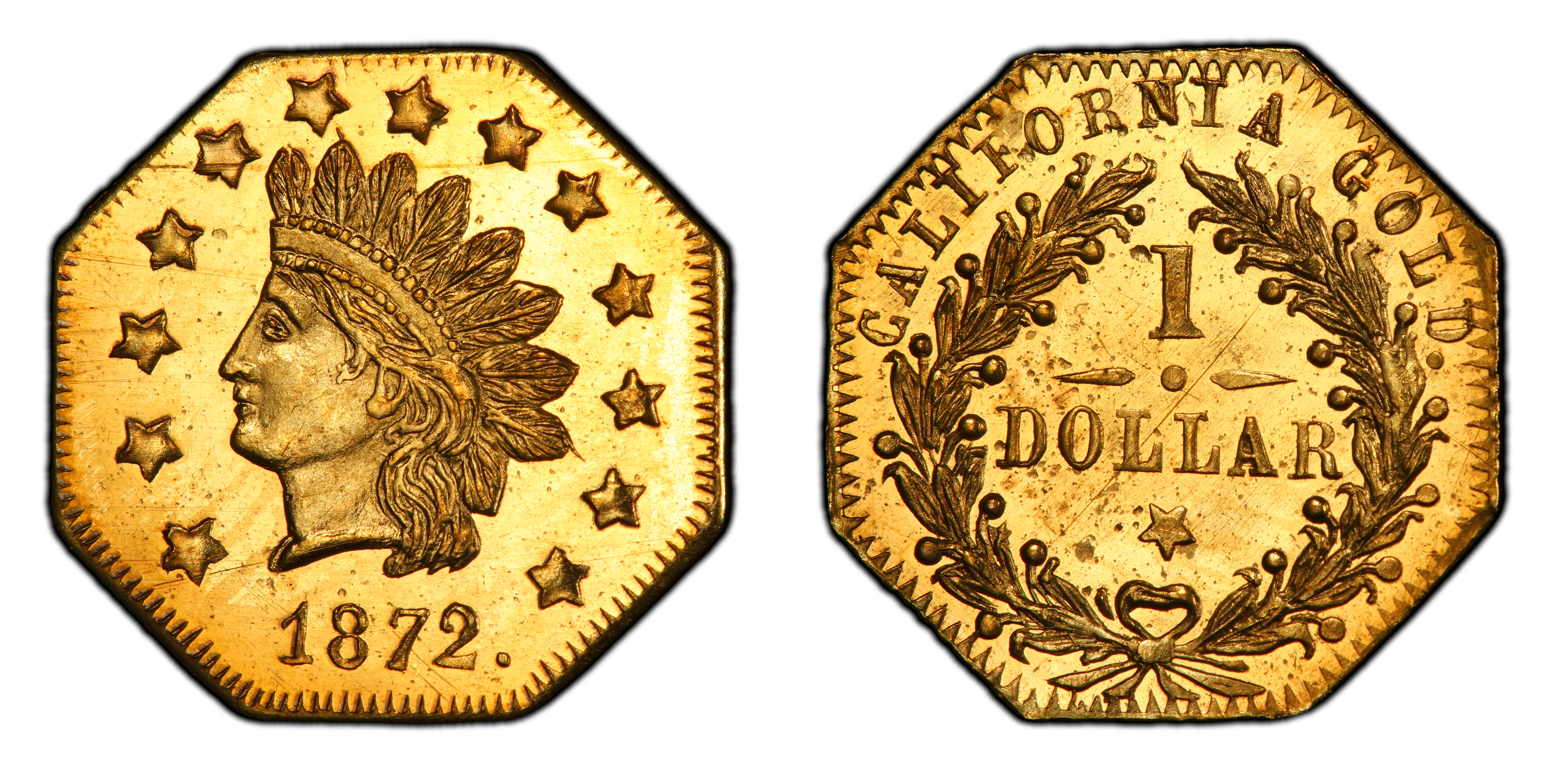
Obverse & Reverse
The 1872 G$1 BG-1120 is a quintessential example of a 'Period Two' California Fractional Gold piece, a fascinating and complex series born from the economic realities of the American West. Following the initial 1848 Gold Rush, California was awash in raw gold but critically short of small-denomination circulating coinage for daily transactions. The first fractional gold pieces, struck from 1852-1857 ('Period One'), were a genuine, albeit private, attempt to fill this void. However, by the late 1850s, the establishment of the San Francisco Mint and the influx of federal coinage had largely satisfied the region's commercial needs. The fractional gold pieces that continued to be produced entered a new phase, now known as 'Period Two' (1859-1882). These later issues, including the BG-1120, were no longer primarily intended to function as currency. Instead, they catered to a burgeoning souvenir and jewelry market. San Francisco, once a rugged outpost, was becoming a destination, and tourists and residents alike sought keepsakes of the Gold Rush era. Jewelers, many of them anonymous, stepped in to meet this demand by producing vast varieties of these miniature gold tokens. Unlike their Period One predecessors, which were struck to a relatively consistent (though still underweight) standard, Period Two pieces were notoriously light for their stated value and exhibited a wide variety of designs, from Liberty heads to Washington portraits to the Indian Head motif seen on this variety. The production process was often crude, utilizing the hammer-striking method where a top die was struck with a sledgehammer, leading to inconsistent strike quality even within the same variety. The Coinage Act of 1864 expressly forbade private coinage, but enforcement was lax in California for nearly two decades, allowing the 'jeweler's issues' to flourish. It wasn't until a crackdown by the Secret Service in the early 1880s that production of denominated pieces ceased, leading to 'Period Three' tokens that cleverly omitted any mention of a dollar value. The BG-1120, therefore, is not a coin in the federal sense, but a historical token that captures the transition of Gold Rush California from a frontier economy to a place of myth and memory, where the gold itself became a memento.
Associated EventCalifornia Gold Rush Aftermath
Reason For MintingPrimarily created to serve the souvenir and jewelry trade in a post-Gold Rush California that was romanticizing its recent past.
Minter HistoryThe specific minter of BG-1120 is unknown, which is characteristic of most 'Period Two' issues. They were produced by various manufacturing jewelers in San Francisco who created the pieces for sale as novelties. Research by Walter Breen and Ronald Gillio has identified some makers from this period, such as Robert B. Gray & Co., but the majority of dies, including those for BG-1120, remain unattributed to a specific hand, representing a cottage industry of anonymous artisans capitalizing on the legend of the Gold Rush.
Historical SignificanceThe BG-1120 and its contemporaries are significant numismatically as they represent a major transition in private coinage from utilitarian necessity to commercial novelty. They illustrate a period of weak federal enforcement of minting laws and highlight the romanticism that quickly enveloped the Gold Rush. For collectors, they form a vast and challenging field of study, offering a direct tangible link to the culture of 19th-century California.
BG-1120
DenominationG$1
Minting Period1872
Assayer/MinterUnknown San Francisco Jeweler
Geographic OriginSan Francisco, California
Obverse DescriptionFeatures a stylized female head facing left, intended to be a representation of an Indian princess. She wears a feathered headdress. The portrait is surrounded by 13 six-pointed stars, representing the original colonies. The date '1872' appears below the bust.
Obverse Inscription1872
Reverse DescriptionThe central device is the denomination '1' and the word 'DOLLAR' contained within a continuous wreath of leaves and berries. The wreath is open at the top.
Reverse Inscription1 DOLLAR
CompositionGold
Stated Fineness Actual FinenessVariable, but typically lower than federal coinage of the era, often around 14 to 21 karats.
EdgePlain
Unknown
Survival EstimateFewer than 75 believed to exist. The combined NGC and PCGS population reports show approximately 20-30 graded examples.
Rarity ScaleR-6 (13-30 known)
This variety is highly sought after due to its classic Indian Head design, octagonal shape, and high rarity. It appeals to specialists in California fractionals, territorial gold collectors, and those who appreciate the charm and history of these miniature gold pieces. The challenge of acquiring a high-grade, problem-free example adds to its allure.
Key VarietiesThe BG-1120 is a specific die marriage and is considered a 'regular strike' for the period. There are no known major varieties from 1872 for this specific BG number. No proof or presentation strikings are known or believed to exist for this variety; all were produced as business strikes, though often with prooflike surfaces due to the striking process.
Authentication TipsGenuine examples have a specific die marker: the '2' in the date is typically very close to, or almost touching, the bust truncation. The stars are often crudely formed and may show weakness. Counterfeits are common in this series; many are modern replicas with a brassy appearance and mushy details. Others are contemporary counterfeits that may be gold-plated. Genuine pieces have a distinct 'feel' and luster from true gold content. Weight and specific gravity tests can be useful, but comparison with certified examples is the best authentication method.
Shopping ConsiderationsA premium quality BG-1120 is defined by a sharp, well-centered strike, which is uncommon for the issue. Look for crispness in the headdress feathers and the details within the wreath on the reverse. The surfaces are critical; many surviving examples have been cleaned, damaged, or used as jewelry. A coin with original, lustrous surfaces commands a significant premium. Prooflike (PL) or Deep Mirror Prooflike (DMPL) examples are especially prized and often designated by grading services. Avoid specimens with significant planchet flaws, harsh cleaning, scratches, or evidence of having been mounted.
A coin's grade is its condition, rated on a 1-70 scale. For rare coins, this is the most critical factor in determining value, as a tiny difference in preservation can mean a huge difference in price.
Relevant Grade TypesAll original examples of BG-1120 were struck as business strikes, intended for sale as souvenirs. They are found in Circulated grades (AU-58 and below) and, more commonly for this souvenir-focused issue, in Mint State (MS, 60-70) grades. No true Proofs were struck during the original period of issue. The highly reflective fields sometimes seen are a byproduct of polished dies and the striking process on small gold planchets, resulting in Prooflike (PL) or Deep Mirror Prooflike (DMPL) business strikes, not a separate class of coin.
Mint State CharacteristicsUncirculated examples often exhibit surprisingly reflective, prooflike fields due to the way they were struck. The quality of the strike is a key determinant of grade; many are weakly struck, particularly on the highest points like the details of the feathers and the center of the wreath. Luster is typically bright and flashy rather than soft and satiny. Small planchet flaws or adjustment marks are not uncommon and should be evaluated for their impact on eye appeal. Contact marks, even small ones, can be distracting on the mirrored fields and will limit the grade.
Circulated Wear PatternsOn circulated examples, wear first appears on the high points of the design. For the obverse, this includes the cheek, the eyebrow, and the details of the feathers in the headdress. On the reverse, the highest points of the leaves and berries in the wreath will show flatness and loss of detail first. In lower grades (VF and below), the stars on the obverse and the letters in 'DOLLAR' will begin to weaken and merge with the fields.
Key Factors For ValueFor the BG-1120, the primary value drivers are grade and surface quality. A sharply struck coin with clean, original, and highly reflective fields will command a substantial premium over a weakly struck or impaired example of the same numerical grade. Eye appeal is paramount. Coins with attractive, original reddish-gold toning are highly desirable. A CAC sticker, indicating premium quality for the grade, adds significant value and is particularly sought after for this series, as it helps buyers navigate the wide range of quality seen on these challenging jeweler's issues.
PCGS Price Guide
| Grade | Price | Population |
|---|---|---|
| 53 | $900.00 | 1 |
| 53+ | $925.00 | N/A |
| 55 | $975.00 | N/A |
| 55+ | $1,025.00 | N/A |
| 58 | $1,175.00 | 6 |
| 58+ | $1,275.00 | N/A |
| 60 | $1,400.00 | N/A |
| 61 | $1,500.00 | 5 |
| 62 | $1,750.00 | 9 |
| 62+ | $1,900.00 | N/A |
| 63 | $2,500.00 | 10 |
| 63+ | $2,850.00 | N/A |
| 64 | $3,750.00 | 11 |
| 64+ | $4,000.00 | N/A |
| 65 | $4,250.00 | 2 |
| 65+ | $5,250.00 | N/A |
| 66 | $6,300.00 | 2 |