1876/5 G50C BG-1059 (Regular Strike)
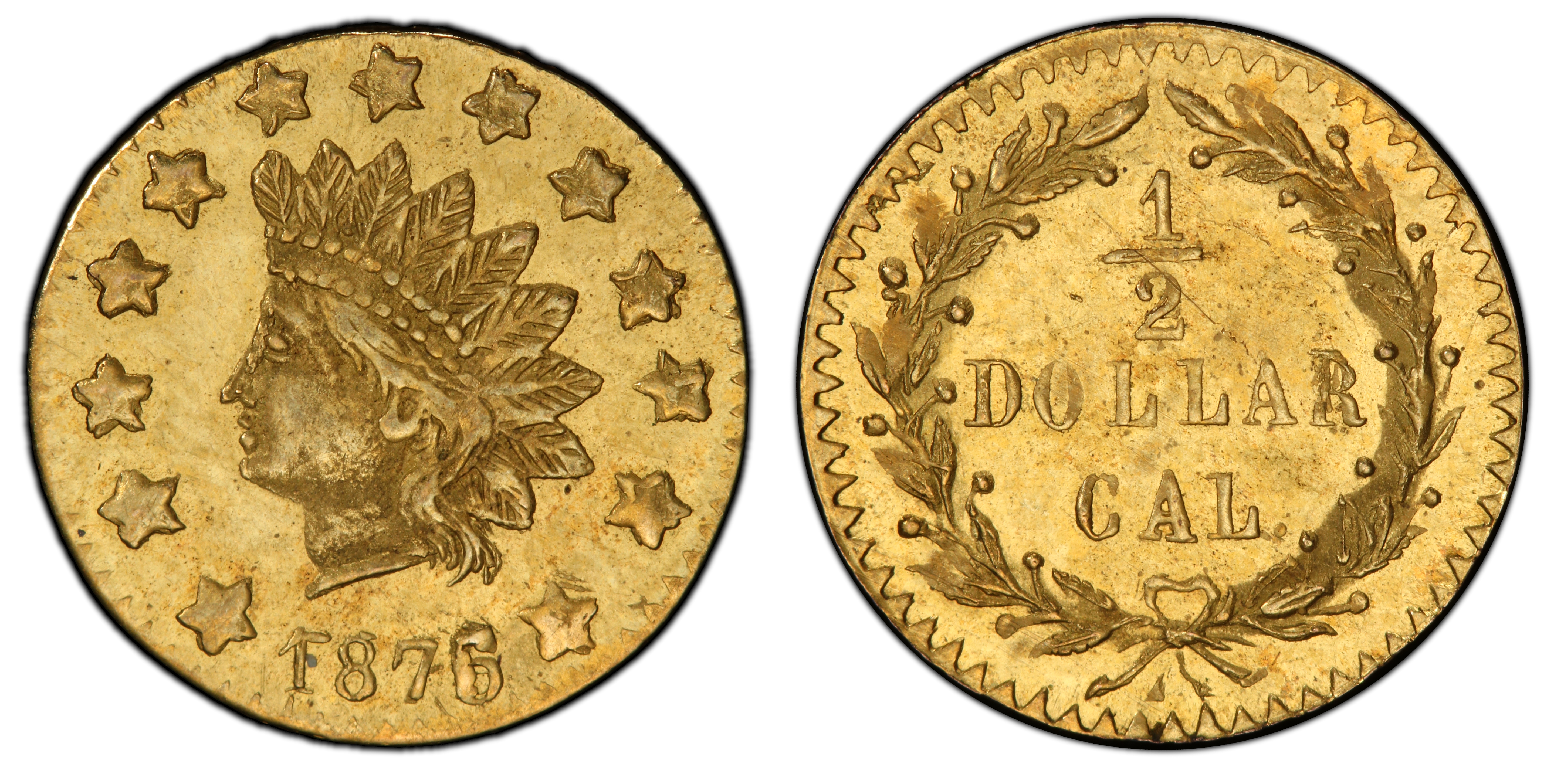
Obverse & Reverse
The 1876/5 50 Cents, cataloged as Breen-Gillio 1059, is a quintessential example of a 'Period Two' California Fractional Gold piece. By the mid-1870s, the original impetus for these tiny gold coins—a severe shortage of small change during the Gold Rush—had long vanished. The establishment and robust output of the San Francisco Mint had saturated the region with official federal coinage. Consequently, the production of fractional gold transitioned from a necessity of commerce to a souvenir and jewelry trade. These later issues, often termed 'jeweler's pieces,' were struck not to facilitate transactions but to be sold as keepsakes and mementos of the romanticized Gold Rush era for tourists and Easterners. Their intrinsic value was typically far below their face value, rendering them a form of token coinage. This specific variety is notable for its dramatic historical context. Its minter, Christopher Ferdinand Mohrig, was a San Francisco jeweler who actively produced these popular gold tokens. However, 1876 marked the end of his enterprise. The United States Secret Service, under the direction of its determined chief James J. Brooks, began to crack down on the production of private coinage, which technically violated the Coinage Act of 1864. Mohrig was arrested on August 10, 1876, and his inventory of coins and minting equipment was confiscated and subsequently destroyed. This seizure explains the relative scarcity of many Mohrig issues, including BG-1059. The 1876/5 overdate itself is a fascinating clue into the production process, showing a die from the previous year being crudely altered for use in America's centennial year, likely as a cost-saving measure for what was a low-margin souvenir business. These pieces are not just numismatic curiosities but tangible artifacts from the final, 'suppressed' chapter of America's private gold coinage history.
Associated EventPost-Gold Rush Souvenir Trade
Reason For MintingPrimarily struck for sale as souvenirs and jewelry, not for general circulation, during a period of rising tourism and nostalgia for the Gold Rush.
Minter HistoryChristopher Ferdinand Mohrig was a San Francisco-based jeweler and one of the more prolific producers of 'Period Two' California Fractional Gold. He is credited with a range of varieties cataloged from BG-790 through BG-1129. His work is characteristic of the later souvenir issues: often underweight, of variable fineness, and sometimes exhibiting crude die work. His numismatic legacy is inextricably linked to his enforcement troubles. His arrest by the Secret Service in August 1876 and the subsequent destruction of his dies and stock mark a pivotal moment in the federal government's suppression of private coinage, effectively ending his production.
Historical SignificanceThis coin represents the final phase of privately issued gold coinage in the United States. Its creation as a souvenir, its clear overdate, and its direct connection to the 1876 Secret Service crackdown on private minters make it a historically significant artifact of post-Gold Rush California and evolving federal monetary authority.
N/A
DenominationG50C (50 Cents)
Minting Period1876
Assayer/MinterChristopher Ferdinand Mohrig
Geographic OriginSan Francisco, California
Obverse DescriptionA small, somewhat crude bust of an Indian princess facing left. The portrait wears a feathered headdress. The field is surrounded by thirteen five-pointed stars, seven to the left and six to the right. The date, 1876, is below the bust, with the 6 clearly punched over a 5.
Obverse Inscription1876/5
Reverse DescriptionThe reverse features a simple wreath composed of two branches tied together at the bottom with a bow. Inside the wreath, the denomination is expressed on two lines, '50' and 'CENTS'.
Reverse Inscription50 CENTS
CompositionGold
Stated Fineness Actual FinenessPeriod Two issues are known to be of inconsistent and often debased fineness, typically ranging from 14 to 22 karats (.583 to .917 fine), which was substantially less than their face value suggested.
Diameter11.90 mm
EdgePlain
Unknown
Survival Estimate100-150
Rarity ScaleR-4
The BG-1059 is highly sought after for several reasons: it has a clear and dramatic 1876/5 overdate, it is tied to the historically important arrest of its minter C.F. Mohrig during the Centennial year, and it represents the fascinating 'suppressed jewelers' issue' period of fractional gold.
Key VarietiesThe primary variety is the 1876/5 overdate, which defines the BG-1059 attribution. No major die varieties from the original minting period are known. Importantly, no true Proofs of this issue were struck. However, some examples are found with Proof-like (PL) or Deep Proof-like (DPL) surfaces, a result of being struck with polished dies to enhance their appeal as souvenirs. These are not separate collector issues or restrikes but are prized for their exceptional eye appeal.
Authentication TipsThe key diagnostic is the overdate: the 6 in the date is clearly struck over a 5, and the undertype is often visible with magnification. Auction records note the alteration was 'crudely altered by hand from a 5, as made.' Genuine pieces exhibit the characteristic fabric of Period Two fractionals: often a slightly uneven strike and a planchet that is thinner than earlier issues. Be wary of modern replicas which often have a soapy, cast-like appearance, incorrect weight, or design details that do not match known genuine examples.
Shopping ConsiderationsA premium quality example for its grade will show a bold strike, especially on the details of the headdress and the digits of the date. Given their purpose as souvenirs, many high-grade examples exist, but they are often marred by handling, cleaning, or use in jewelry. Look for specimens with original, undisturbed luster, which often has a bright, slightly brassy-gold color. Avoid coins that are bent, show evidence of being mounted in bezels, or have been harshly cleaned, as this severely impacts value. The visibility and clarity of the '6 over 5' overdate is a key value driver; a bold overdate commands a significant premium.
A coin's grade is its condition, rated on a 1-70 scale. For rare coins, this is the most critical factor in determining value, as a tiny difference in preservation can mean a huge difference in price.
Relevant Grade TypesOriginal period issues were business strikes, although intended as souvenirs rather than for circulation. They are found in Circulated (1-58) grades, though this is less common, and are most often encountered in Mint State (MS, 60-70) grades. No true Proof (PR/PF) examples were struck during the original period of issue. The existence of Proof-like (PL) and Deep Proof-like (DPL) specimens is due to the use of polished dies by the minter to increase their souvenir appeal, but these are not a separate striking category like official U.S. Mint Proofs.
Mint State CharacteristicsUncirculated examples of BG-1059 typically display a bright, flashy luster, a result of the polished dies used for these souvenir pieces. The strike can be inconsistent; while some are sharp, many show weakness in the center of the reverse on the denomination or on the high points of the Indian's hair and feathers. The fields are prone to minute handling marks and die polishing lines. A superior Mint State example will have minimal distracting marks, strong luster, and a relatively sharp strike for the issue.
Circulated Wear PatternsOn circulated examples, wear first appears on the highest points of the design. For the obverse, this includes the cheek of the Indian princess and the highest feathers in the headdress. On the reverse, the digits '50' and the leaves and bow of the wreath will show initial friction and flattening. In lower grades (VF and below), the stars on the obverse will begin to lose their points and the legend on the reverse will become soft.
Key Factors For ValueThe primary value drivers for this coin are grade, surface quality, and the prominence of the overdate. A sharply struck coin with clean, original surfaces and flashy luster will command a significant premium. Examples designated as PL or DPL by grading services are especially prized. The strength and clarity of the 1876/5 overdate is a critical factor; a bold and easily discernible overdate makes an example far more desirable. As with most classic U.S. coins, a CAC sticker indicating premium quality for the grade will add a substantial premium.
PCGS Price Guide
| Grade | Price | Population |
|---|---|---|
| 40 | $175.00 | 1 |
| 45 | $180.00 | N/A |
| 45+ | $185.00 | N/A |
| 50 | $190.00 | 1 |
| 50+ | $210.00 | N/A |
| 53 | $220.00 | 1 |
| 53+ | $230.00 | N/A |
| 55 | $250.00 | 9 |
| 55+ | $285.00 | N/A |
| 58 | $325.00 | 22 |
| 58+ | $350.00 | N/A |
| 60 | $375.00 | 3 |
| 61 | $400.00 | 14 |
| 62 | $500.00 | 32 |
| 62+ | $575.00 | N/A |
| 63 | $650.00 | 21 |
| 63+ | $775.00 | N/A |
| 64 | $1,000.00 | 7 |
| 64+ | $1,175.00 | N/A |
| 65 | $1,375.00 | 2 |
| 65+ | $1,750.00 | N/A |
| 66 | $3,500.00 | 1 |