1874 G50C BG-1053 (Regular Strike)
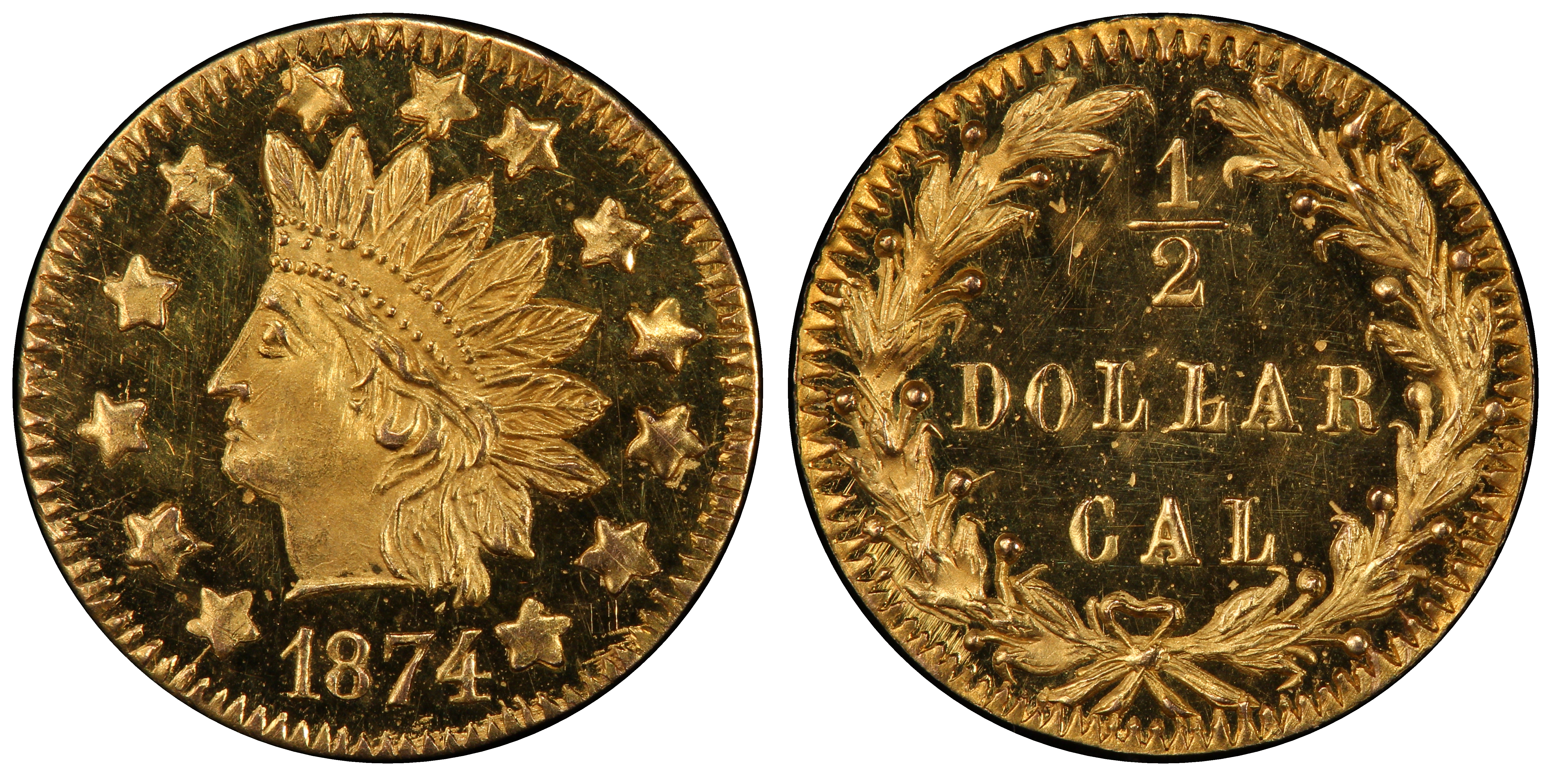
Obverse & Reverse
The 1874 G50C BG-1053 is a quintessential example of a 'Period Two' California Fractional Gold piece. The story of these fascinating miniature coins begins with the California Gold Rush. The massive influx of population after 1848 created a bustling economy that was paradoxically starved for circulating coinage. With gold dust plentiful but impractical for small transactions, and the output of the new San Francisco Mint (est. 1854) initially insufficient to saturate commerce with small change, a void emerged. Private minters and jewelers stepped in, beginning in 1852, to produce fractional gold coins in 25C, 50C, and $1 denominations. These 'Period One' (1852-1857) issues were genuinely intended to and did circulate as currency, albeit often with a gold content below their face value. By the late 1850s, however, the United States Mint was producing enough official coinage to meet California's needs, rendering the private issues obsolete for commerce. Instead of disappearing, they found a new purpose. Jewelers in San Francisco recognized a burgeoning market for these tiny gold pieces as souvenirs and keepsakes for tourists and as charms for jewelry. This marked the beginning of 'Period Two' (1858-1882), a prolific era during which hundreds of varieties were struck not for the cash drawer, but for the curio cabinet. The BG-1053, dated 1874, falls squarely into this category. Struck two decades after the initial frenzy, these pieces were part of a sophisticated souvenir trade. The Coinage Act of 1864 had made private coinage illegal, but the law was not strictly enforced against these small, low-value tokens until the Secret Service cracked down in the early 1880s. Until then, jewelers continued production, often using artistic license with designs, such as the popular Indian Head motif seen here, which capitalized on romantic notions of the American West. These pieces were typically struck on very thin planchets of varying fineness and often on polished dies to enhance their eye appeal, leading many to survive in high grades with proof-like surfaces.
Associated EventCalifornia Gold Rush (Later Souvenir Period)
Reason For MintingPrimarily struck for sale as souvenirs, jewelry charms, and curiosities for the tourist trade, not for monetary circulation.
Minter HistoryThe specific minter of the BG-1053 variety is not definitively known, a common trait for many Period Two issues. The dies were produced by various San Francisco-based jewelers and craftsmen. Prominent makers of fractional gold during this era included figures like Robert B. Gray & Co. While no specific maker's mark is present on BG-1053, its style is consistent with the work of these anonymous but skilled artisans who catered to the significant souvenir market in post-Gold Rush San Francisco. These minters operated in a legally grey area, technically violating the 1864 Coinage Act but largely ignored by authorities until the early 1880s.
Historical SignificanceThe BG-1053 represents the evolution of private California coinage from a necessary medium of exchange to a commercial souvenir. It is a tangible artifact of California's burgeoning tourism industry in the 1870s and the romantic mythology that had already grown around the Gold Rush. Numismatically, Period Two issues are significant for their vast variety and artistic designs, which were untethered from the need to mimic official U.S. coinage.
N/A
Denomination50 Cents
Minting Period1874
Assayer/MinterUnknown Private Minter
Geographic OriginSan Francisco, California
Obverse DescriptionThe obverse features a small, stylized portrait of a Native American (Indian Head) facing left, adorned with a feathered headdress. The portrait is encircled by thirteen stars representing the original colonies. The date, 1874, is positioned below the bust.
Obverse Inscription1874
Reverse DescriptionThe reverse is dominated by a wreath composed of two olive branches, open at the top and tied with a bow at the bottom. Within the wreath, the denomination is expressed on two lines as '1/2' and 'DOLLAR'.
Reverse Inscription1/2 DOLLAR
CompositionGold
Stated Fineness Actual FinenessVaries, typically between 14 and 22 karats for Period Two issues.
Weight0.25 grams
Diameter10.50 mm
EdgePlain
Unknown
Survival Estimate76-200 (Consistent with R-5 rating)
Rarity ScaleR-5
This variety appeals to collectors due to its direct connection to the romantic era of the American West, its miniature size, and classic Indian Head design. As a Period Two issue, examples are often found in high grades, allowing collectors to acquire a pristine-looking artifact from the 1870s at a more accessible price point than the rarer, circulated Period One issues.
Key VarietiesThe primary variety for this issue is the regular business strike. A significant sub-variety recognized by grading services is the 'Proof-Like' (PL) or 'Deep Proof-Like' (DPL) designation. These are not true proofs but were struck using highly polished dies on polished planchets to increase their appeal as souvenirs. No later-date restrikes are known for this specific BG number.
Authentication TipsAuthentic Period Two fractionals like BG-1053 must be denominated ('DOLLAR' or 'CENTS' or an abbreviation). Be wary of pieces that say 'CAL GOLD' in place of a denomination, or which feature a bear on the reverse, as these are hallmarks of modern replicas. Genuine pieces are typically very thin, often the thickness of one or two business cards, and may show weakness in the strike due to being manually hammer-struck. Counterfeits are often thicker, have a soapy or cast-like appearance, and incorrect design details. Comparing a potential purchase to high-resolution images of certified examples is crucial.
Shopping ConsiderationsA premium quality example of BG-1053 is defined by a sharp strike, particularly on the details of the headdress and the lettering on the reverse. Given their souvenir nature, many were struck on polished planchets; seek out examples with bright, reflective fields and minimal contact marks. Avoid coins that have been harshly cleaned, which dulls the luster and imparts hairline scratches. Also, check carefully for any evidence of having been mounted in jewelry, such as solder marks or tooling on the rims. A specimen with original, reddish-gold toning and strong eye appeal will command a significant premium. Proof-Like (PL) or Deep Proof-Like (DPL) examples are highly desirable and carry a premium over standard strikes.
A coin's grade is its condition, rated on a 1-70 scale. For rare coins, this is the most critical factor in determining value, as a tiny difference in preservation can mean a huge difference in price.
Relevant Grade TypesOriginal 1874 BG-1053 issues were business strikes (MS) intended for sale as souvenirs, not for circulation. While a few may have entered circulation and would be found in Circulated grades (1-58), the vast majority survive in Mint State (MS, 60-70). No true Proofs (PR/PF) were struck during the original period of issue. However, many were struck on highly polished dies and planchets to enhance their visual appeal, earning a Proof-Like (PL) or Deep Proof-Like (DPL) designation from grading services. These are considered a special category within the business strike issuance.
Mint State CharacteristicsUncirculated examples are characterized by their luster, which can range from soft and satiny to deeply reflective (Proof-Like). Strike quality varies; look for sharpness in the feathers of the headdress and the numerals of the date. Due to the manual striking process, some inherent weakness may be present and is not always a flaw. The most desirable MS examples have clean, mark-free fields and strong eye appeal.
Circulated Wear PatternsOn circulated examples, wear will first appear on the highest points of the design. For the obverse, this is the cheek of the Indian and the feathers at the top of the headdress. On the reverse, the highest points of the wreath's leaves and the numerals '1/2' will show the first signs of friction and flattening. In lower grades, the stars and legends will begin to merge with the fields.
Key Factors For ValueThe primary value driver for this coin is its grade and surface quality. A high-grade Mint State coin (e.g., MS-64 or higher) is worth substantially more than a circulated or low-grade uncirculated example. The presence of a Proof-Like (PL) or Deep Proof-Like (DPL) designation adds a significant premium. Eye appeal is critical; coins with clean, original surfaces and attractive toning are prized above those that are spotted, darkly toned, or have been cleaned. A CAC sticker indicating premium quality for the grade will also add a strong premium.
PCGS Price Guide
| Grade | Price | Population |
|---|---|---|
| 55 | $310.00 | 1 |
| 55+ | $325.00 | N/A |
| 58 | $350.00 | 5 |
| 58+ | $375.00 | N/A |
| 60 | $400.00 | N/A |
| 61 | $450.00 | N/A |
| 62 | $500.00 | 5 |
| 62+ | $625.00 | N/A |
| 63 | $850.00 | 9 |
| 63+ | $900.00 | N/A |
| 64 | $975.00 | 5 |
| 64+ | $1,200.00 | N/A |
| 65 | $2,750.00 | 2 |
| 65+ | $3,150.00 | N/A |
| 66 | $3,750.00 | 1 |
| 67 | N/A | N/A |