1876 G50C BG-1063 (Regular Strike)
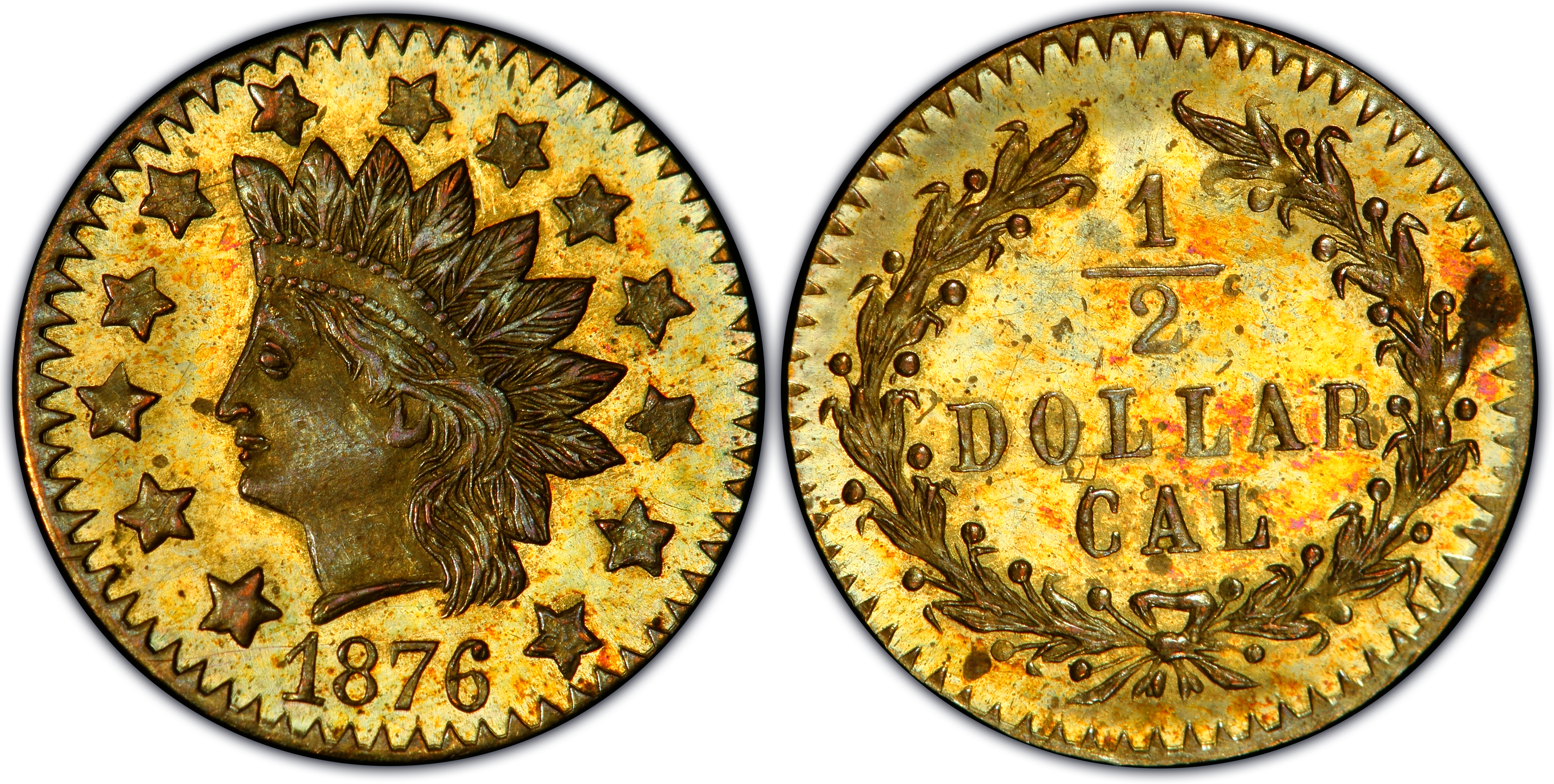
Obverse & Reverse
The 1876 G50C BG-1063 is a product of the second and most prolific period of California Fractional Gold production (1859-1882), often termed the 'Jeweler's Issue' era. The initial wave of fractional gold (1852-1856) arose from a genuine necessity for small-denomination coinage during the chaotic height of the Gold Rush, where gold dust was an impractical medium for daily transactions. By the late 1850s, the San Francisco Mint was producing enough federal silver and gold coinage to alleviate this shortage. The rationale for private gold coinage thus shifted dramatically. Enterprising jewelers in San Francisco, many of French origin, recognized a burgeoning market for gold souvenirs and keepsakes. Tourists, businessmen, and locals alike were captivated by the romance of the Gold Rush, and these miniature gold 'coins' served as perfect mementos. These pieces were not intended to circulate as money, a fact reflected in their often-low intrinsic gold value relative to their face value. Their production was a commercial enterprise aimed at the numismatic and tourist trades. The Coinage Act of 1864 explicitly forbade private coinage, creating a legal gray area for these manufacturers. To circumvent the law, they often omitted the word 'DOLLAR' or 'CENTS,' or, as is common with many later issues, used back-dated dies to suggest they were pre-1864 products. The BG-1063, dated 1876, is a classic example of this period's output. It was produced in an era when the Centennial Exposition in Philadelphia was fueling a nationwide interest in American history and souvenirs, a sentiment that producers of California Fractional Gold capitalized upon. These pieces represent the commercial evolution of a pioneer necessity into a nostalgic commodity.
Associated EventPost-Gold Rush California Souvenir Market
Reason For MintingTo be sold as souvenirs, keepsakes, and curiosities to tourists and collectors, capitalizing on the legacy of the California Gold Rush.
Minter HistoryThe specific minter for BG-1063 is not definitively known, as was common for this period to avoid legal scrutiny. However, stylistic analysis and die characteristics link it to the extensive operations of Robert B. Gray & Co. of San Francisco. This firm was a successor to earlier partnerships involving French jewelers, such as Frontier, Deviercy & Co., who were pioneers of the 'jeweler's issue' period. These minters were skilled artisans, capable of producing intricate dies for these tiny pieces. Their business model focused on producing a wide variety of designs with frequently changing dates to appeal to the collector market. They operated more as manufacturing jewelers than as true private minters in the style of the earlier Period One assayers.
Historical SignificanceThe historical significance of BG-1063 and its contemporaries lies in its representation of the commercialization of the Gold Rush legend. It marks the transition of private coinage from a functional monetary instrument to a collectible souvenir. These 'suppressed jeweler's issues' are a fascinating chapter in numismatic history, existing at the intersection of private enterprise, legal prohibition, and the enduring allure of gold. They are tangible artifacts of California's burgeoning tourism industry and the national romanticism surrounding the 'Wild West' in the late 19th century.
BG-1063
Denomination50 Cents
Minting Periodc. 1871-1882 (with dated 1876)
Assayer/MinterLikely Robert B. Gray & Co. (successors to Frontier, Deviercy & Co.)
Geographic OriginSan Francisco, California
Obverse DescriptionA female head facing left, often identified as an 'Indian Princess' design. She wears a feathered headdress. The portrait is surrounded by thirteen five-pointed stars, seven to the left and six to the right.
Obverse Inscription1876
Reverse DescriptionThe denomination '1/2' is centrally located within an olive wreath. The wreath is composed of two branches tied together at the bottom with a ribbon.
Reverse Inscription1/2
CompositionGold
Stated Fineness Actual FinenessVariable, typically between .300 and .500 fine gold, significantly below the standard for federal coinage.
Weight0.25 grams
Diameter10.00 mm
EdgePlain
Unknown
Survival EstimateFewer than 75 believed to exist
Rarity ScaleR-6 (Very Scarce: 31-75 known)
This variety is highly sought after due to its attractive 'Indian Head' design, its status as a dated issue from the Centennial year, and its relative scarcity (R-6). It appeals to collectors of California Fractional Gold, territorial issues, and those fascinated by the post-Gold Rush era. The miniature size and intricate detail make it a classic example of the popular 'Cal Gold' series.
Key VarietiesThe primary variety is the Regular Strike business issue (BG-1063). No original-period proof strikings are known or believed to exist. However, collectors must be aware of the distinction between Period Two (1859-1882) jeweler's issues like this one and the controversial, back-dated 'Period Three' pieces made primarily by New York jeweler Herman Kroll in the early 20th century. Furthermore, some dies from these later periods were used to create modern restrikes in the mid-20th century. Original BG-1063s are exclusively from the 1871-1882 period.
Authentication TipsAuthentic examples exhibit a specific strike character. The planchets were often thin and the strikes slightly weak in areas. Look for known die markers and clash marks characteristic of the BG-1063 dies. The luster on originals should be satiny or semi-prooflike, not the hard, glassy mirrored fields of modern copies. The color of the gold is often a lighter, brassy yellow due to the low fineness. Counterfeits may have incorrect details in the feathers or wreath, incorrect weight, or exhibit a casting texture (small pits or bubbles) under magnification. Comparison with high-resolution images of certified examples is essential.
Shopping ConsiderationsA premium quality example for this issue is defined by a sharp, well-centered strike, particularly on the high points of the headdress feathers and the details of the wreath. Many examples are weakly struck, so a bold strike commands a significant premium. Original, lustrous surfaces are highly desirable; many have been cleaned or polished over the years, which drastically reduces value. Look for coins with minimal and scattered contact marks. The presence of die clashing on the reverse is common for this variety and is not considered a detriment. Avoid examples with evidence of tooling, harsh cleaning, or repairs. A coin certified by a major grading service (PCGS or NGC) is strongly recommended for this series due to the prevalence of counterfeits and imitations.
A coin's grade is its condition, rated on a 1-70 scale. For rare coins, this is the most critical factor in determining value, as a tiny difference in preservation can mean a huge difference in price.
Relevant Grade TypesOriginal period issues of BG-1063 were business strikes intended for sale as souvenirs, not circulation. Therefore, they are typically found in Circulated (1-58) and, more commonly, Mint State (MS, 60-70) grades. No Proof (PR/PF) examples were struck during the original manufacturing period. Any piece described as a 'Proof' is likely a modern restrike or imitation and should not be confused with these original issues.
Mint State CharacteristicsUncirculated examples of BG-1063 often display a soft, satiny luster, though some can be semi-prooflike with reflective fields. The strike is a key determinant of quality; many are softly struck, especially on the stars and wreath. A sharp, fully detailed strike is rare and highly valued. Due to the manufacturing process, it is common to see minor planchet flaws or faint die polish lines, which are not necessarily considered grade-limiting if they are not distracting. Small, non-distracting contact marks are typical.
Circulated Wear PatternsAlthough most examples are uncirculated, any wear would first appear on the highest points of the design. On the obverse, this would be the cheek and the upper feathers of the headdress. On the reverse, the high points of the wreath leaves and the bow of the ribbon would show the first signs of friction. In lower grades, the finer details of the feathers would merge and the legends would become soft.
Key Factors For ValueThe primary drivers of value for an 1876 G50C BG-1063 are grade and surface quality. A sharply struck coin with clean, original, lustrous surfaces will command a much higher price than a weakly struck or cleaned example of the same grade. Eye appeal is paramount; coins with a pleasing, original golden color are preferred. Certification by PCGS or NGC is nearly mandatory for establishing market value and authenticity. A CAC sticker on a certified coin indicates premium quality for the grade and often results in a significant price premium.
PCGS Price Guide
| Grade | Price | Population |
|---|---|---|
| 55 | $400.00 | 2 |
| 55+ | $410.00 | N/A |
| 58 | $425.00 | 3 |
| 58+ | $435.00 | N/A |
| 60 | $450.00 | N/A |
| 61 | $475.00 | 1 |
| 62 | $500.00 | 4 |
| 62+ | $575.00 | N/A |
| 63 | $750.00 | 5 |
| 63+ | $900.00 | N/A |
| 64 | $1,250.00 | 5 |
| 64+ | $1,500.00 | N/A |
| 65 | $2,250.00 | 1 |