1881 G50C BG-1070 (Regular Strike)
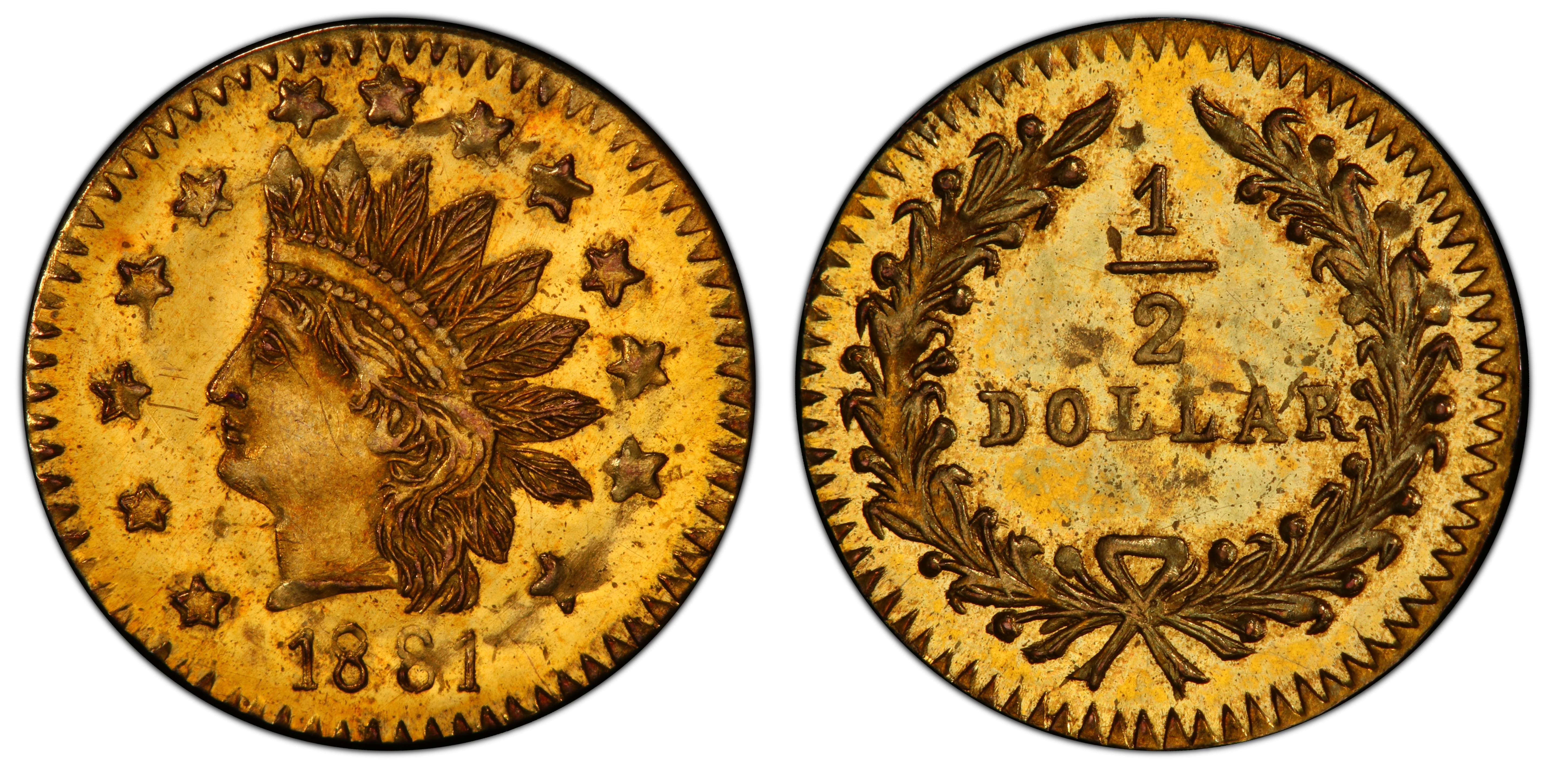
Obverse & Reverse
The 1881 BG-1070 50 Cents is a quintessential example of a 'Period Two' California Fractional Gold piece, a fascinating and complex series born from the aftermath of the California Gold Rush. The initial wave of fractional gold (Period One, 1852-1856) was struck out of a genuine commercial need to supplement the lack of small change in the gold fields. However, by the late 1850s, the San Francisco Mint was producing sufficient federal coinage, rendering the private issues largely obsolete for circulation. Production ceased, only to resume unexpectedly in 1859, ushering in Period Two (1859-1882). This new generation of fractional gold served a different purpose. San Francisco had transformed from a chaotic boomtown into a burgeoning metropolis and a popular tourist destination. Enterprising jewelers and minting firms, many of whom remain anonymous, recognized a lucrative market for gold souvenirs. These small-denomination gold pieces were novel, easily transportable mementos of the Gold Rush era. The BG-1070, dated 1881, was struck near the end of this period. Unlike their Period One predecessors, these 'jeweler's issues' were not intended to meet a specific weight or fineness standard and were almost always intrinsically worth less than their face value. Their creation was a commercial venture, catering to tourists and collectors. This era was also marked by increasing pressure from the federal government. The U.S. Secret Service viewed the private minting of denominated coins as a violation of federal law and began to investigate and shut down manufacturers. This pressure intensified, and by 1883, it culminated in a crackdown that forced producers to either cease operations or switch to non-denominated tokens, marking the end of Period Two. The BG-1070 is therefore a relic from the twilight of legal, private denominated coinage in America, representing the transition of fractional gold from a circulating medium of necessity to a cherished collectible souvenir.
Associated EventPost-Gold Rush California Tourism
Reason For MintingPrimarily produced as souvenirs and curios for tourists and collectors in San Francisco rather than for general circulation.
Minter HistoryThe specific minter or jeweler who produced the BG-1070 variety is unknown, which is common for many Period Two California Fractional Gold pieces. This period was characterized by numerous small-scale operations, often run by jewelers who did not apply a distinctive mintmark. Their work is identified today only by the specific die characteristics cataloged by Breen and Gillio.
Historical SignificanceThe BG-1070 represents the final phase of privately issued denominated gold coinage in the United States. It captures a moment when these pieces shifted from being functional money to commercial souvenirs, reflecting the economic and social maturation of California. Its existence is a testament to the persistent legacy of the Gold Rush and the legal gray area that private minters exploited before federal authority fully clamped down.
BG-1070
Denomination50 Cents
Minting Period1881
Assayer/MinterUnknown private minter
Geographic OriginSan Francisco, California
Obverse DescriptionFeatures a stylized Indian Head portrait facing left, often described as a 'squaw head'. The portrait is surrounded by 13 six-pointed stars.
Obverse Inscription[No Inscription]
Reverse DescriptionThe denomination '50 CENTS' is displayed within a decorative wreath of two branches tied with a ribbon at the bottom. Above the denomination, the date '1881' is placed within the wreath.
Reverse Inscription50 CENTS 1881
CompositionGold
Stated Fineness Actual FinenessVariable, but typically lower than federal coinage of the era.
Weight0.25 grams
Diameter10.50 mm
EdgePlain
Unknown
Survival EstimateFewer than 75 known
Rarity ScaleR-5 (Breen-Gillio Scale)
This coin is highly sought after for its connection to the romanticized Old West, its status as one of the smallest U.S.-related gold coins, and the challenge of collecting the many die varieties of the series. The Indian Head motif is particularly popular among collectors.
Key VarietiesThe BG-1070 is itself a specific die variety. No major, contemporaneously-issued sub-varieties are cataloged. As a Period Two issue, it is not associated with later-date Proof restrikes in the way some official U.S. Mint coins are. However, the entire field of fractional gold is plagued by contemporary counterfeits and later-made replicas, many of which are collectible in their own right but must be distinguished from original issues.
Authentication TipsAuthentication requires comparison to known genuine examples, ideally using the photographs in the Breen-Gillio reference, 'California Pioneer Fractional Gold'. Genuine pieces often have a slightly crude, hand-made appearance. The strike can be uneven, with some areas of weakness. The luster is often soft rather than deeply prooflike. Be wary of pieces with a soapy or unnatural luster, incorrect weight, or design details that do not perfectly match the die characteristics of BG-1070. Modern copies are common, but often have incorrect details or a modern, machine-made appearance. Any piece with a bear on the reverse is a token, not a denominated coin.
Shopping ConsiderationsA premium quality example for its grade will exhibit an unusually sharp strike, particularly on the high points of the Indian's hair and the details of the wreath. Original, uncleaned surfaces with some remaining mint luster command a significant premium. The tiny size makes these coins susceptible to damage, so inspect carefully for evidence of having been mounted in jewelry, which is common. Avoid examples that have been harshly cleaned, polished, or show evidence of tooling or repairs. Eye appeal is paramount; a coin with a pleasing, original reddish-gold patina is far more desirable than a brighter, dipped-out specimen.
A coin's grade is its condition, rated on a 1-70 scale. For rare coins, this is the most critical factor in determining value, as a tiny difference in preservation can mean a huge difference in price.
Relevant Grade TypesOriginal 1881 BG-1070 issues were business strikes intended for sale as souvenirs, not circulation, thus they are typically found in higher grades. They are graded on the Circulated (AU-50 to AU-58 for light handling) and Mint State (MS, 60-70) scales. Due to their purpose, true circulated examples are scarce. No true Proofs were struck during the original minting period. Some high-grade examples exhibit prooflike (PL) or deep mirror prooflike (DMPL) surfaces from polished dies, but these are business strikes and not a separate issue.
Mint State CharacteristicsUncirculated examples of BG-1070 often display a soft, satiny luster. The strike is a key determinant of quality; many are weakly struck on the stars or the highest points of the hair on the obverse, and on the 'CENTS' on the reverse. A well-struck example is a rarity. Due to their tiny size and handling as souvenirs, even high-grade Mint State examples will often show small, scattered contact marks. Deeply prooflike examples are very rare and highly prized.
Circulated Wear PatternsOn handled or lightly circulated examples, wear first appears on the highest points of the design. Look for flattening on the cheek and the hair just above the ear of the Indian princess. On the reverse, the highest points of the wreath's leaves and the bow will show the first signs of friction and rubbing. In lower grades (VF and below), the stars on the obverse and the finer details of the wreath will begin to merge with the fields.
Key Factors For ValueBeyond the numerical grade, value is driven by three main factors: strike, surface quality, and eye appeal. A sharply struck coin with strong details can be worth significantly more than a weakly struck coin of the same grade. Original, uncleaned surfaces are critical; any evidence of harsh cleaning, polishing, or alterations will drastically reduce value. Finally, coins with attractive, original color and luster have superior eye appeal and are prized by collectors. A CAC sticker for this issue indicates a premium quality coin for the grade and will often trade for a substantial premium.
PCGS Price Guide
| Grade | Price | Population |
|---|---|---|
| 53 | $255.00 | 1 |
| 53+ | $260.00 | N/A |
| 55 | $265.00 | 2 |
| 55+ | $270.00 | N/A |
| 58 | $280.00 | 1 |
| 58+ | $290.00 | N/A |
| 60 | $300.00 | N/A |
| 61 | $350.00 | 2 |
| 62 | $425.00 | 11 |
| 62+ | $475.00 | N/A |
| 63 | $675.00 | 9 |
| 63+ | $750.00 | N/A |
| 64 | $900.00 | 11 |
| 64+ | $1,100.00 | N/A |
| 65 | $1,350.00 | 1 |
| 65+ | $1,500.00 | N/A |
| 66 | $1,750.00 | 1 |