1876 G50C BG-1064 (Regular Strike)
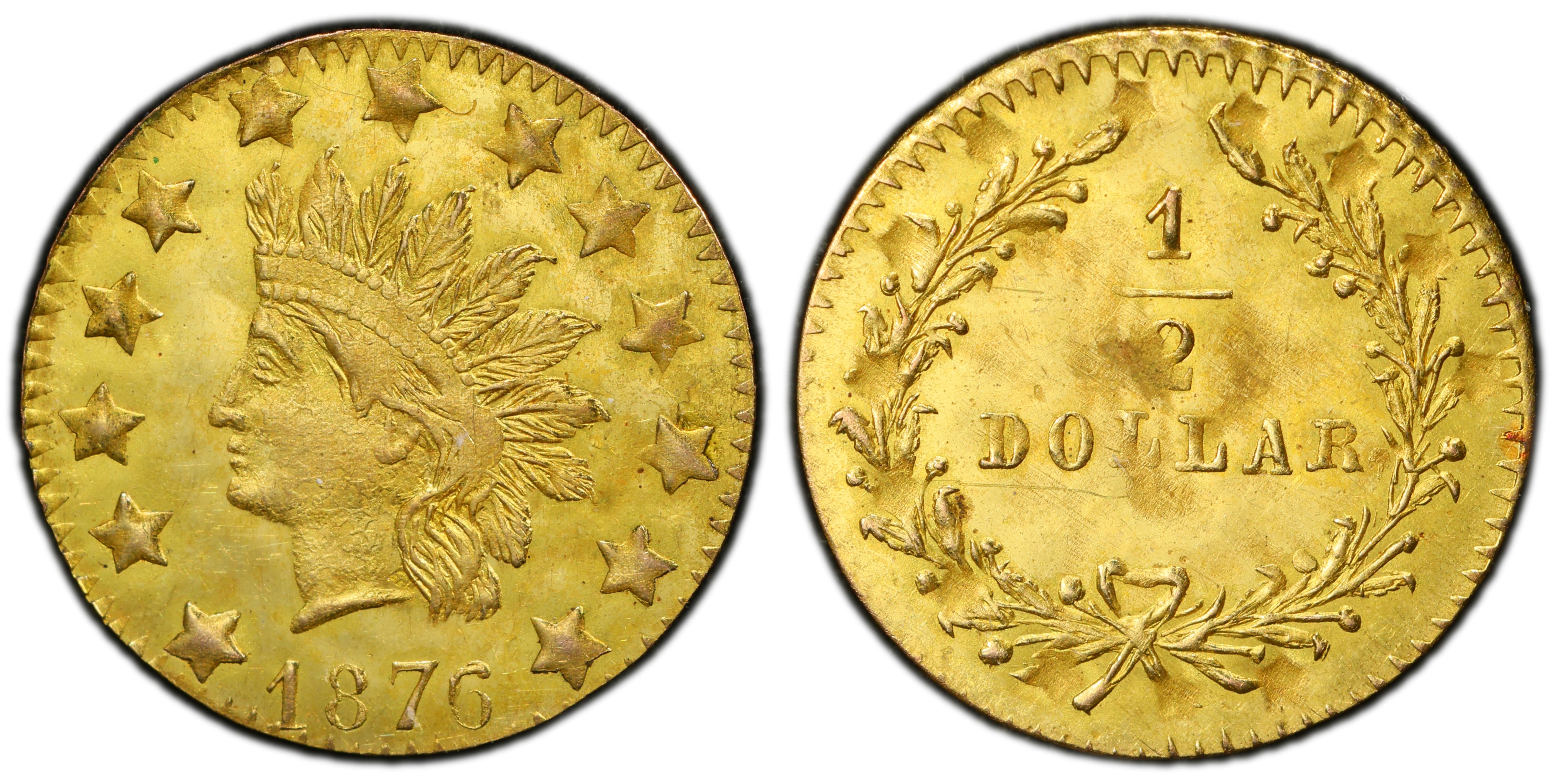
Obverse & Reverse
The 1876 BG-1064 Half Dollar is a quintessential example of a 'Period Two' California Fractional Gold piece. The story of these fascinating miniature coins begins decades earlier. The California Gold Rush, ignited in 1848, flooded the West with gold dust but created an acute shortage of small-denomination coinage for daily transactions. A 'pinch' of gold dust for a drink was an inexact and chaotic system. To fill this commercial void, private jewelers and metalworkers, primarily in San Francisco, began striking their own quarter, half, and one-dollar gold coins starting in 1852. These initial 'Period One' (1852-1857) issues were intended for and saw actual circulation, becoming an integral, albeit unofficial, part of the regional economy. However, by the late 1850s, the new San Francisco Mint was in full operation, producing ample quantities of official U.S. silver and gold coins, which obviated the need for private fractional gold. Yet, the concept had taken hold. Jewelers recognized a new market: souvenirs and novelty items for tourists and locals who were captivated by the romance of the Gold Rush. This gave birth to the 'Period Two' (1858-1882) issues, to which the BG-1064 belongs. These later pieces were not intended for circulation. Instead, they were sold as keepsakes, charms for bracelets, and mementos of a now-legendary era. The production quality of Period Two pieces was often cruder than their predecessors, and their gold content was frequently debased and inconsistent, as their value was in their novelty, not their intrinsic worth. The Coinage Act of 1864 officially outlawed private coinage, but the law was weakly enforced in the remote West, allowing jewelers to continue production for nearly two more decades. These pieces often featured more fanciful designs, such as Indian Heads, which were popular motifs of the era. The production of all such items was finally halted in 1883 when the U.S. Secret Service cracked down on their manufacture, bringing the era of California Fractional Gold to a definitive close. Today, the BG-1064 is prized by collectors not as a coin that financed Gold Rush commerce, but as a tangible artifact of how that commerce was remembered and romanticized.
Associated EventPost-Gold Rush California Economy
Reason For MintingPrimarily struck as a souvenir or jewelry item for the tourist trade, capitalizing on the nostalgia of the California Gold Rush.
Minter HistoryThe specific minter for the BG-1064 die pair is not definitively known, which is common for many Period Two varieties. These pieces were produced by numerous San Francisco-based jewelers and artisans who often did not apply a maker's mark. Their primary business was jewelry and watchmaking, and the production of these small gold tokens was a profitable sideline. Their manufacturing methods were typically less sophisticated than official mints, often employing simple hand-operated screw presses or even the hammer-striking method, resulting in coins with variable strike quality.
Historical SignificanceThe BG-1064 is historically significant as a representation of the commercialization of the Gold Rush legend. Unlike its Period One predecessors born of necessity, this piece was born of nostalgia. It demonstrates the transition of fractional gold from a circulating medium of exchange to a collectible souvenir, marking a shift in California's economic identity from a raw frontier to a place with a celebrated past that could be marketed and sold.
N/A
Denomination50 Cents
Minting Period1876
Assayer/MinterUnknown
Geographic OriginSan Francisco, California
Obverse DescriptionFeatures a small, stylized head of a Native American facing left, wearing a feathered headdress. The portrait is encircled by 13 five-pointed stars. The date, 1876, appears below the bust.
Obverse Inscription1876
Reverse DescriptionA wreath composed of two branches is tied with a bow at the bottom. Inside the wreath, the denomination is expressed on two lines: '1/2' above 'DOLLAR'. This particular variety is known as a 'No CAL' type, as the words 'CALIFORNIA GOLD' are absent from the reverse design.
Reverse Inscription1/2 DOLLAR
CompositionGold
Stated Fineness Actual FinenessVariable, often lower than official U.S. coinage, typical for Period Two issues.
Weight0.25 grams
Diameter10.00 mm
EdgePlain
Unknown
Survival EstimateFewer than 30 believed to exist.
Rarity ScaleR-6 (Very Rare)
This variety appeals to specialists in the extensive California Fractional Gold series. Its allure comes from its high rarity (R-6), the popular Indian Head motif, and its status as a 'No CAL' variety, which distinguishes it from more common types. As a Period Two issue, examples are more frequently found in higher grades, offering collectors the chance to own a visually appealing, uncirculated piece of Gold Rush-era memorabilia.
Key VarietiesThe primary variety is the regular strike of 1876. No known patterns, trial pieces, or official later-date restrikes exist for this specific Breen-Gillio number. The key distinction for collectors is its 'No CAL' reverse. All known genuine examples from this period are considered original.
Authentication TipsGenuine BG-1064 examples exhibit specific die characteristics. The stars on the obverse should be sharp and well-formed, though overall strike weakness is common. The font style of the date and reverse lettering is critical and should be compared to known genuine examples. Counterfeits and modern replicas often have a soapy, cast-like appearance, incorrect weight, or design details that are too crude or too modern. A key diagnostic for many genuine fractionals is their very thin planchet and sometimes evidence of the hammer-striking process, which can result in slight waviness. Any piece with a bear on the design is a modern replica, not a genuine 19th-century fractional.
Shopping ConsiderationsWhen acquiring a BG-1064, third-party certification from PCGS or NGC is highly recommended due to the prevalence of counterfeits. A premium quality example will exhibit a sharp strike for the issue, particularly on the details of the headdress and the numerals of the date. Seek out coins with clean, original surfaces that retain some measure of mint luster; many Period Two pieces were well-preserved and should not show signs of circulation. Be wary of pieces that have been harshly cleaned, which will appear overly bright and show hairline scratches. Also, carefully inspect for evidence of being previously mounted in jewelry, such as rim damage or solder marks, which would significantly reduce the value.
A coin's grade is its condition, rated on a 1-70 scale. For rare coins, this is the most critical factor in determining value, as a tiny difference in preservation can mean a huge difference in price.
Relevant Grade TypesOriginal 1876 BG-1064 issues were business strikes, but as they were made for collectors and not commerce, they are most commonly found in Mint State (MS, 60-70) grades. Circulated (1-58) examples are scarce, as any wear would be from mishandling rather than commercial use. No official Proof (PR/PF) examples were struck during the original period of issue, and no later restrikes are known to exist.
Mint State CharacteristicsUncirculated examples of BG-1064 often have a soft, satiny luster rather than a hard, frosty one. The strike can be inconsistent; central details like the Indian's cheek and the reverse bow may be weak even on a high-grade piece. Planchets are very thin and can sometimes show parallel striations from the preparation of the gold strip. Due to the softness of the gold, even Mint State coins will typically display small, scattered contact marks. A well-struck piece with minimal marks and attractive original reddish-gold toning commands a significant premium.
Circulated Wear PatternsOn this specific design, wear first appears on the highest points of the obverse: the Indian's cheekbone and the feathers at the very top of the headdress. On the reverse, the highest points of the wreath's leaves and the numerals '1/2' will show the first signs of friction. In lower grades (e.g., VF), the smaller details of the feathers would begin to merge and the legend would soften.
Key Factors For ValueFor the BG-1064, the primary value drivers are rarity and grade. Surface quality is paramount; an example with original, undisturbed luster and skin will be worth far more than a cleaned or polished one of the same grade. Strike sharpness is the next consideration; a coin with a bold rendering of the portrait and wreath is highly desirable. Eye appeal, enhanced by attractive original toning, plays a significant role. Finally, a CAC sticker on a certified coin provides a strong premium, as it indicates approval for solid quality within the assigned grade.
PCGS Price Guide
| Grade | Price | Population |
|---|---|---|
| 55 | $425.00 | 1 |
| 55+ | $450.00 | N/A |
| 58 | $475.00 | N/A |
| 58+ | $500.00 | N/A |
| 60 | $550.00 | N/A |
| 61 | $600.00 | 1 |
| 62 | $700.00 | 7 |
| 62+ | $800.00 | N/A |
| 63 | $900.00 | 6 |
| 63+ | $1,150.00 | N/A |
| 64 | $1,750.00 | 9 |