1878/6 G50C BG-1066 (Regular Strike)
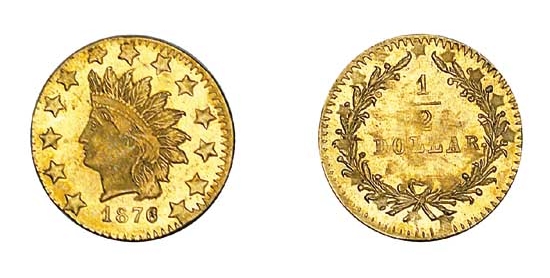
Obverse & Reverse
The 1878/6 BG-1066 50 Cent piece is a quintessential example of a 'Period Two' California Fractional Gold coin, a series born from the souvenir and jewelry trade that flourished long after the initial fever of the Gold Rush had subsided. The first wave of fractional gold, struck from 1852 to roughly 1857, was born of necessity, created by private jewelers to alleviate a severe shortage of small-denomination coinage for daily commerce. By the late 1870s, however, the San Francisco Mint was in full operation, and the economic rationale for these tiny gold pieces had vanished. Their purpose shifted entirely. These later issues, often termed 'Jeweler's Issues,' catered to a burgeoning tourism industry and a national fascination with the 'Wild West.' Eastern visitors and residents alike sought mementos of the Gold Rush, and these miniature gold coins, often bearing romanticized 'Indian Head' or 'Liberty Head' motifs, were the perfect keepsake. The BG-1066 was struck from a die muled with an obvious 1878 over 1876 date, a common practice among Period Two minters who often reused and recut dies to save costs. The production quality was typically inferior to official U.S. Mint coinage, often struck on thin, underweight planchets with inconsistent striking pressure. While the Private Coinage Act of 1864 had made such private minting illegal, the law was not strictly enforced against these small souvenir pieces until the early 1880s when the Secret Service, concerned about potential for fraud, finally cracked down and ended their production. Thus, the BG-1066 represents not a coin for circulation, but a tangible link to the popular mythology of the Gold Rush, produced in its fading twilight for a nostalgic public.
Associated EventPost-Gold Rush Era / Western Souvenir Trade
Reason For MintingTo serve as a popular souvenir or keepsake of the California Gold Rush for tourists and collectors.
Minter HistoryWhile not definitively signed, the style and period of manufacture are consistent with the work of Robert B. Gray & Co. of San Francisco. Gray was a prolific producer of Period Two fractional gold. In late 1858 or 1859, he acquired the business of another prominent jeweler and fractional minter, Antoine Louis Nouzillet. Gray continued to use some of Nouzillet's dies but also created his own, often hallmarked with a 'G'. Gray's operation catered heavily to the souvenir market, producing a wide variety of designs until he sold his interests to the California Jewelry Co. in 1871. The dies for later varieties like BG-1066 may have remained in use by successor firms.
Historical SignificanceThe BG-1066 is significant not as a medium of exchange, but as a numismatic artifact that documents the transition of California fractional gold from utilitarian coinage to commercial souvenir. It reflects the romanticized memory of the Gold Rush in the late 19th century and is a key representative of the so-called 'Jeweler's Issues' that were eventually suppressed by the federal government.
Not Applicable
Denomination50 Cents
Minting Period1878
Assayer/MinterProbably Robert B. Gray & Co.
Geographic OriginSan Francisco, California
Obverse DescriptionA rather crude, stylized portrait of a Native American (Indian Head) facing left, wearing a feathered headdress. The portrait is surrounded by thirteen stars of varying quality. The date '1878' appears below the bust, with a clear '8' punched over a '6'.
Obverse Inscription1878
Reverse DescriptionThe reverse features the denomination '50 CENTS' within a wreath. The wreath is composed of 20 berries, ten on each side, and is tied with a bow at the bottom. The legend 'CALIFORNIA GOLD' encircles the wreath at the periphery.
Reverse InscriptionCALIFORNIA GOLD 50 CENTS
CompositionGold
Stated Fineness Actual FinenessTypically varied from 14 to 22 karats for Period Two issues; not specifically known for this variety.
Weight0.25 grams
Diameter11.00 mm
EdgePlain
Unknown
Survival Estimate30-50 coins
Rarity ScaleHigh R-5 (31-75 known)
This variety is highly sought after by specialists in California fractional gold due to its clear and dramatic 1878/6 overdate, its status as a scarce High R-5 variety, and its representation of the later 'souvenir' period of this fascinating series. The Indian Head motif is also broadly popular among collectors.
Key VarietiesThe primary variety is the 1878/6 overdate business strike. No proof strikings from the period of issue are known to exist, as these were commercial products. No later-date restrikes or special collector issues are known. The key distinguishing feature is the prominent repunching of the 8 over the 6 in the date.
Authentication TipsGenuine examples are struck on very thin gold planchets, often the thickness of one or two business cards. Look for a characteristically weak or uneven strike, especially at the peripheries, which is common due to the hammer-striking process. The 8-over-6 overdate should be clear under magnification. Counterfeits are often thicker, have a soapy or cast-like appearance, may have incorrect details in the wreath (e.g., number of berries), and lack the sharp, albeit crude, die work of originals. Also, genuine Period Two pieces are always denominated (e.g., 'CENTS' or 'DOLLAR'); pieces that say 'CAL GOLD CHARM' or lack a denomination are later tokens.
Shopping ConsiderationsA premium quality example for its grade will show a bold strike for the variety, with as much detail as possible in the headdress feathers and the central denomination. Luster is a key factor; many high-grade examples exhibit shimmering, prooflike fields, which are highly desirable and command significant premiums. Avoid examples that have been harshly cleaned, which strips the original skin and luster. Also be wary of coins that have been mounted in jewelry, looking for evidence of rim filing, solder, or tooling. The clarity and prominence of the overdate is a major factor in eye appeal and value for this specific variety.
A coin's grade is its condition, rated on a 1-70 scale. For rare coins, this is the most critical factor in determining value, as a tiny difference in preservation can mean a huge difference in price.
Relevant Grade TypesOriginal period issues were business strikes intended for commercial sale as souvenirs, not for monetary circulation. They are found in what would be considered Circulated grades (1-58), though wear is often from handling rather than commerce, and Mint State (MS, 60-70) grades. No Proofs (PR/PF) were struck during the original period of issue. Any piece described as 'Prooflike' (PL) is a business strike with reflective surfaces and is highly desirable.
Mint State CharacteristicsUncirculated examples of BG-1066 are defined by their luster, which is often semi-prooflike to prooflike with significant reflectivity in the fields. The strike is characteristically uneven; it is common to see weakness on the stars or the peripheral legends. High points of the design, such as the Indian's cheek and the wreath details, may not be fully struck up even on a choice Mint State piece. Planchet quality is often poor, and small, mint-made flaws or alloy spots are not uncommon and should be evaluated for their impact on eye appeal.
Circulated Wear PatternsWear first appears on the high points of the design. On the obverse, check for flatness on the Indian's cheekbone, the feathers of the headdress, and the eyebrow. On the reverse, the highest points of the wreath's leaves and the numerals of the denomination '50' will show the first signs of friction. In lower grades (VF and below), the stars on the obverse and the letters in the legends will begin to lose their sharpness and merge towards the fields.
Key Factors For ValueFor the BG-1066, value is driven by several key factors. Firstly, the grade and surface quality; examples with original, lustrous, and problem-free surfaces are prized. Secondly, the strike; a coin with a sharper-than-average strike on both the central devices and legends commands a premium. Thirdly, eye appeal is paramount; coins with attractive, original gold toning and highly reflective, prooflike fields are in greatest demand. Finally, the clarity of the 1878/6 overdate significantly influences value, with bold examples being the most desirable.
PCGS Price Guide
| Grade | Price | Population |
|---|---|---|
| 60 | $325.00 | N/A |
| 61 | $375.00 | 3 |
| 62 | $450.00 | 10 |
| 62+ | $525.00 | N/A |
| 63 | $700.00 | 14 |
| 63+ | $850.00 | N/A |
| 64 | $1,150.00 | 9 |