1870 G$1 BG-1118 (Regular Strike)
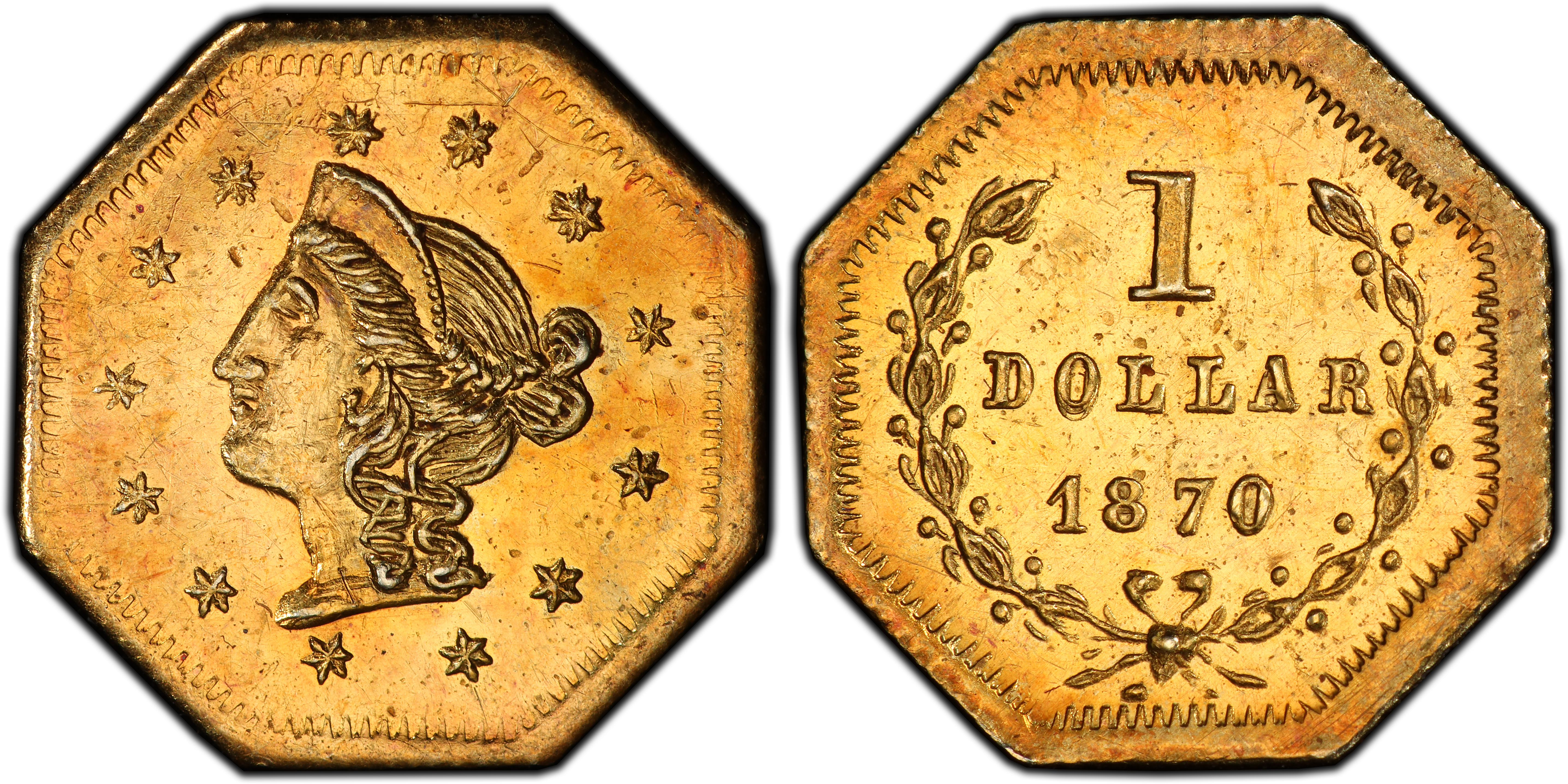
Obverse & Reverse
The 1870 G$1 BG-1118 is a product of the second major phase of private coining in California, known to numismatists as 'Period Two' (1859-1882). Unlike the 'Period One' issues (1852-1857), which were struck out of genuine commercial necessity to alleviate a shortage of small change, Period Two pieces were created in a dramatically different socio-economic landscape. By 1870, San Francisco was a well-established metropolis, amply supplied with federal coinage from its own Branch Mint. The acute need for private fractional gold had vanished. Instead, a flourishing market for souvenirs and curiosities had emerged, fueled by tourism and a romanticized vision of the Gold Rush. San Francisco's jewelers, many of whom were the successors to the original private minters, astutely catered to this demand. They produced a vast array of small gold 'coins' in quarter, half, and dollar denominations that were intended not for the cash drawer, but for the watch fobs, necklaces, and souvenir cabinets of visitors and locals alike. These 'jeweler's issues' were characteristically underweight for their stated value, often crudely engraved, and frequently made of debased gold, distinguishing them from their Period One predecessors. The Private Coinage Act of 1864 had made such private minting illegal, but the law was not strictly enforced by the Secret Service until the early 1880s. This legal gray area allowed producers like Robert B. Gray & Co. to operate openly, striking pieces like the BG-1118. This particular variety, nicknamed the 'Goofy Head' by modern collectors for its somewhat primitive and stylized Liberty portrait, is a quintessential example of its era: a nostalgic token of the Gold Rush created for a generation that had already witnessed the closing of that frontier, serving as a tangible, if not monetarily legitimate, piece of California's golden heritage.
Associated EventPost-Gold Rush California Commerce
Reason For MintingPrimarily struck to be sold as souvenirs, jewelry, and keepsakes for tourists and residents, rather than for general circulation.
Minter HistoryRobert B. Gray & Co. was a significant producer of 'Period Two' California Fractional Gold. Around 1859-60, Gray took over the business of Antoine Nouizillet, a prominent Period One minter. Gray continued to use some of Nouizillet's existing dies but also created his own, often marked with a distinctive 'G' as seen on the obverse of some varieties attributed to him. The firm operated in San Francisco, a hub for jewelers who capitalized on the public's fascination with the Gold Rush. In 1871, a year after this piece was struck, Gray sold his interests to the California Jewelry Company, which continued the tradition of striking fractional gold pieces.
Historical SignificanceThe BG-1118 is significant not as a coin used in commerce, but as a cultural artifact representing the commercialization of the Gold Rush mythos. It illustrates a shift from utilitarian private coinage to souvenir tokens, a transition driven by economic maturity and the rise of tourism in California.
N/A
DenominationG$1
Minting Period1870
Assayer/MinterRobert B. Gray & Co.
Geographic OriginSan Francisco, California
Obverse DescriptionA stylized head of Liberty facing left, with crudely rendered hair and facial features, which has led to the 'Goofy Head' nickname. She wears a coronet, and the portrait is encircled by 13 five-pointed stars. The overall design is a primitive imitation of contemporary federal gold coinage.
Obverse Inscription Reverse DescriptionAn ornamental wreath encircles the central inscriptions. At the top, in a horseshoe shape, is the legend 'CALIFORNIA GOLD'. The denomination and date are in the center, arranged on three lines.
Reverse InscriptionCALIFORNIA GOLD / 1 / DOLLAR / 1870
CompositionGold
Stated Fineness Actual FinenessVariable, but typically less than federal standard (.900 fine). Period Two issues are known to be debased.
EdgeReeded
Unknown
Survival Estimate31-75 known examples
Rarity ScaleR-5
This variety is highly sought after due to its distinctive and memorable 'Goofy Head' moniker, which sets it apart from the hundreds of other fractional gold designs. As an octagonal dollar from a known maker, it embodies the classic charm of the souvenir era of California gold. Its R-5 rarity ensures persistent demand.
Key VarietiesNo major varieties from the original minting period are known for BG-1118. As a 'Period Two' issue, it was not subject to later official restrikes by entities like the U.S. Mint. However, the entire series of California Fractional Gold is plagued by contemporary counterfeits and modern replicas, some of which may mimic this design.
Authentication TipsAuthentic Period Two pieces like the BG-1118 should have a denomination (e.g., 'DOLLAR'). Modern replicas often omit this or use phrases like 'CAL GOLD CHARM'. Genuine pieces are typically very thin and can have weak or uneven strikes due to the crude 'hammer method' of minting. Fakes are often thicker, with sharper, more uniform details, and may have a soapy or unnatural luster. A key diagnostic on some examples of BG-1118 is a small triangular die chip on the lower reverse rim. The crudeness of the 'Goofy Head' portrait itself is a key feature, but must be compared to known genuine examples, as fakes can be even cruder.
Shopping ConsiderationsA premium quality example for its grade will exhibit a sharp strike for the issue, especially on the stars and the wreath details. Surfaces should be free of distracting marks, cleaning, or evidence of having been mounted in jewelry, a common fate for these pieces. Originality is paramount; look for coins with a rich, undisturbed orange-gold or coppery-gold patina. Toning can range from deep orange to having hints of olive-green or lilac. Avoid examples that are overly bright and polished or show evidence of tooling or repairs. Given the variable strike quality, a coin with strong central details (date, denomination) is highly desirable.
A coin's grade is its condition, rated on a 1-70 scale. For rare coins, this is the most critical factor in determining value, as a tiny difference in preservation can mean a huge difference in price.
Relevant Grade TypesOriginal period issues were business strikes intended for sale as souvenirs, not circulation, but are graded along the same standard. They are found in Circulated (1-58) and Mint State (MS, 60-70) grades. No official Proofs (PR/PF) of this issue were struck in 1870, and there are no known authorized later-date restrikes. Some examples exhibit prooflike surfaces, a result of polished dies, and may receive a 'PL' designation from grading services.
Mint State CharacteristicsUncirculated examples of BG-1118 are defined by their luster, which is typically satiny and can be quite vibrant. Due to the crude manufacturing process, the strike is often uneven. The stars may appear soft or flat, and the highest points of Liberty's hair and the wreath may show weakness even on a Mint State coin. The surfaces are often prooflike. Small, planchet-related flaws or die file marks are common and may not detract from the grade if they are characteristic of the issue.
Circulated Wear PatternsWear first appears on the high points of Liberty's cheek, hair above the ear, and the coronet. On the reverse, the highest leaves and berries of the wreath will show flatness and loss of detail. On lower-grade examples, the stars will begin to merge with the fields, and the date and denomination will show significant weakness.
Key Factors For ValueSurface preservation and eye appeal are the primary drivers of value. An example with original, uncleaned surfaces and attractive, rich golden toning will command a significant premium. The sharpness of the strike is crucial; a well-struck 'Goofy Head' is rare and desirable. The absence of damage (scratches, rim bumps, evidence of jewelry mounting) is essential. A CAC sticker for this issue is highly valued by collectors as it confirms both the grade and the superior quality for that grade.
PCGS Price Guide
| Grade | Price | Population |
|---|---|---|
| 35 | $600.00 | 1 |
| 40 | $625.00 | N/A |
| 45 | $650.00 | N/A |
| 45+ | $675.00 | N/A |
| 50 | $700.00 | 4 |
| 50+ | $725.00 | N/A |
| 53 | $750.00 | N/A |
| 53+ | $775.00 | N/A |
| 55 | $800.00 | 13 |
| 55+ | $810.00 | N/A |
| 58 | $950.00 | 7 |
| 58+ | $1,050.00 | N/A |
| 60 | $1,200.00 | 2 |
| 61 | $1,300.00 | 4 |
| 62 | $1,500.00 | 8 |
| 62+ | $1,650.00 | N/A |
| 63 | $1,850.00 | 3 |
| 63+ | $2,600.00 | N/A |
| 64 | $4,250.00 | 1 |
| 64+ | N/A | 1 |