1875 G$1 BG-1112 (Regular Strike)
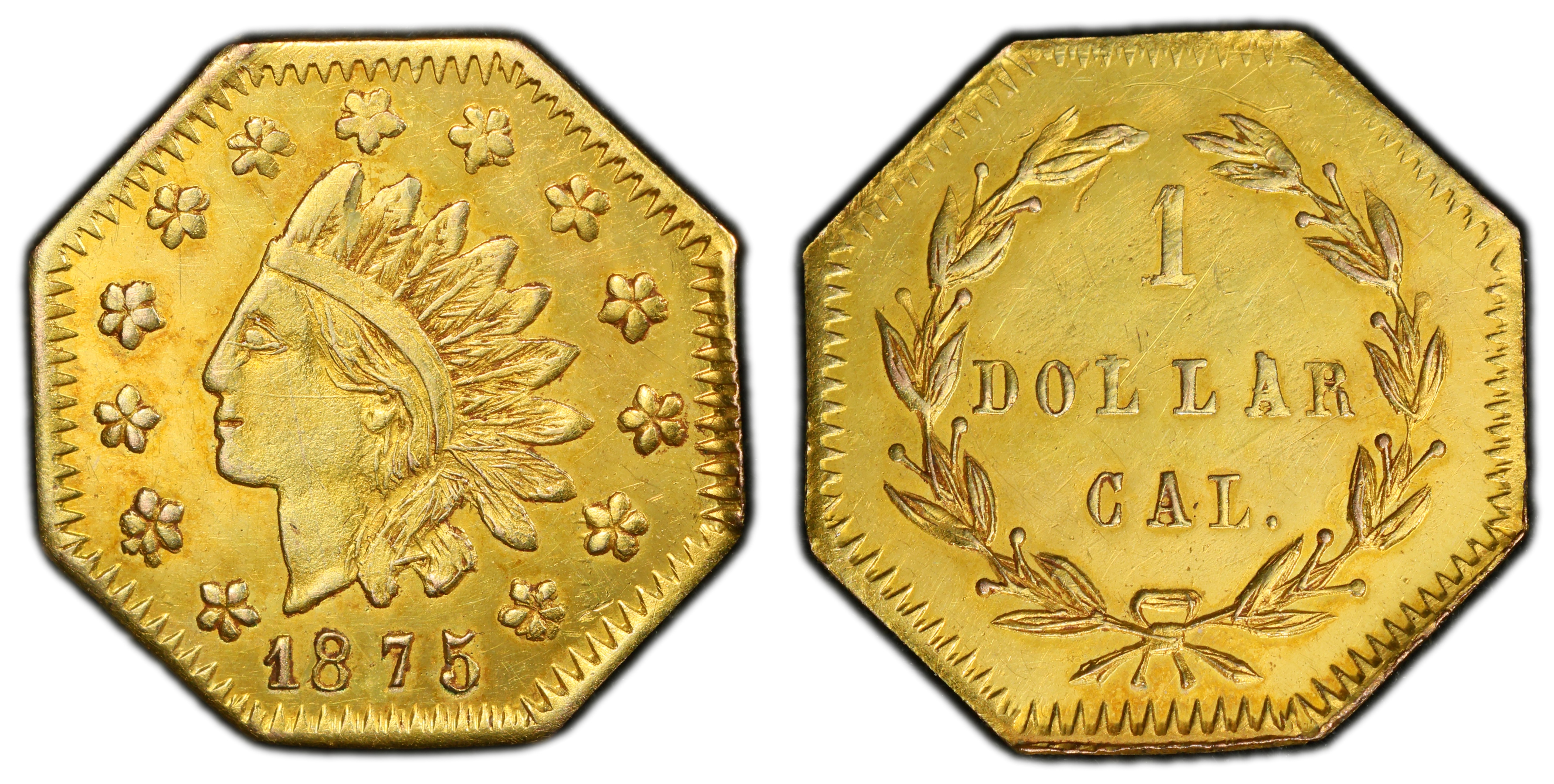
Obverse & Reverse
The 1875 Octagonal Gold Dollar, cataloged as BG-1112 in the Breen-Gillio reference, is a quintessential example of a 'Period Two' California Fractional Gold piece. The story of these fascinating miniature coins begins with the California Gold Rush. The massive influx of population and gold dust created a chaotic economic environment with a severe shortage of small-denomination circulating coinage. To fill this void, private jewelers and metallurgists in San Francisco began striking their own quarters, halves, and dollars from 1852. These early 'Period One' (1852-1857) issues were functional, intended to facilitate daily commerce, and contained gold value reasonably close to their face value. However, the establishment and ramping up of production at the official U.S. Branch Mint in San Francisco in the mid-1850s gradually satisfied the region's need for small change. This rendered the private issues obsolete for their original purpose. Yet, demand for the tiny gold pieces persisted, not for circulation, but as keepsakes. The romance of the Gold Rush had captured the nation's imagination, and these miniature gold coins became popular souvenirs for tourists and trinkets to be sent to family back East. This gave rise to the 'Period Two' issues (1859-1882), a category to which the BG-1112 belongs. These pieces were struck not as currency, but as commercial products for the jewelry and souvenir trade. Consequently, their intrinsic value was an secondary concern; they were often significantly underweight and made from lower-purity gold compared to Period One issues. The Coinage Act of 1864 made private coinage illegal, but it was not strictly enforced against these small souvenir pieces until the early 1880s, allowing their production to flourish for over two decades. The BG-1112, dated 1875, was struck deep into this souvenir period. Its 'Indian Head' design was a popular motif of the era, evoking romantic notions of the American West. The minter of BG-1112 remains unidentified, a common trait for many Period Two varieties which are collectively termed 'mavericks.' These were often produced by anonymous jewelers who copied popular designs. Today, the BG-1112 is a very rare and highly sought-after numismatic artifact, prized not for its intrinsic value but for its direct connection to the post-Gold Rush history of California and the unique market for souvenir coinage it spawned.
Associated EventCalifornia Gold Rush Aftermath
Reason For MintingPrimarily struck for sale as a souvenir or jewelry item to tourists and collectors, not for monetary circulation.
Minter HistoryThe specific minter of BG-1112 is unknown. Period Two of California Fractional Gold production saw many San Francisco-based jewelers and private entrepreneurs striking pieces for the souvenir market. Known makers from this era include figures like Robert B. Gray & Co. and the Joseph Bros., but many varieties, likely including BG-1112, were 'maverick' issues from unidentified workshops that did not mark their products.
Historical SignificanceThis coin represents the transition of California fractional gold from a necessary form of currency to a popular souvenir item. It is a tangible artifact of the post-Gold Rush tourist trade and the romanticizing of the 'Wild West' in the American imagination during the latter half of the 19th century.
N/A
Denomination$1
Minting Period1875
Assayer/MinterUnknown Private Minter
Geographic OriginSan Francisco, California
Obverse DescriptionFeatures a small, delicate Indian Head facing left, a design motif popular on U.S. coinage of the period. The portrait is surrounded by 13 six-pointed stars representing the original colonies. The date '1875' is below the bust.
Obverse Inscription1875
Reverse DescriptionThe central device is the denomination '1' and the word 'DOLLAR' arranged in two lines. This is enclosed within a continuous wreath of leaves and berries, tied with a bow at the bottom.
Reverse Inscription1 DOLLAR
CompositionGold
Stated Fineness Actual FinenessVariable, but generally known to be debased and significantly below the standard for U.S. gold coinage of the era.
EdgePlain
Unknown
Survival EstimateFewer than 15 known, likely in the 4-12 range.
Rarity ScaleHigh R-6
The BG-1112 is highly sought after due to its extreme rarity and attractive octagonal shape and Indian Head design. As a Period Two issue, it is a key representative of the fascinating souvenir-era of fractional gold production. Its scarcity ensures it is a highlight of any advanced collection of California small denomination gold.
Key VarietiesNo major varieties, proof issues, or restrikes are recorded for the BG-1112. All known examples are considered regular business strikes produced for commercial sale in 1875.
Authentication TipsAuthentic BG-1112 examples should have a denominated reverse ('1 DOLLAR'). Replicas from the 20th century often lack a denomination or feature designs like a bear, which are not found on genuine Period One or Two pieces. The strike is characteristically weak on the high points of the Indian's feathers. Look for fine die striations, which give original pieces a prooflike or 'wiry' texture. Counterfeits are often smooth or have a mushy appearance. Third-party grading is highly recommended for authentication.
Shopping ConsiderationsA premium quality example for this issue is defined less by absolute grade and more by surface quality and strike. Look for a specimen with minimal contact marks, particularly on the delicate Indian's cheek and within the open fields. The strike is key; while the feather tips are almost always weak, a coin with a bold date and legends is highly desirable. Many surviving examples have prooflike or heavily striated surfaces; coins that retain this original texture without evidence of harsh cleaning or polishing command a significant premium. Avoid examples that have been repaired, tooled, or used as jewelry, as this severely impacts value.
A coin's grade is its condition, rated on a 1-70 scale. For rare coins, this is the most critical factor in determining value, as a tiny difference in preservation can mean a huge difference in price.
Relevant Grade TypesAll original 1875 BG-1112 coins were struck as 'business strikes,' intended for commercial sale as souvenirs. They are found in Circulated (AU-58 and below, though rarely seen this low) and Mint State (MS, 60-70) grades. No true Proofs were struck during the original period of issue, and there are no known later-date collector restrikes.
Mint State CharacteristicsUncirculated examples of BG-1112 are characterized by a bright, flashy luster, often with pronounced die striations that give the surfaces a prooflike (PL) appearance. The strike is characteristically weak on the tips of the feathers in the headdress. The fields are prone to small contact marks due to the softness of the gold and handling as souvenirs. A high-end MS example would display sharp details on the date and lettering, minimal distracting marks, and strong underlying luster.
Circulated Wear PatternsOn circulated examples, wear first appears on the high points of the design: the Indian's cheek, brow, and the front of the headdress. On the reverse, the highest points of the wreath's leaves and the bow will show initial friction and smoothing. In lower grades, the delicate details of the feathers and the finer lines of the wreath would begin to merge.
Key Factors For ValueFor the BG-1112, rarity is paramount, but among surviving examples, value is driven by three key factors. First is surface preservation: coins with original, undisturbed prooflike or satiny surfaces are prized over those that have been cleaned or polished. Second is the strike: examples with an unusually bold strike, especially on the feather details, command a strong premium. Third is eye appeal: a coin with minimal distracting marks and a pleasing, uniform gold color will be more valuable than a similarly graded piece with noticeable flaws. A CAC sticker indicating premium quality for the grade adds a significant premium.
PCGS Price Guide
| Grade | Price | Population |
|---|---|---|
| 58 | $900.00 | 1 |
| 58+ | $950.00 | N/A |
| 60 | $1,000.00 | 1 |
| 61 | $1,100.00 | 2 |
| 62 | $1,250.00 | 10 |
| 62+ | $1,500.00 | N/A |
| 63 | $1,650.00 | 6 |
| 63+ | $1,850.00 | N/A |
| 64 | $2,250.00 | 5 |