1876 G$1 BG-1114 (Regular Strike)
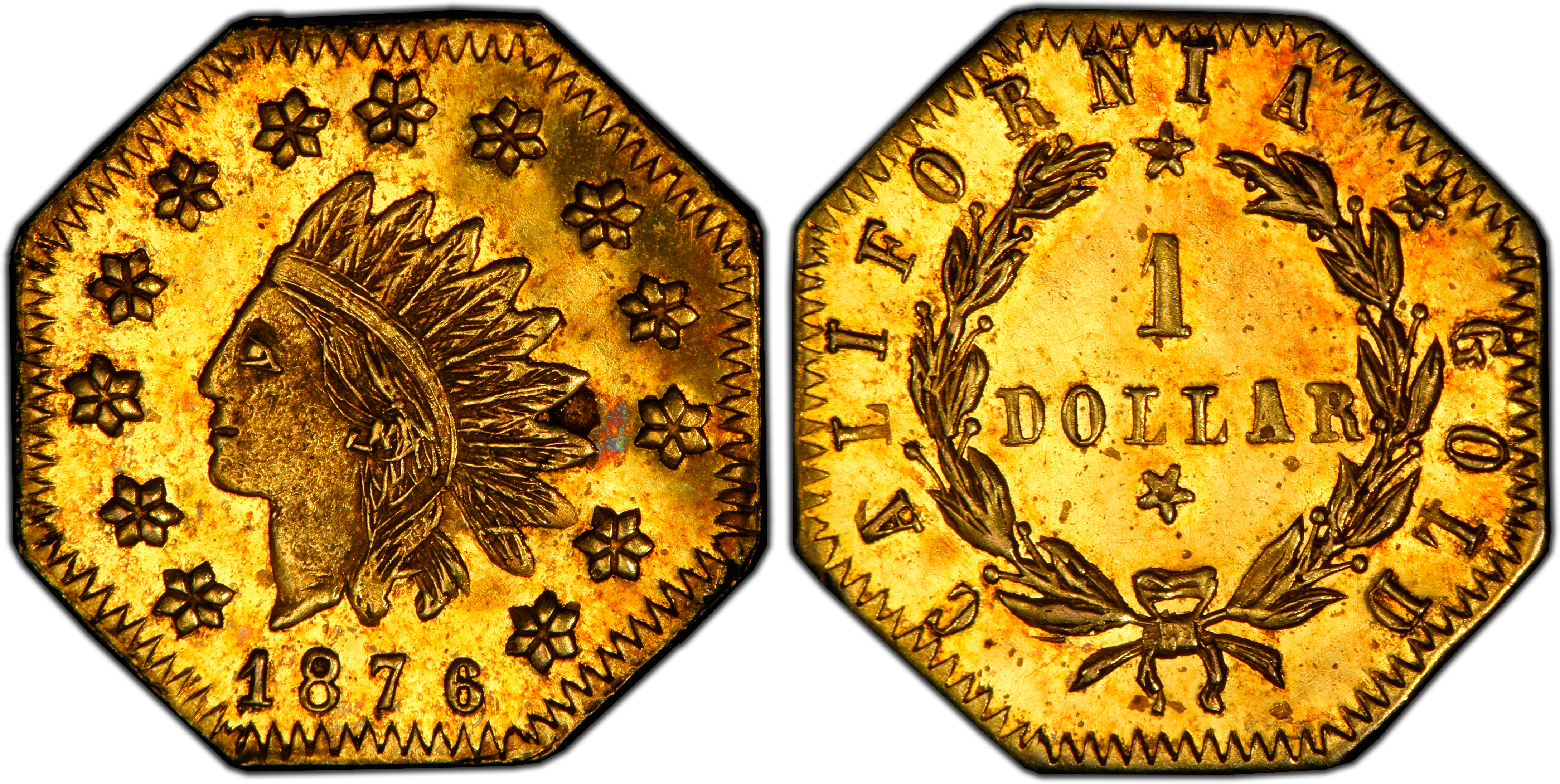
Obverse & Reverse
The 1876 G$1 BG-1114 belongs to the second major period of California Fractional Gold production (1858-1882), a fascinating era that saw these miniature gold pieces transition from necessities of commerce to popular souvenirs and jewelry items. Unlike the 'Period One' issues (1852-1857), which were struck to alleviate a severe shortage of small change during the initial Gold Rush boom, the later pieces were created in a different economic climate. By the 1870s, the U.S. Mint in San Francisco was in full operation, and federally issued coinage was plentiful. The raison d'être for private fractional gold had vanished. However, the allure of California and the Gold Rush remained a powerful force in the national imagination. Enterprising jewelers, primarily in San Francisco but also in other cities, recognized a burgeoning market for mementos of the Golden State. These 'jeweler's issues' were often lighter and thinner than their Period One predecessors, with gold content that did not correspond to their face value. Their production was a direct violation of the Private Coinage Act of 1864, but federal enforcement in California was lax until the early 1880s. This legal ambiguity allowed for a prolific output of diverse and often whimsical designs throughout the 1870s, including the popular Indian Head motif seen on BG-1114. These pieces were sold to tourists, sent back East in letters, and incorporated into rings, pins, and watch fobs. The year 1876 was particularly significant as it marked the nation's Centennial, an event that fueled a nationwide passion for historical and souvenir items, likely boosting the market for these miniature gold 'coins.' The production of BG-1114 and its contemporaries finally ceased around 1883 when Secret Service Chief James J. Brooks initiated a crackdown, effectively ending the 30-year chapter of private fractional gold minting.
Associated EventPost-Gold Rush Era / U.S. Centennial
Reason For MintingPrimarily struck as souvenirs and for use in jewelry, catering to a tourist market and public fascination with the California Gold Rush.
Minter HistoryThe specific minter for BG-1114 is unrecorded, a common trait for many Period Two issues. These pieces were generally produced by various anonymous or small-scale jewelers in California. Unlike the earlier assayers who often marked their work, these later producers operated in a legally grey area and often remained anonymous. Their primary business was jewelry and novelty items, not full-scale minting, and the fractional gold pieces were a profitable sideline.
Historical SignificanceThe BG-1114 is a tangible artifact of the commercialization of the Gold Rush legend. It represents a shift from the utilitarian, circulation-focused private coinage of the 1850s to the souvenir and novelty trade of the 1870s, demonstrating the enduring national mythos of the California frontier long after the initial rush had ended.
BG-1114
DenominationG$1
Minting Period1876
Assayer/MinterUnknown Jeweler
Geographic OriginSan Francisco, California (presumed)
Obverse DescriptionAn Indian Head portrait facing left, styled after contemporary U.S. Mint designs but often cruder in execution. The portrait is typically surrounded by 13 six-pointed stars, representing the original colonies. The date '1876' appears below the bust.
Obverse Inscription1876
Reverse DescriptionA wreath of two branches tied together with a bow at the bottom. The wreath encircles the denomination '1' and the word 'DOLLAR'.
Reverse Inscription1 DOLLAR
CompositionGold
Stated Fineness Actual FinenessVariable, but generally lower than U.S. Mint standards for the period.
EdgePlain
Extremely low; precise figures are unknown.
Survival Estimate4-6 pieces known.
Rarity ScaleHigh R-7
This is a landmark rarity in the California Fractional Gold series. Its appeal stems from its extreme scarcity (High R-7), the popular Indian Head design, and its octagonal shape. It is a trophy coin for advanced specialists who seek to assemble a complete set of Breen-Gillio varieties.
Key VarietiesBG-1114 is a unique die marriage. No major varieties, patterns, or restrikes from the original period of production are known to exist. All known examples are considered business strikes, though they were made for souvenir purposes and often exhibit prooflike surfaces from polished dies.
Authentication TipsAuthentication requires expert knowledge. Genuine pieces exhibit specific die characteristics and a particular 'feel' in their strike and planchet quality. Look for a mushy or soft strike in some areas, a common trait of jeweler's issues. Counterfeits are rampant in this series; many are brass or thinly gold-plated. Fakes often have incorrect design details (e.g., a bear on the reverse, which is never found on genuine denominated issues) or a soapy, cast-like appearance. All high-value California Fractionals should be authenticated and graded by a top-tier service like PCGS or NGC, which reference the Breen-Gillio catalog.
Shopping ConsiderationsFor a coin of this rarity, any example offered is a major event. A premium quality piece would be well-struck for the issue, with sharp details on the Indian's headdress and the wreath on the reverse. Given that these were made with polished dies, examples with deeply prooflike or reflective surfaces are highly desirable and command significant premiums. Luster should be original and unbroken. Avoid examples that have been harshly cleaned, show signs of tooling, or have been removed from jewelry, which may leave solder marks or rim damage. Given the extreme rarity, even a problem-free circulated example would be a major prize, but most known specimens are in Mint State.
A coin's grade is its condition, rated on a 1-70 scale. For rare coins, this is the most critical factor in determining value, as a tiny difference in preservation can mean a huge difference in price.
Relevant Grade TypesOriginal period issues were business strikes intended for sale as souvenirs, not circulation. They are found in Circulated (1-58) grades, though this is rare, and more commonly in Mint State (MS, 60-70) grades. No true Proofs were struck during the original period. However, because they were often struck using highly polished dies to enhance their appeal as novelties, many Mint State examples exhibit prooflike (PL) or deep mirror prooflike (DMPL) surfaces. These are not a different type of coin but a desirable surface characteristic within the Mint State grades.
Mint State CharacteristicsUncirculated examples of BG-1114 are characterized by their strike quality and surface preservation. Strikes can be inconsistent; a sharp strike across all central devices is rare and highly prized. Luster is typically flashy and reflective due to the polished dies. Being small and made of soft gold, they are highly susceptible to contact marks and abrasions, even from simple handling. The highest-graded examples will be virtually free of distracting marks in the fields.
Circulated Wear PatternsOn a circulated example, wear would first appear on the highest points of the design. For the obverse, this includes the cheek, the eyebrow, and the feathers of the headdress. On the reverse, the high points of the bow and the leaves in the wreath would show the first signs of friction. In lower grades, the finer details of the feathers and wreath would merge, and the legends would become soft.
Key Factors For ValueFor BG-1114, rarity is the primary driver of value. Beyond that, the key factors are grade and eye appeal. A sharp strike is paramount and will add a significant premium. The degree of reflectivity in the fields (prooflike status) is also critical. Surface quality is vital; an example with clean, original surfaces and minimal distracting marks will always be favored over a cleaned or heavily marked piece of the same grade. A CAC sticker, indicating premium quality for the grade, would add a substantial premium to a coin of this caliber.
PCGS Price Guide
| Grade | Price | Population |
|---|---|---|
| 55 | $2,500.00 | 1 |
| 55+ | $2,650.00 | N/A |
| 58 | $2,850.00 | 1 |
| 58+ | $3,150.00 | N/A |
| 60 | $3,750.00 | 1 |
| 61 | $4,250.00 | N/A |
| 62 | $5,000.00 | 3 |
| 62+ | $5,250.00 | N/A |
| 63 | $5,500.00 | 4 |