1873/2 G50C BG-1050 (Regular Strike)
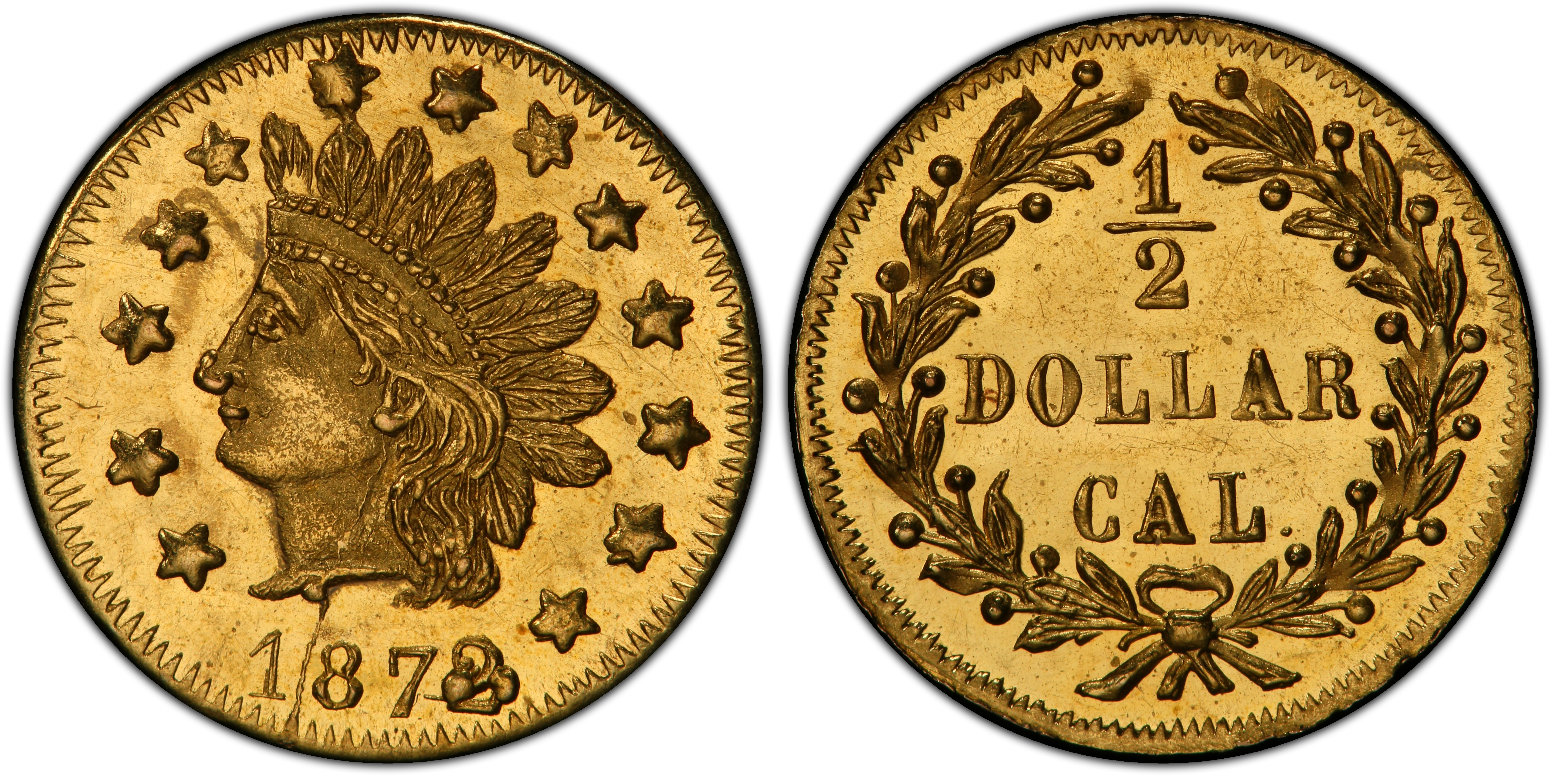
Obverse & Reverse
The 1873/2 G50C, cataloged as Breen-Gillio 1050 (BG-1050), is a fascinating artifact from the twilight years of California's private minting era. By the early 1870s, the initial chaos of the Gold Rush had subsided, and the United States government had established a firm monetary presence on the West Coast with the San Francisco Mint. However, a persistent shortage of small-denomination coinage continued to plague local commerce. Federal silver coins were scarce, and the base metal cents and nickels of the East were viewed with suspicion and were often unwelcome. This created a niche market for privately issued gold coins, particularly quarter, half-dollar, and dollar denominations. These pieces were not legal tender but were widely accepted as a convenient medium of exchange, functioning as tokens valued for their intrinsic gold content. The period from 1872 to 1882 saw a resurgence in the production of these 'charms' or 'tokens,' often by jewelers and manufacturing firms in San Francisco. The BG-1050 is a product of this later period, characterized by more refined manufacturing techniques than the cruder issues of the 1850s. The '1873/2' overdate is a key feature, resulting from the re-purposing of an 1872-dated die by punching a '3' over the '2'. This was a common cost-saving measure among private minters. These pieces circulated briefly but their quasi-legal status was always tenuous. The U.S. government viewed them as an infringement on its sole authority to coin money. A federal law passed in 1864 made private coinage illegal, but it was not strictly enforced against these small-denomination tokens until the Secret Service began actively investigating and suppressing their manufacture in the early 1880s, effectively ending the era of California Fractional Gold. Today, the BG-1050 is significant as a tangible link to this final chapter of private currency in the American West, valued for its historical context, distinctive overdate variety, and relative scarcity.
Associated EventPost-Gold Rush Economic Period in California
Reason For MintingTo alleviate a chronic shortage of official small-denomination coinage for daily commerce in California.
Minter HistoryThe exact minter of the BG-1050 is not definitively known, a common trait for many later-period California Fractional Gold pieces. Production is attributed to various San Francisco-based jewelers and private manufacturers who struck these pieces as a commercial venture. Firms like Frontier, Deviercy & Co. are often associated with this type of coinage. These minters operated in a legal gray area, producing gold 'tokens' that were technically not counterfeits of U.S. coinage but served the same economic function. They were skilled metallurgists and engravers who created a wide variety of designs, often mimicking federal motifs like the Liberty head to enhance public acceptance.
Historical SignificanceThe coin represents the final phase of private minting in the United States, a practice born of necessity during the Gold Rush. It showcases the persistence of local solutions to monetary problems long after the establishment of federal mints and highlights the eventual assertion of federal authority over currency. The overdate feature also provides a glimpse into the practical, cost-saving methods of 19th-century private minting operations.
N/A
Denomination50 Cents
Minting Period1873
Assayer/MinterUnknown private minter, possibly Frontier, Deviercy & Co. or other San Francisco jewelers.
Geographic OriginSan Francisco, California
Obverse DescriptionA portrait of a beaded coronet Liberty Head facing left. The portrait is surrounded by 13 six-pointed stars.
Obverse Inscription[None, only stars and portrait]
Reverse DescriptionThe denomination '1/2' is centered within a wreath composed of two olive branches tied with a ribbon at the bottom. The date '1873' is located below the ribbon. A small 'G' (for Gold) is located below the date.
Reverse Inscription1/2 1873 G
CompositionGold
Stated Fineness Actual FinenessVaries, but generally around .800 to .900 fine.
Weight0.25 grams
Diameter10.00 mm
EdgePlain
Unknown
Survival Estimate75-125
Rarity ScaleR-5
This variety is highly sought after for its clear and dramatic 1873/2 overdate, which is visible even on worn examples. It combines the historical allure of California Fractional Gold with a specific, collectible die variety. Its status as a 'Period One' genuine issue intended for commerce further enhances its appeal over later souvenir pieces.
Key VarietiesBG-1050 is itself the key variety, defined by the 1873/2 overdate on the reverse. There are no other major recognized varieties of this specific catalog number from the period of issue. No contemporary Proofs, patterns, or trial pieces are known to exist.
Authentication TipsThe primary diagnostic is the clear remnants of the '2' underneath the '3' in the date. The top curve and bottom-right tail of the '2' are typically visible. Genuine examples have a specific die crack that often develops on the reverse, running from the rim through the top of the 'F' in 'OF' (if present on the type) or through the wreath leaves. Counterfeits may have a mushy or indistinct overdate, incorrect weight, or a soapy, cast-like surface appearance. Compare the style of the Liberty head and wreath to known genuine examples, as fakes often fail to replicate the precise engraving style.
Shopping ConsiderationsA premium quality example will show a bold overdate and strong strike details, particularly on Liberty's hair and the wreath leaves. Original, uncleaned surfaces with some remaining luster command significant premiums. These coins are small and soft, so they are susceptible to damage. Carefully check for rim bumps, scratches, tooling, or evidence of having been mounted in jewelry. Eye appeal is paramount; seek out coins with a pleasing, original reddish-gold or orange-gold patina rather than those that have been brightly polished or harshly cleaned. A sharp strike is more important than the specific numerical grade for many collectors of this series.
A coin's grade is its condition, rated on a 1-70 scale. For rare coins, this is the most critical factor in determining value, as a tiny difference in preservation can mean a huge difference in price.
Relevant Grade TypesOriginal issues of BG-1050 were business strikes intended for circulation. They are found in Circulated grades (AG-3 to AU-58) and, more rarely, in Mint State (MS-60 to MS-70). No Proof (PR/PF) examples were struck during the original period of issue, and there are no known later-date collector restrikes for this specific variety.
Mint State CharacteristicsUncirculated examples of BG-1050 typically exhibit a soft, satiny luster. The strike can be variable; a well-struck coin will show sharp details in the hair strands around Liberty's face and full definition in the wreath leaves. Conversely, weakness is often seen in the centers. Because they were handled in bulk, even Mint State examples may show small nicks or contact marks, particularly on the high points of Liberty's cheek and the stars.
Circulated Wear PatternsWear first appears on the high points of the design. On the obverse, friction will first dull the luster on Liberty's cheek, coronet, and the hair above her ear. On the reverse, the highest points of the wreath leaves and the bow knot will show the first signs of wear. In lower grades (VG and below), the stars will begin to merge with the field and the finer details of the wreath will be completely worn away. The overdate, however, often remains identifiable even in lower grades.
Key Factors For ValueThe single most important factor is the surface quality; an example with original, undisturbed luster and skin will always be worth more than a cleaned or polished coin of the same grade. The strength and clarity of the 1873/2 overdate is a primary value driver. A sharp, well-defined strike commands a significant premium. Eye appeal, including attractive original toning and a lack of distracting marks or planchet flaws, is crucial. For certified coins, a CAC sticker indicating premium quality for the grade will add a substantial premium, as it confirms the coin's superior eye appeal and originality.
PCGS Price Guide
| Grade | Price | Population |
|---|---|---|
| 55 | $400.00 | 2 |
| 55+ | $450.00 | N/A |
| 58 | $500.00 | 1 |
| 58+ | $550.00 | N/A |
| 60 | $600.00 | N/A |
| 61 | $670.00 | 1 |
| 62 | $700.00 | 6 |
| 62+ | $850.00 | N/A |
| 63 | $1,000.00 | 7 |
| 63+ | $1,200.00 | N/A |
| 64 | $2,000.00 | 7 |
| 64+ | $2,250.00 | N/A |
| 65 | $2,750.00 | 2 |