1875 G$1 BG-1111 (Regular Strike)
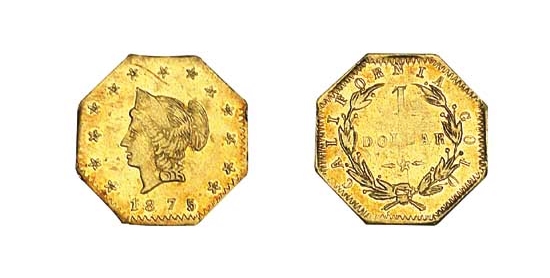
Obverse & Reverse
The 1875 G$1, cataloged as Breen-Gillio 1111, is a quintessential example of a 'Period Two' California Fractional Gold piece. By the mid-1870s, the initial, urgent need for small-denomination coinage that characterized the Gold Rush's peak ('Period One,' 1852-1858) had long since been met by the output of the official San Francisco Mint. The socio-economic landscape had transformed; California was an established state, and its economy was rapidly diversifying. The impetus for producing these tiny gold pieces had shifted entirely from commerce to novelty. San Francisco jewelers, such as the attributed minter Robert B. Gray & Co., recognized a burgeoning market for souvenirs and keepsakes that evoked the romance and adventure of the now-legendary Gold Rush. These pieces were marketed to tourists, sentimental locals, and individuals back East who were captivated by tales of the Golden State. The Coinage Act of 1864 had technically made the private minting of coinage illegal, but enforcement by the Secret Service was lax and inconsistent, particularly for pieces that were clearly not intended to defraud or seriously circulate as currency. This legal gray area allowed jewelers to continue production throughout the 1870s, a decade that actually saw an increase in the variety and quantity of such tokens. The BG-1111 was thus born into a world where its value was not in its purchasing power, but in its symbolism. It was a tangible memento of a pivotal era in American history. The manufacturing process was rudimentary, often involving hand-cut dies and a hammer-striking method, leading to significant variations in strike quality. The gold content was also unregulated, typically far below the face value, rendering them tokens rather than true coins. Production of all such pieces was finally halted by more stringent Secret Service enforcement in the early 1880s, bringing the fascinating era of California Fractional Gold to a close and cementing the status of surviving pieces like the BG-1111 as cherished historical artifacts.
Associated EventPost-Gold Rush California Tourism & Souvenir Trade
Reason For MintingTo be sold as a popular and affordable souvenir of the California Gold Rush era for tourists and collectors.
Minter HistoryRobert B. Gray & Co. was a prominent San Francisco jewelry firm active during the 'Period Two' era of fractional gold. In late 1858 or 1859, Gray acquired the business and equipment, including dies, of another established fractional gold minter, Antoine Louis Nouizillet. Gray continued to produce pieces using some of Nouizillet's old dies before creating new ones bearing his own hallmark, a distinctive 'G' punch. Gray's operation was known for producing some of the heavier and more intrinsically valuable souvenir pieces of the period. He sold his interests to the California Jewelry Co. in 1871, but his dies and influence persisted.
Historical SignificanceThe BG-1111 exemplifies the transition of fractional gold from a necessary form of currency to a commercial souvenir, reflecting California's evolving economy and its romanticized perception in the national consciousness. It represents the final chapter of private gold minting in the United States before federal enforcement ended the practice.
BG-1111
Denomination$1
Minting Period1875
Assayer/MinterRobert B. Gray & Co. (Attributed)
Geographic OriginSan Francisco, California
Obverse DescriptionA crudely rendered head of Liberty faces left, wearing a coronet. The portrait is surrounded by thirteen stars of varying quality and spacing. The date, 1875, is positioned below the bust truncation.
Obverse Inscription1875
Reverse DescriptionThe denomination '1' and the word 'DOLLAR' are enclosed within a wreath. The wreath is composed of two branches tied together at the bottom with a bow. The design is typically simple and somewhat coarse in execution.
Reverse Inscription1 DOLLAR
CompositionGold
Stated Fineness Actual FinenessVariable, often 14 to 22 karats, with bullion value being substantially less than face value.
Weight0.50 grams
Diameter11.50 mm
EdgePlain
Unknown
Survival EstimateVery few; likely less than 20.
Rarity ScaleR-7 (High)
This variety is sought after for its high rarity and its connection to the popular and historically rich field of California Fractional Gold. As a 'Period Two' dollar, it represents a distinct and fascinating chapter of the story. Its octagonal shape is also a classic and desirable feature for collectors.
Key VarietiesThe primary variety is the regular strike BG-1111. No known major variations, patterns, or official restrikes exist from the period. All known examples are considered business strikes, although they were produced for souvenir purposes. Later copies and replicas from the 20th century are common, but these are not considered part of the original series and are typically uniface, bear no denomination, or have fantasy elements like bears.
Authentication TipsAuthentic BG-1111 specimens possess a characteristic crude strike and often exhibit die rust or other imperfections. The style of the lettering and the portrait, while naive, should match known genuine examples. Weight and diameter can vary slightly but should be close to the established norms. Modern fakes are often sharply struck, have a soapy or cast-like surface, and may be made of brass or low-karat gold with incorrect weight. Genuine pieces must have a stated denomination (e.g., 'DOLLAR'); souvenir tokens lacking a denomination or featuring a bear are not authentic period pieces. Reference the Breen-Gillio guide for die diagnostics.
Shopping ConsiderationsA premium quality example for its grade will display a relatively sharp strike for the issue, particularly on the date and Liberty's coronet. Original, uncleaned surfaces with some remaining luster are highly desirable. Since these were made by jewelers, many were mounted or damaged; look for examples free of solder marks, holes, or harsh cleaning scratches. Weakness in the strike is common and should be distinguished from wear. Given the high rarity, any example, even those with minor problems, is considered significant.
A coin's grade is its condition, rated on a 1-70 scale. For rare coins, this is the most critical factor in determining value, as a tiny difference in preservation can mean a huge difference in price.
Relevant Grade TypesAll original 1875 BG-1111 dollars were produced as business strikes, intended to be sold as souvenirs. They are found in Circulated (1-58) and, more commonly, Mint State (MS, 60-70) grades due to their souvenir nature. No proofs were struck during the original minting period, and there are no known later-date official restrikes. Any piece described as a 'Proof' is likely a modern copy or has been misattributed; many Period Two issues have proof-like surfaces from polished dies but are not true Proofs.
Mint State CharacteristicsUncirculated examples of BG-1111 often have proof-like or reflective fields resulting from the use of polished dies by the jeweler-minter. However, the strike is characteristically weak in the centers. The high points of Liberty's hair and the leaves in the wreath may show softness even on a choice specimen. Luster is typically bright and flashy rather than deep and frosty. Small planchet flaws, die cracks, or areas of die rust are common and do not necessarily detract from the grade if they are characteristic of the variety.
Circulated Wear PatternsOn circulated examples, wear first appears on the highest points of the design: Liberty's cheek, hair above the eye, and the coronet. On the reverse, the numeral '1' and the leaves at the top of the wreath will show initial friction and flattening. In lower grades (VF and below), the date and stars will become weak and begin to merge with the fields.
Key Factors For ValueRarity is the primary driver of value for this variety. Beyond that, a sharp strike is the most important factor, as many are softly impressed; a well-defined portrait and wreath command a significant premium. Surface quality is critical: examples with clean, original, lustrous surfaces are prized above those that have been cleaned, polished, or used in jewelry. Eye appeal, encompassing attractive toning and a lack of distracting marks, plays a major role. A CAC sticker on a certified coin provides third-party verification of quality for the grade and often results in a higher market value.
PCGS Price Guide
| Grade | Price | Population |
|---|---|---|
| 55 | $2,750.00 | N/A |
| 55+ | $3,250.00 | N/A |
| 58 | $4,000.00 | 2 |
| 58+ | $4,500.00 | N/A |
| 60 | $5,000.00 | N/A |
| 61 | $5,750.00 | N/A |
| 62 | $6,500.00 | 1 |