1870 G$1 BG-1205 (Regular Strike)
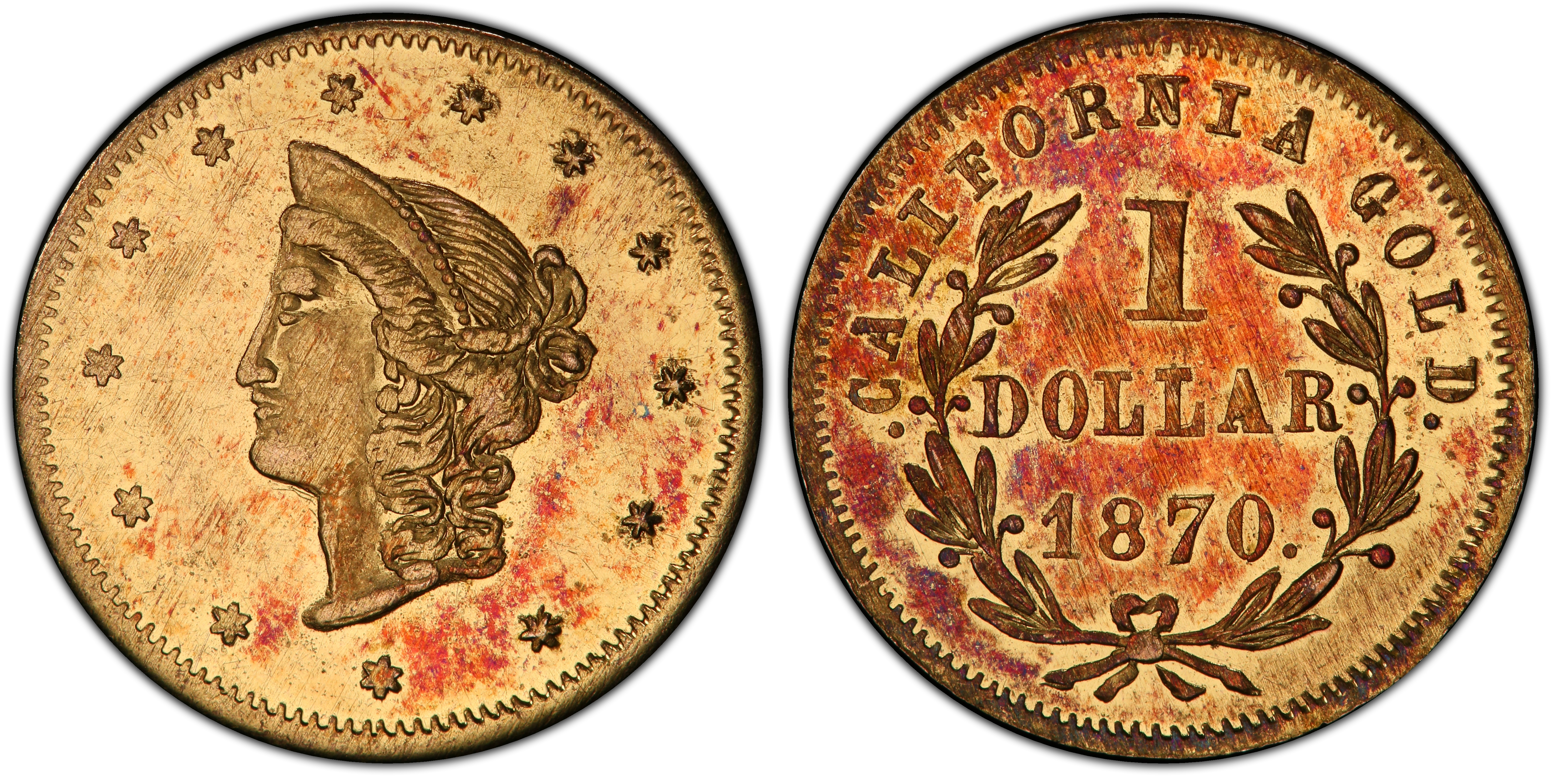
Obverse & Reverse
The 1870 G$1 BG-1205 is a product of the second period (1859-1882) of California Fractional Gold production, often termed the 'Jewelers' Issues' era. Following the initial Gold Rush boom, the immediate, desperate need for circulating coinage that drove the creation of Period One (1852-1857) fractionals had subsided. The establishment of the San Francisco Mint in 1854 began to supply the region with official U.S. coinage, gradually displacing the private issues. However, the allure of gold and the tradition of local coinage persisted. Jewelers and private minters in San Francisco continued to strike these small-denomination gold pieces, but their primary purpose shifted. While some may have seen limited use in small-scale transactions, they were increasingly produced as souvenirs, keepsakes for tourists, and novelty items. This period was characterized by a wide variety of designs, often cruder and more fanciful than the earlier issues, and a general trend of the coins containing less gold than their stated face value. The U.S. government took a dim view of private coinage, and the Coinage Act of 1864 officially made the practice illegal. Enforcement was initially lax, allowing production to continue for nearly two more decades. The BG-1205, dated 1870, falls squarely into this legally ambiguous period. It was struck by an unknown maker, a common trait for these 'jewelers' issues,' as minters sought to avoid legal repercussions. Production methods were often rudimentary, employing hand-cut dies and manual screw or hammer presses, which resulted in significant variations in strike quality. The era of these charming gold pieces came to a definitive end in 1883 when the U.S. Secret Service cracked down on their production, confiscating dies and effectively halting the minting of California Fractional Gold.
Associated EventCalifornia Gold Rush and Post-Rush Era
Reason For MintingPrimarily created as souvenirs and novelty items for the jewelry trade during a period when the acute shortage of small change had eased.
Minter HistoryThe specific minter for BG-1205 is unknown, which is typical for many Period Two California Fractional Gold pieces. These coins are often referred to as 'jewelers' issues' because they were predominantly made by anonymous watchmakers, engravers, and jewelers in San Francisco who had the skills and equipment to work with gold on a small scale. Unlike the more organized private mints of the early 1850s, these later producers often operated without clear identifying marks to avoid government scrutiny after the Private Coinage Act of 1864.
Historical SignificanceThe BG-1205 is significant as a representative of the later period of California Fractional Gold, illustrating the transition of these pieces from quasi-currency to souvenir tokens. It reflects the sustained romanticism of the Gold Rush and the continued demand for gold novelties long after the initial fever had passed. The variety and anonymity of these issues highlight a chapter of private enterprise operating in a legal gray area before federal authority fully suppressed private coinage.
BG-1205
Denomination$1
Minting Period1870
Assayer/MinterUnknown private minter, likely a San Francisco jeweler.
Geographic OriginSan Francisco, California
Obverse DescriptionA crudely executed, right-facing bust of Liberty, often nicknamed the 'Goofy Head' by collectors due to its naive style. Liberty is surrounded by thirteen stars, representing the original colonies.
Obverse InscriptionNo inscription.
Reverse DescriptionThe denomination '1' and the word 'DOLLAR' are enclosed within a wreath of leaves and berries. The date '1870' appears below the wreath.
Reverse Inscription1 DOLLAR 1870
CompositionGold
Stated Fineness Actual FinenessVaries, but typically lower than official U.S. coinage of the era.
EdgePlain
Unknown
Survival Estimate76-150 known
Rarity ScaleR-4+ / R-5
The BG-1205 is popular due to its distinctive and endearingly crude 'Goofy Head' design, which gives it a unique character. As a dated one-dollar denomination from the souvenir or 'jewelers' issue' period, it represents an accessible entry point into the fascinating world of California Fractional Gold, a tangible link to the legacy of the Gold Rush.
Key VarietiesThe primary issue is the regular business strike. No known contemporary varieties, patterns, or restrikes exist for this specific Breen-Gillio number. The series of California Fractional Gold itself contains over 450 distinct varieties cataloged by Breen and Gillio, but BG-1205 is a singular die marriage.
Authentication TipsGenuine BG-1205 coins often exhibit a slightly weak or uneven strike due to their manual production. The gold color should be consistent, not plated. Look for sharp, albeit crude, details on authentic pieces. Counterfeits are common in this series; many are modern replicas sold as souvenirs which often feature a bear on the reverse (a fantasy element not found on genuine historical pieces). Authentication by a major third-party grading service like PCGS or NGC is highly recommended. The reference work 'California Pioneer Fractional Gold' by Breen and Gillio is the definitive guide for attribution.
Shopping ConsiderationsWhen acquiring a BG-1205, seek an example with a bold strike, especially on the date and the word 'DOLLAR'. Original, uncleaned surfaces are paramount; many surviving examples have been cleaned, polished, or used as jewelry, resulting in hairlines, scratches, or evidence of mounting. A premium quality specimen will possess clean surfaces with some remnant luster, often prooflike in appearance, and be free of significant distracting marks. Eye appeal is crucial; pieces with attractive, original olive-gold toning command a premium. Given the prevalence of counterfeits and damaged pieces, purchasing a certified coin from a reputable dealer is the safest approach.
A coin's grade is its condition, rated on a 1-70 scale. For rare coins, this is the most critical factor in determining value, as a tiny difference in preservation can mean a huge difference in price.
Relevant Grade TypesOriginal 1870 BG-1205 issues were business strikes, likely intended as novelties rather than for extensive circulation, and are found in both Circulated (1-58) and Mint State (MS, 60-70) grades. No true Proofs were struck during the original period of issue. While some Mint State examples exhibit reflective, prooflike (PL) surfaces due to the polishing of the dies, they are not considered separate Proof strikings. There are no known later-date restrikes or special collector issues for this variety.
Mint State CharacteristicsUncirculated examples of BG-1205 are defined by the presence of original mint luster, which can range from satiny to semi-prooflike. Strike quality varies significantly; a well-struck coin will show clear details in Liberty's hair and the wreath leaves. Weakness is common, particularly on the highest points. Due to the small size and manual handling, even high-grade Mint State coins may exhibit tiny planchet flaws or contact marks that do not impair the overall grade.
Circulated Wear PatternsWear first appears on the high points of Liberty's cheek, hair, and the bow of the wreath on the reverse. On lower grade circulated examples, the stars on the obverse will begin to merge with the field, and the finer details of the wreath will become indistinct. The date is relatively protected and often remains legible even on well-worn specimens.
Key Factors For ValueThe primary drivers of value for an 1870 BG-1205 are grade and surface quality. An uncleaned coin with original skin and luster will always be worth substantially more than a cleaned or polished example of the same grade. Strike sharpness is a key differentiator; a coin with a full, crisp strike is highly desirable. Eye appeal, encompassing toning and the absence of distracting marks, plays a major role. Finally, certification by PCGS or NGC is standard for this series, and a sticker from CAC (Certified Acceptance Corporation) indicating premium quality for the grade can add a significant premium.
PCGS Price Guide
| Grade | Price | Population |
|---|---|---|
| 12 | $1,350.00 | 1 |
| 15 | $1,360.00 | N/A |
| 20 | $1,375.00 | N/A |
| 25 | $1,385.00 | N/A |
| 30 | $1,400.00 | 2 |
| 35 | $1,425.00 | 2 |
| 40 | $1,475.00 | 3 |
| 45 | $1,500.00 | 1 |
| 45+ | $1,525.00 | N/A |
| 50 | $1,650.00 | 3 |
| 50+ | $1,675.00 | N/A |
| 53 | $1,750.00 | 5 |
| 53+ | $1,775.00 | N/A |
| 55 | $1,900.00 | 7 |
| 55+ | $1,975.00 | N/A |
| 58 | $2,100.00 | 11 |
| 58+ | $2,300.00 | N/A |
| 60 | $3,000.00 | N/A |
| 61 | $3,750.00 | 9 |
| 62 | $4,250.00 | 4 |
| 62+ | $4,750.00 | N/A |
| 63 | $6,750.00 | 2 |
| 64 | N/A | N/A |