1876 G50C BG-1060 (Regular Strike)
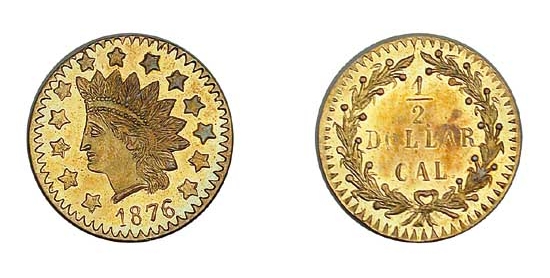
Obverse & Reverse
The 1876 BG-1060 Gold 50 Cents is a product of the second period of California Fractional Gold production, a fascinating and complex chapter in American numismatics. The initial California Gold Rush (1848-1855) created an immense and immediate need for circulating coinage in the rapidly growing territory. With the nearest federal mint in Philadelphia—a perilous journey away—local assayers and jewelers stepped in to fill the void, first with large denomination slugs and coins, and by 1852, with fractional denominations of 25 cents, 50 cents, and one dollar. These 'Period One' (1852-1857) issues were generally of high purity and intended to alleviate the severe shortage of small change, supplementing the clumsy use of gold dust for minor transactions. However, the story of the BG-1060 is rooted in a later era. By 1864, the United States government passed a new Coinage Act, explicitly making private coinage illegal. This effectively ended the legitimate minting of fractional gold for commerce. Yet, the allure of California gold and the romance of the Gold Rush had created a new market: souvenirs and jewelry. 'Period Two' (1859-1882) pieces, including the 1876 BG-1060, were struck to meet this demand. These coins were no longer intended to be a monetary necessity but were instead keepsakes and novelty items. Many were produced by San Francisco jewelers who reused old dies or created new ones with popular motifs like the Indian Head. These later issues often contained less gold than their stated face value, solidifying their status as tokens rather than circulating currency. The year 1876 was significant as it marked the Centennial of the United States, an event celebrated with great fanfare across the country, including at the Centennial Exposition in Philadelphia. It is highly probable that pieces like the BG-1060 were produced to capitalize on the patriotic and nostalgic sentiments of the time, sold to tourists and locals alike as mementos of both the nation's centenary and California's unique gold rush legacy.
Associated EventPost-Gold Rush Souvenir Era
Reason For MintingPrimarily struck as a souvenir or jewelry piece for the tourist trade, not for general circulation as currency.
Minter HistoryThe specific minter of BG-1060 is unknown, a common trait for Period Two fractional gold. The 'jeweler's issues,' as they are often called, were made by numerous, often anonymous, artisans in San Francisco. Unlike the famed assayers of the main Gold Rush, these producers were catering to a different market and did not typically mark their work with identifiable initials or names. They possessed the skills to work with gold and cut dies, producing these miniature coins for a public eager for gold rush mementos.
Historical SignificanceThe BG-1060 is significant not as a coin that facilitated commerce, but as a tangible link to the enduring legacy of the California Gold Rush. It represents the commercialization of that history, demonstrating how the event was mythologized and commodified for a new generation. Its existence illustrates the transition from utilitarian private coinage born of necessity to souvenir tokens that celebrated a romanticized past.
BG-1060
DenominationG50C
Minting Period1876
Assayer/MinterUnknown, likely a San Francisco jeweler
Geographic OriginSan Francisco, California
Obverse DescriptionA Native American princess head, commonly referred to as an 'Indian Head,' facing left. She wears a feathered headdress. The portrait is encircled by 13 six-pointed stars.
Obverse Inscription Reverse DescriptionThe denomination '1/2' is surrounded by a wreath composed of two leafy branches tied together at the bottom with a ribbon. The date '1876' is positioned below the wreath, and the legend 'CALIFORNIA GOLD' is inscribed above it.
Reverse InscriptionCALIFORNIA GOLD 1/2 1876
CompositionGold
Stated Fineness Actual FinenessVariable, but generally lower than Period One issues.
Weight0.25 grams
Diameter10.00 mm
EdgePlain
Unknown
Survival Estimate31-75
Rarity ScaleR-5+
The BG-1060 appeals to collectors due to its classic Indian Head design, its direct connection to the California Gold Rush souvenir era, and its relative scarcity. As a Period Two issue, it is more affordable than the earlier circulating fractionals, making it an accessible entry point into this popular collecting area.
Key VarietiesThe primary variety is the regular business strike. No proof restrikes from this period are known. Collectors should be aware of contemporary counterfeits and modern replicas, which are common for all California Fractional Gold. The Breen-Gillio (BG) catalog is the definitive reference, and BG-1060 is a specific die marriage. Other BG numbers for 1876 50C coins represent different die pairings or design variations.
Authentication TipsAuthentic BG-1060 coins have a specific die crack pattern; spindly cracks are often visible on both the obverse and reverse. The strike can be uneven, but genuine examples show characteristic sharpness on certain elements when well-struck. The gold color should be consistent with 19th-century alloys, often with a slightly brassy or reddish hue. Modern fakes are often gold-plated, have incorrect weight and size, and exhibit mushy or incorrect design details. Third-party grading and authentication by services like PCGS or NGC is highly recommended.
Shopping ConsiderationsA premium quality example for its grade will possess a sharp strike, especially on the feathers of the headdress and the details of the wreath. Look for original, undisturbed luster and pleasing eye appeal. Many of these pieces were cleaned or used in jewelry, so finding an example free of rim damage, ex-jewelry evidence (like solder or tooling), and harsh cleaning is a priority. Toning can range from a light straw-gold to deeper olive or sea-green hues, with attractive, original toning adding to the coin's desirability. Avoid pieces with significant spotting or surface impairments.
A coin's grade is its condition, rated on a 1-70 scale. For rare coins, this is the most critical factor in determining value, as a tiny difference in preservation can mean a huge difference in price.
Relevant Grade TypesOriginal period issues of BG-1060 were business strikes. As they were sold primarily as souvenirs rather than for circulation, they are most commonly found in Mint State (MS, 60-70) grades. Circulated examples (1-58) exist but are less common, as they did not see widespread commercial use. No proofs were struck during the original period of issue, and there are no known later-date collector restrikes for this specific variety.
Mint State CharacteristicsUncirculated examples of BG-1060 often display prooflike or semi-prooflike surfaces due to the polished dies used by jewelers. The quality of the strike can vary; look for full definition on the Indian's profile and the wreath leaves. Luster is typically bright and flashy. Small planchet flaws or die cracks are common and considered characteristic of the issue, not necessarily detractors unless they are severe. Minor contact marks from handling are expected, but large, distracting marks will lower the grade.
Circulated Wear PatternsOn circulated examples, wear first appears on the high points of the design: the Indian's cheek, the eyebrow, and the feathers in the headdress. On the reverse, the highest points of the wreath and the numerals of the fraction '1/2' will show the first signs of friction and flattening.
Key Factors For ValueFor the BG-1060, the primary value drivers are grade and surface quality. A high-grade Mint State coin (e.g., MS-64 or higher) with original, lustrous surfaces commands a significant premium. Eye appeal is crucial; examples with attractive original toning and a sharp strike are highly sought after. Conversely, coins that have been harshly cleaned, polished, or removed from jewelry will be worth substantially less. A CAC sticker, indicating premium quality for the grade, adds a strong premium for this issue.
PCGS Price Guide
| Grade | Price | Population |
|---|---|---|
| 55 | $285.00 | 2 |
| 55+ | $300.00 | N/A |
| 58 | $325.00 | 2 |
| 58+ | $340.00 | N/A |
| 60 | $375.00 | N/A |
| 61 | $450.00 | 2 |
| 62 | $600.00 | 5 |
| 62+ | $650.00 | N/A |
| 63 | $900.00 | 6 |
| 63+ | $1,075.00 | N/A |
| 64 | $1,350.00 | 7 |
| 64+ | $1,500.00 | N/A |
| 65 | $2,000.00 | 2 |