1874 G50C BG-1054 (Regular Strike)
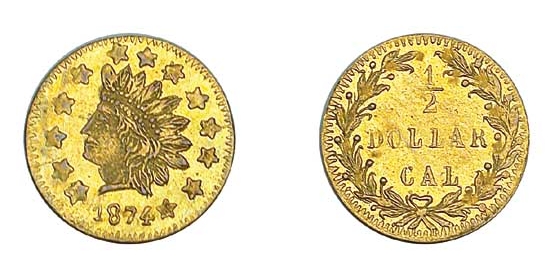
Obverse & Reverse
The 1874 BG-1054 50 Cent piece emerges from the second major phase of California's private gold coining era, often dubbed 'Period Two' (1859-1882) by numismatic historians like Walter Breen and Ronald Gillio. Unlike the earlier 'Period One' issues, which were struck out of genuine commercial necessity to alleviate the crippling shortage of small change during the initial Gold Rush, the context for Period Two issues is more complex. By the 1870s, the United States Mint in San Francisco was in full operation, and the acute currency crisis had largely abated. The reason for minting these small-denomination gold pieces shifted. They were produced primarily by jewelers and metalsmiths, serving a dual purpose as both quasi-currency in localized transactions and, increasingly, as popular souvenirs and keepsakes for tourists and locals fascinated by the romance of the Gold Rush. This variety, an Indian Head type, reflects a design trend that had become popular in national coinage with the introduction of the Indian Head cent. The production of these pieces was a gray-market activity; while the private coining of money had been outlawed by the Coinage Act of April 22, 1864, the law was not rigorously enforced against these tiny, low-value pieces until 1883. Consequently, numerous jewelers in San Francisco continued to strike them. These 'jeweler's issues' were often underweight and made from gold of varying fineness, a stark contrast to the more consistently assayed Period One coins. Their existence speaks to a persistent local demand for gold in tangible, fractional forms and the enduring cultural impact of the Gold Rush on California's identity. The BG-1054 is a quintessential example of this later period—a beautifully designed but unofficial piece that captures the transition of fractional gold from a vital commercial tool to a cherished memento.
Associated EventPost-Gold Rush Economic Period
Reason For MintingPrimarily produced by jewelers to serve a dual role as circulating currency in a coin-starved region and as popular souvenirs of the California Gold Rush.
Minter HistoryThe specific minter or jeweler responsible for the BG-1054 die marriage is unknown, a common fate for many Period Two California Fractional Gold varieties. The dies were likely produced by one of the many skilled but anonymous engravers operating in San Francisco's vibrant jewelry district during the 1870s. These craftsmen would create coin dies for various jewelers who would then strike the pieces on demand. The lack of a specific maker's mark or initial means attribution is to a broader class of 'jeweler's issues' rather than a specific, identifiable firm.
Historical SignificanceThe BG-1054 is significant as a tangible artifact of the post-Gold Rush era in California, representing the evolution of private coinage from a necessity to a commercial novelty and souvenir. It highlights a period of lax federal enforcement and the persistent local demand for gold pieces, embodying the romantic legacy of the Gold Rush long after its initial frenzy had passed.
N/A
Denomination50 Cents
Minting Period1874
Assayer/MinterUnknown Private Minter
Geographic OriginSan Francisco, California
Obverse DescriptionThe obverse features a female head in profile facing left, adorned with a Native American feathered headdress. The portrait is often referred to as an 'Indian Head' design. It is surrounded by thirteen six-pointed stars, representing the original colonies, along the periphery.
Obverse Inscription Reverse DescriptionThe reverse features the denomination '1/2' enclosed within a wreath composed of two leafy branches tied together at the bottom with a ribbon. The legend 'CALIFORNIA GOLD' is inscribed above the wreath, arching along the upper rim.
Reverse InscriptionCALIFORNIA GOLD 1/2
CompositionGold
Stated Fineness Actual FinenessVariable, but typically lower than U.S. Mint standards for the period.
Diameter10.00 mm
EdgePlain
Unknown
Survival Estimate4-6 known specimens
Rarity ScaleLow R-7
This coin is highly sought after due to its extreme rarity (Low R-7) and the popularity of the Indian Head motif. As a Period Two issue, it tells the story of the latter phase of California's private minting history, appealing to specialists in Territorial gold and collectors of U.S. pioneer coinage. Its tiny size and intricate design present a unique collecting challenge.
Key VarietiesThe BG-1054 is itself a key variety, distinguished by its specific obverse and reverse die pairing. No major sub-varieties from the original minting period are known or cataloged. No special collector issues, such as proofs or restrikes, are known to exist for this specific Breen-Gillio number.
Authentication TipsAuthentication requires careful comparison to known genuine examples. Pay close attention to the shape and placement of the stars, the details in the headdress feathers, and the specific font used for the reverse legend and fraction. Period Two issues are often crudely struck, so mushiness in some areas can be normal, but the overall style must be correct. Counterfeits of this era are common and often have a soapy, cast-like appearance, incorrect weight, or design details that are fantasies rather than copies of known varieties. Consultation of the Breen-Gillio reference work is essential.
Shopping ConsiderationsFor a 'premium quality' example, a potential buyer should seek a coin with a sharp strike, particularly on the highest points of the Indian's cheek and the details of the wreath. Original, uncleaned surfaces with some remaining mint luster are paramount and command significant premiums. Many surviving examples are cleaned or have been used as jewelry, so evidence of solder, harsh cleaning (hairlines), or tooling should be carefully checked for under magnification. Given the typical crude strike, a coin that is well-centered and fully struck on a round planchet is more desirable than a weakly struck or off-center example. Eye appeal is critical for this series.
A coin's grade is its condition, rated on a 1-70 scale. For rare coins, this is the most critical factor in determining value, as a tiny difference in preservation can mean a huge difference in price.
Relevant Grade TypesAll original examples of BG-1054 were struck as business strikes intended for potential circulation or sale as souvenirs. They are found in Circulated grades (AG-3 to AU-58) and, more commonly for this period, in Mint State (MS-60 to MS-70). No proofs were struck during the original period of issue, and no later-date Proof restrikes are known to exist.
Mint State CharacteristicsUncirculated examples of BG-1054 typically exhibit a soft, satiny luster characteristic of privately struck gold. The strike is often somewhat weak in the center of the obverse (the cheek and portions of the headdress) and the reverse (the fraction and bow of the wreath). Planchet quality can be irregular, and small adjustment marks or laminations are not uncommon. High-grade Mint State examples are prized for their clean surfaces, minimal contact marks, and superior strike quality for the issue.
Circulated Wear PatternsWear first appears on the highest points of the design. On the obverse, this includes the cheek, the eyebrow, and the tips of the feathers in the headdress. On the reverse, the leaves and the bow of the wreath will show the first signs of friction. On lower-grade examples, the stars and legends will begin to merge with the fields.
Key Factors For ValueExtreme rarity is the primary value driver. Beyond that, surface preservation is paramount; an example with original, lustrous 'skin' is far more valuable than a cleaned or polished coin of the same technical grade. Strike quality is the next key factor, as a sharply struck piece that shows the full detail of the dies is a rarity. Finally, superior eye appeal—meaning a pleasing, original color and mark-free surfaces—can add a significant premium. A CAC sticker for this issue would confirm quality for the grade and would be highly desirable to discerning collectors.
PCGS Price Guide
| Grade | Price | Population |
|---|---|---|
| 58 | $750.00 | 1 |
| 58+ | $800.00 | N/A |
| 60 | $875.00 | N/A |
| 61 | $950.00 | N/A |
| 62 | $1,000.00 | 5 |
| 62+ | $1,350.00 | N/A |
| 63 | $2,000.00 | 3 |
| 63+ | $3,000.00 | N/A |
| 64 | $4,500.00 | 2 |