1875 G50C BG-1056 (Regular Strike)
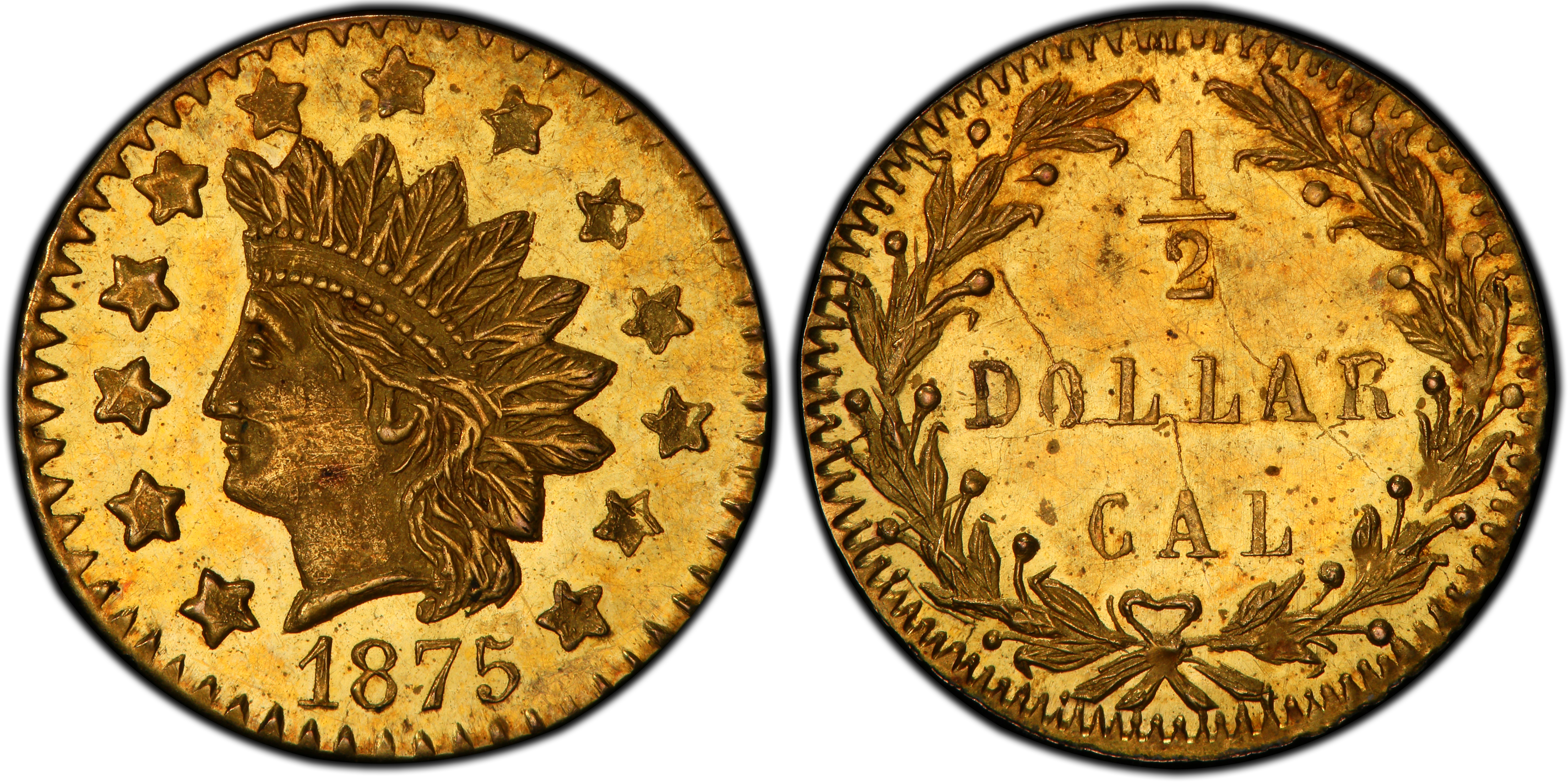
Obverse & Reverse
The 1875 50 Cents, cataloged as Breen-Gillio 1056 (BG-1056), represents the twilight era of privately issued California Fractional Gold. By the mid-1870s, the economic landscape of California had matured significantly from the chaotic early days of the Gold Rush. The massive influx of federal coinage and the establishment of the San Francisco Mint in 1854 had largely satisfied the region's monetary needs. However, a cultural preference for gold and a persistent shortage of small change for daily transactions sustained a niche market for these privately struck gold tokens. These pieces, often called 'charms' or 'souvenirs' to circumvent federal laws against private coinage, were produced by jewelers and private minters primarily in San Francisco. The Act of April 22, 1864, had made private coinage illegal, but production continued clandestinely, often with backdated or ambiguous designs to avoid prosecution. The BG-1056, dated 1875, is a 'Period Two' issue, struck between 1858 and 1882. Unlike the earlier, cruder necessity pieces, these later issues were generally better made, with more standardized designs, but their gold content was often minimal, and they primarily served as keepsakes, jewelry items, or tourist trinkets. They capitalized on the romantic allure of the Gold Rush, providing a tangible, affordable link to California's golden identity. The production of these pieces finally ceased after the Secret Service began actively prosecuting their makers in the early 1880s, bringing an end to a unique and fascinating chapter in American numismatic history.
Associated EventPost-Gold Rush Economic Normalization
Reason For MintingTo satisfy a lingering demand for small denomination specie and to serve as popular souvenirs for tourists and locals.
Minter HistoryThe specific minter for BG-1056 is unknown, a common trait for Period Two fractionals due to the illegal nature of their production. Numismatic research by experts like Mike Locke suggests that many of these later-dated pieces were likely struck by jewelers or specialized manufacturers in San Francisco, such as M. M. Frederick. These producers operated in a gray market, creating small gold tokens that mimicked official coinage but were carefully marketed as non-monetary items to avoid legal trouble.
Historical SignificanceThe BG-1056 is significant not as a coin of necessity, but as a cultural artifact representing the enduring legacy of the Gold Rush. It showcases how the 'romance of gold' was commercialized in late 19th-century California and demonstrates the persistent use of private gold tokens long after their original economic justification had vanished. Its existence highlights the cat-and-mouse game played between private minters and the U.S. government over the right to produce coinage.
N/A
Denomination50 Cents
Minting Period1875
Assayer/MinterUnknown private minter, possibly manufactured by the firm of M. M. Frederick of San Francisco.
Geographic OriginSan Francisco, California
Obverse DescriptionA right-facing Liberty head, stylistically similar to the contemporary U.S. gold coinage but of a distinct, cruder execution. The portrait is surrounded by 13 six-pointed stars.
Obverse Inscription Reverse DescriptionThe denomination '1/2' is centered within an open laurel wreath. The date '1875' is positioned below the wreath, and the legend 'CALIFORNIA GOLD' is inscribed above it along the upper periphery.
Reverse InscriptionCALIFORNIA GOLD 1/2 1875
CompositionGold
Stated FinenessNot stated, but typically low fineness for souvenir pieces of this era.
Actual FinenessVariable, often between 9 and 14 karats (.375 to .585 fine).
Weight0.25 grams
Diameter10.00 mm
EdgePlain
Unknown, but likely a few thousand.
Survival Estimate200-300
Rarity ScaleR-5 (Very Scarce)
BG-1056 appeals to collectors for its classic 'Liberty Head / Wreath' design, which evokes official U.S. coinage. As a dated, genuine Period Two fractional, it is an accessible and representative example of the later souvenir issues that are an essential part of the complete California Fractional Gold series.
Key VarietiesThe primary variety is the Regular Strike (business strike) as described. No Proofs or special collector strikings from the period are known to exist. Subtle die state variations may be found by specialists, but there are no major recognized varieties for BG-1056.
Authentication TipsGenuine BG-1056 coins exhibit a characteristic soft luster and a somewhat crude but consistent strike. The stars on the obverse and the lettering on the reverse should be carefully examined and compared to known genuine examples; they are often weakly defined. Common counterfeits are often brassy in color, have a soapy or tool-marked appearance, incorrect weight, or exhibit lettering and design details that are mushy or inconsistent with the known die characteristics. Authentication by a third-party grading service is highly recommended.
Shopping ConsiderationsA premium quality example for its grade will possess a sharp strike, particularly on Liberty's hair details and the numerals of the date. Seek out pieces with smooth, lustrous surfaces free of distracting marks, rim bumps, or evidence of having been mounted in jewelry, which is a common issue for these items. Original, uncleaned 'skin' with a nice reddish-gold or orange-peel texture is highly desirable. Avoid coins that appear harshly cleaned, polished, or exhibit scratches or tooling in the fields.
A coin's grade is its condition, rated on a 1-70 scale. For rare coins, this is the most critical factor in determining value, as a tiny difference in preservation can mean a huge difference in price.
Relevant Grade TypesOriginal issues were business strikes intended for circulation or as souvenirs and are found in Circulated (AU-58 and below) and Mint State (MS, 60-70) grades. No Proof (PR/PF) examples of BG-1056 were struck during its period of issue. Any piece described as a 'Proof' would be a modern fabrication or a misattribution.
Mint State CharacteristicsUncirculated examples of BG-1056 often show some weakness in the strike, particularly on the highest points of Liberty's hair and the leaves in the wreath. Luster is typically satiny and can be subdued compared to federal gold. Small planchet flaws or adjustment marks are not uncommon due to the nature of private production. Contact marks, even on high-grade pieces, are to be expected due to the softness of the low-karat gold and handling over the years.
Circulated Wear PatternsWear first appears on the high points of Liberty's hair, cheek, and the bow of the wreath. On the reverse, the numerals '1/2' and the leaves at the top of the wreath will show the first signs of friction. In lower grades (VF and below), the stars on the obverse and the letters in 'CALIFORNIA GOLD' will begin to lose their sharpness and merge with the fields.
Key Factors For ValueThe primary drivers of value for a BG-1056 are grade and surface quality. An example with a sharp strike and minimal marks will command a significant premium over a weakly struck or heavily abraded piece of the same numerical grade. Originality of the surfaces is paramount; coins that have been polished, harshly cleaned, or removed from jewelry are heavily penalized in the market. Eye appeal, encompassing attractive natural toning and lustrous fields, is a key, albeit subjective, factor. Certification by a top-tier grading service (PCGS or NGC) is standard for this series and a CAC sticker indicates premium quality for the assigned grade.
PCGS Price Guide
| Grade | Price | Population |
|---|---|---|
| 55 | $230.00 | 1 |
| 55+ | $240.00 | N/A |
| 58 | $250.00 | 7 |
| 58+ | $260.00 | N/A |
| 60 | $350.00 | 1 |
| 61 | $400.00 | 4 |
| 62 | $475.00 | 20 |
| 62+ | $525.00 | N/A |
| 63 | $600.00 | 17 |
| 63+ | $700.00 | N/A |
| 64 | $875.00 | 9 |
| 64+ | $1,150.00 | N/A |
| 65 | $2,100.00 | 2 |
| 66 | N/A | N/A |