1870 G$1 BG-1108 (Regular Strike)
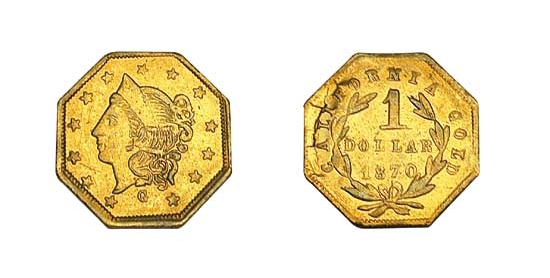
Obverse & Reverse
The 1870 G$1 BG-1108 is a quintessential example of 'Period Two' California Fractional Gold, a fascinating and complex era of private coinage. Following the initial wave of Period One issues (1852-1857), which were struck to genuinely alleviate a shortage of small change, the character of fractional gold shifted dramatically. By the late 1860s and early 1870s, the San Francisco Mint was in full operation, supplying ample federal coinage and rendering the commercial need for private gold obsolete. Instead, these later 'jeweler's issues' were primarily created to satisfy the burgeoning tourist trade and local demand for souvenirs and keepsakes. San Francisco had transformed from a chaotic boomtown into a sophisticated city, a destination for travelers who wanted a memento of the great Gold Rush. These small, intricate gold pieces served that purpose perfectly. The production of these coins existed in a legal gray area. The Private Coinage Act of 1864 had prohibited the issuance of private coins, and the U.S. Secret Service, under its zealous chief James J. Brooks, actively investigated and pressured the manufacturers. To circumvent the law, many jewelers struck coins with earlier dates or omitted incriminating markings. Despite this, production continued into the early 1880s. The BG-1108, dated 1870, was likely produced by one of the several manufacturing jewelers active in San Francisco at the time, such as Robert B. Gray & Co., who sold his enterprise to the California Jewelry Company (operated by the Levison Brothers) in 1871. These firms had the equipment and expertise to create dies and strike these miniature coins, which were often crudely produced using a hammer-striking method. Their intrinsic value was typically less than their face value, reinforcing their status as tokens rather than true circulating money. Today, the BG-1108 is prized not for its role in commerce, but as a tangible link to post-Gold Rush California and a testament to the ingenuity of the city's craftsmen. Its extreme rarity elevates it to a significant numismatic trophy within a highly specialized collecting field.
Associated EventCalifornia Gold Rush Aftermath & Tourism Boom
Reason For MintingPrimarily struck for sale as souvenirs, jewelry, and curiosities for tourists and locals, rather than to fill a commercial need for circulating coinage.
Minter HistoryThe specific minter of the BG-1108 die pair is not definitively known, a common trait for Period Two issues as makers sought to avoid legal trouble. However, the style and timing are consistent with the work of San Francisco manufacturing jewelers. The leading candidate is Robert B. Gray & Co., a known producer of fractional gold. Gray sold his business in 1871 to the California Jewelry Company, owned by the Levison Brothers, who continued the practice. These firms were not assayers in the territorial sense, but skilled craftsmen who manufactured jewelry and related novelty items for a thriving city.
Historical SignificanceThe BG-1108 represents the transition of California fractional gold from a necessary medium of exchange to a commercial souvenir product. Its existence highlights the lasting romantic appeal of the Gold Rush and the legal conflicts between private enterprise and federal oversight of coinage in the late 19th century.
BG-1108
Denomination$1
Minting Period1870
Assayer/MinterUnknown San Francisco Jeweler (Possibly Robert B. Gray & Co. or successors)
Geographic OriginSan Francisco, California
Obverse DescriptionA fairly crude rendering of a Liberty Head facing left, with LIBERTY inscribed on her coronet. The portrait is surrounded by 13 six-pointed stars arranged in a circle near the octagonal border.
Obverse InscriptionLIBERTY
Reverse DescriptionThe central device is the denomination '1' and the word 'DOLLAR' on two lines, with the date '1870' below. This is enclosed within a simple wreath composed of two branches tied with a bow at the bottom. The legend 'CALIFORNIA GOLD' is absent from this variety.
Reverse Inscription1 DOLLAR 1870
CompositionGold
Stated Fineness Actual Fineness Weight0.98 grams
Diameter12.30 mm
EdgePlain
Unknown
Survival Estimate4-12 (Derived from R-7 rating)
Rarity ScaleR-7
This coin is highly sought after for its extreme rarity (R-7). As a dollar denomination from Period Two, it is larger than the more common quarter and half dollar issues, making it a desirable type coin. Its octagonal shape and crude, historic charm appeal to specialists in fractional and pioneer gold.
Key VarietiesThere are no major, commonly collected varieties or restrikes known for the BG-1108 die pair. The primary challenge for collectors is simply locating an example for sale.
Authentication TipsAuthentication requires direct comparison with known genuine examples, ideally using the Breen-Gillio reference photographs. The strike is typically somewhat soft and crude, characteristic of hammer striking. Surfaces should exhibit the texture of genuine gold, not the porous or soapy look of common brass replicas. Be highly suspicious of examples with perfect, sharp strikes or unusual luster. Genuine Period Two pieces do not feature bears in their design; tokens with bears are modern fantasy pieces. Due to its high rarity and the prevalence of counterfeits, third-party certification by PCGS or NGC is strongly recommended.
Shopping ConsiderationsA 'premium quality' BG-1108 is one that is well-centered and has a reasonably bold strike for the issue, especially on the date and Liberty's portrait. Look for examples with clean, original surfaces that have not been harshly cleaned or polished, which is a common issue. Luster is typically subdued and satiny. A primary concern for all fractional gold is evidence of having been mounted as jewelry. Carefully inspect the edges and fields for signs of solder, tooling, or rim damage that has been smoothed over. Any example free from jewelry mounting damage commands a significant premium.
A coin's grade is its condition, rated on a 1-70 scale. For rare coins, this is the most critical factor in determining value, as a tiny difference in preservation can mean a huge difference in price.
Relevant Grade TypesOriginal examples of BG-1108 were business strikes, although intended as souvenirs rather than for circulation. They are found in both Circulated (AU-58 and below, though rare) and Mint State (MS, 60-70) grades. Due to their purpose as keepsakes, many survivors are uncirculated. No true Proofs from the original minting period are known to exist. Any piece described as a 'Proof' would be a later-date fantasy issue or a misattribution of a specimen with prooflike surfaces.
Mint State CharacteristicsUncirculated examples often show a lack of uniform strike. The central devices, like Liberty's cheek and the 'DOLLAR' on the reverse, may be fully struck while the stars at the periphery are weak, or vice versa. This is a result of the hammer-striking process. Luster is typically soft and satiny rather than bright and flashy. Small planchet flaws or adjustment marks are not uncommon and should not be confused with post-strike damage. Bag marks are less common than on federal issues, but small handling marks from decades of storage in jewelry boxes are typical.
Circulated Wear PatternsOn circulated examples, wear first appears on the highest points: Liberty's cheek, the hair above her eye, and the leaves of the wreath on the reverse. The fine details of the coronet and the bow on the reverse will show flattening. In lower grades, the stars and legends would begin to merge with the fields.
Key Factors For ValueFor the BG-1108, rarity is the primary value driver. Given two examples in the same numerical grade, the coin with superior eye appeal and surface quality will command a premium. Key factors include the sharpness of the strike, the presence of original, unmolested surfaces (as opposed to cleaned or polished), and the absence of any damage from jewelry use. A CAC sticker for this issue would be a strong value enhancer, confirming quality for the assigned grade.
PCGS Price Guide
| Grade | Price | Population |
|---|---|---|
| 30 | $900.00 | 1 |
| 35 | $950.00 | N/A |
| 40 | $1,000.00 | N/A |
| 45 | $1,050.00 | N/A |
| 45+ | $1,100.00 | N/A |
| 50 | $1,300.00 | N/A |
| 50+ | $1,500.00 | N/A |
| 53 | $1,750.00 | 1 |
| 53+ | $1,850.00 | N/A |
| 55 | $2,000.00 | 2 |
| 55+ | $2,150.00 | N/A |
| 58 | $2,350.00 | 3 |
| 58+ | $2,650.00 | N/A |
| 60 | $3,500.00 | N/A |
| 61 | $4,250.00 | N/A |
| 62 | $5,000.00 | N/A |
| 62+ | $5,750.00 | N/A |
| 63 | $7,500.00 | 2 |