1881 25C BG-799BB (Regular Strike)
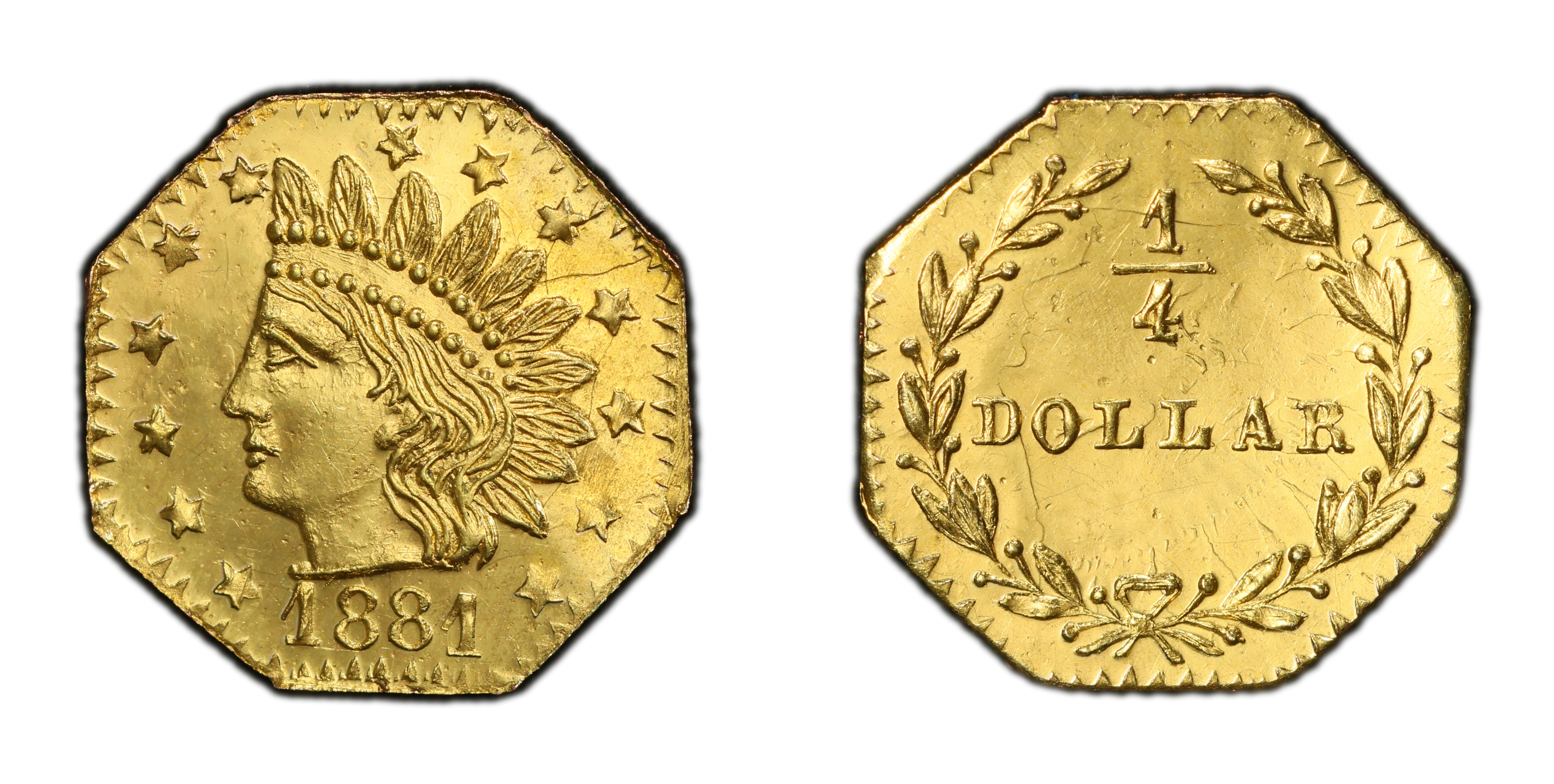
Obverse & Reverse
The 1881 25C BG-799BB is a product of the twilight years of California's fascinating fractional gold series. By the 1880s, the initial, desperate need for small circulating coinage that drove the creation of the first 'Cal Fracs' in 1852 had long subsided. The San Francisco Mint was in full operation, and federal coinage was plentiful. The purpose of these later-period 'jeweler's issues' had shifted dramatically from utilitarian currency to souvenirs and novelty items. The romance of the Gold Rush, though decades past, was a powerful marketing tool, and a burgeoning tourist trade in San Francisco created a vibrant market for these miniature gold tokens. Minter Robert B. Gray was a prominent San Francisco manufacturing jeweler who produced a wide variety of these small denomination pieces from the mid-1870s until the early 1880s. Unlike the earlier 'Period One' issues, which contained close to their face value in gold, these 'Period Two' pieces were intentionally underweight tokens. Their value was not in their metallic content but in their appeal as mementos of California's golden legacy. The passage of the Act of April 22, 1864, had made private coinage illegal, but the law was not strictly enforced against these small tokens until a final crackdown in 1883 effectively ended their production. The BG-799BB variety, with its classic Indian Head motif, was a popular design of the era, evoking a uniquely American frontier spirit that appealed to visitors. These pieces were struck using the traditional hammer method, where dies were struck by hand, leading to significant variations in strike quality and centering, a characteristic feature of the series.
Associated EventPost-Gold Rush California Tourism
Reason For MintingPrimarily created as souvenirs and novelty items for the tourist trade, not for general circulation.
Minter HistoryRobert B. Gray was a San Francisco-based manufacturing jeweler active during the 1870s and early 1880s. He was one of the most prolific producers of the later-period (Period Two) California fractional gold tokens. His firm created a wide array of designs and denominations, catering to the significant demand for souvenirs from visitors to California. His pieces are generally well-regarded for their craftsmanship within the series, though like all 'jeweler's issues', they were intentionally underweight tokens rather than true coinage.
Historical SignificanceThe BG-799BB represents the final phase of private gold minting in California, a period when the purpose of such items shifted from necessity-driven coinage to commercial souvenir production. It is a tangible link to the romantic, mythologized memory of the Gold Rush that fueled California's tourism and identity in the late 19th century. Its existence highlights the lax enforcement of federal private coinage laws until the final cessation of the practice in 1883.
N/A
Denomination25C
Minting Period1881
Assayer/MinterRobert B. Gray & Co.
Geographic OriginSan Francisco, California
Obverse DescriptionA stylized Indian Head facing left, with a feathered headdress. The portrait is surrounded by 13 stars, representing the original colonies.
Obverse Inscription Reverse DescriptionThe denomination '1/4' is enclosed within a wreath of leaves. The word 'CALIFORNIA' is typically absent on this variety.
Reverse Inscription1/4
CompositionGold
Stated Fineness Actual FinenessVaries, typically 14 to 22 karats, but always containing significantly less than face value in gold.
Diameter9.80 mm
EdgePlain
Unknown
Survival EstimateFewer than 30
Rarity ScaleR-6+
This variety is sought after for its high rarity (R-6+), attractive Indian Head design, and its place as one of the final issues of the historic California Fractional Gold series. Its octagonal shape adds to its distinctiveness and collector appeal.
Key VarietiesThe primary distinction for BG-799BB is its specific die pairing. No major varieties, patterns, or official restrikes are known for this specific Breen-Gillio number. Collectors should be aware that many different die pairings and makers produced similar Indian Head quarter-dollar tokens around this time, each with its own BG number. The 'Regular Strike' designation confirms it is an original business strike from the period, as no Proofs were made.
Authentication TipsGenuine examples have a characteristic soft, slightly prooflike luster from the polished dies used. Check for die markers specific to the BG-799BB variety. The stars on the obverse and the details of the wreath on the reverse should be carefully compared to known genuine examples. Counterfeits are common and may be gold-plated brass or have incorrect weight and design details. Many fakes have a soapy, washed-out appearance or exhibit incorrect lettering fonts.
Shopping ConsiderationsA premium quality example for this issue will exhibit a sharp, well-centered strike, which is uncommon due to the hand-hammered production method. Look for pieces with minimal distracting contact marks and original, uncleaned surfaces. A strong strike on the high points of the Indian's cheek and the feathers of the headdress is highly desirable. Eye appeal is paramount; coins with a lustrous, almost proof-like surface command significant premiums. Avoid examples that have been holed, repaired, or harshly cleaned, as these are common problems for the series.
A coin's grade is its condition, rated on a 1-70 scale. For rare coins, this is the most critical factor in determining value, as a tiny difference in preservation can mean a huge difference in price.
Relevant Grade TypesAll original BG-799BB pieces were struck as business strikes, intended for sale as souvenirs. They are found in Circulated (1-58) and, more commonly, Mint State (MS, 60-70) grades, as many were kept as keepsakes. No Proof (PR/PF) examples were struck during the original period of issue, and no later-date restrikes are known to exist.
Mint State CharacteristicsUncirculated examples of BG-799BB often display a bright, reflective luster, sometimes described as 'proof-like,' due to the preparation of the dies. Strike weakness is common; look for full detail in the central devices. The fields can be very clean, but small planchet flaws or adjustment marks made prior to striking are not unusual for the series. Contact marks, even on high-grade pieces, are often present due to the softness of the gold and their method of storage and transport.
Circulated Wear PatternsWear first appears on the high points of the design: the cheek and feathers of the Indian princess on the obverse, and the highest leaves and bow of the wreath on the reverse. On moderately worn examples, the individual feathers will begin to merge, and the stars will lose their sharpness.
Key Factors For ValueFor the BG-799BB, the primary value drivers are rarity and grade. Surface quality is critical; an example with original, undisturbed luster will be worth far more than a cleaned or polished one of the same grade. Strike sharpness is a major factor, with well-centered and fully struck specimens commanding strong premiums. Eye appeal, encompassing toning, luster, and the absence of distracting marks, plays a significant role. Given the prevalence of counterfeits, certification by a top-tier grading service (PCGS or NGC) is essential for market acceptance and value.
PCGS Price Guide
| Grade | Price | Population |
|---|---|---|
| 61 | $700.00 | 1 |
| 62 | $1,000.00 | 3 |
| 62+ | $1,150.00 | N/A |
| 63 | $1,650.00 | 5 |
| 63+ | $1,800.00 | N/A |
| 64 | $2,250.00 | 4 |