1876 25C BG-799F (Regular Strike)
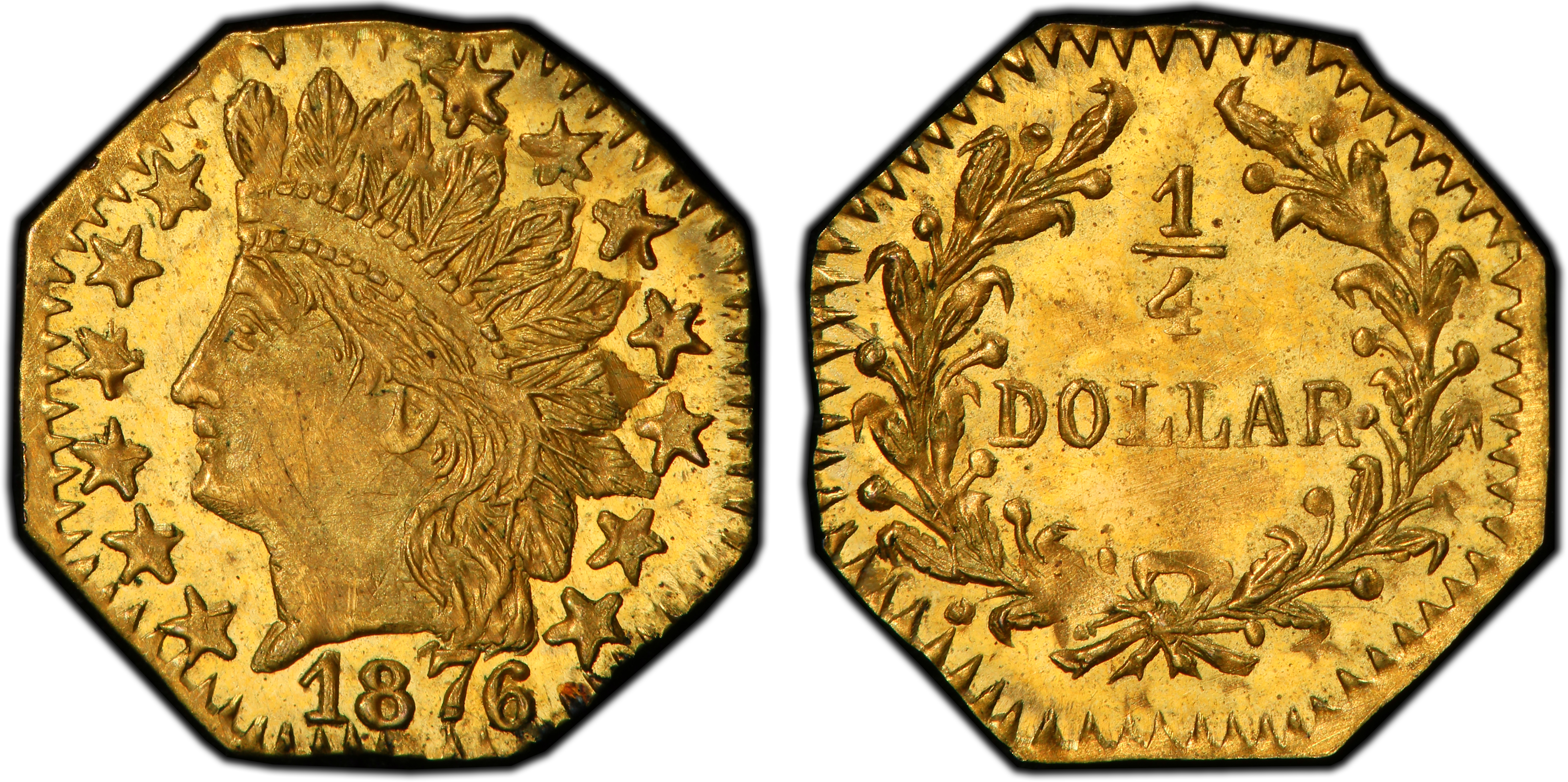
Obverse & Reverse
The 1876 BG-799F 25 cent piece emerges from the second major phase of California's private gold coinage, known to numismatists as 'Period Two' (1859-1882). Unlike the 'Period One' issues, which were struck out of genuine commercial necessity to alleviate a dire shortage of small change during the Gold Rush, the Period Two pieces occupy a more complex, quasi-legal space. The Coinage Act of 1864 had explicitly forbidden private individuals from issuing currency, rendering the manufacture of denominated gold coins a federal crime. However, enforcement in the West was lax, and the public's fascination with the Gold Rush created a booming market for souvenirs and keepsakes. San Francisco jewelers, many of whom remain anonymous, stepped into this market. They produced a dizzying variety of miniature gold 'coins' that were sold as novelties, incorporated into jewelry, or kept as mementos of a visit to the romanticized West. By 1876, the United States was celebrating its Centennial, and Philadelphia was hosting a massive Exposition. This event spurred national pride and interest in American history, likely increasing tourist demand for items like California Fractional Gold. These pieces were not intended to, and largely did not, function as circulating money. Their gold content was often less than their face value would imply, and their tiny size made them impractical for daily commerce. The BG-799F, with its classic 'Indian Head' motif—a design romanticizing the American frontier—was perfectly tailored to this souvenir market. The production of these pieces continued until a Secret Service crackdown in the early 1880s finally extinguished the practice, closing a fascinating chapter of American enterprise and numismatic history. Today, these 'jeweler's issues' are highly collectible, valued not for their intrinsic worth but as tangible artifacts of a transitional period in California's history.
Associated EventPost-Gold Rush California Tourism
Reason For MintingPrimarily struck for sale to tourists and collectors as souvenirs, capitalizing on the romantic legacy of the Gold Rush.
Minter HistoryThe specific maker of the BG-799F die pair is unknown, a common trait for Period Two fractional gold. These pieces were produced by various manufacturing jewelers in San Francisco who rarely signed their work to avoid potential legal trouble with federal authorities following the Coinage Act of 1864. Their business model was based on creating attractive, low-cost gold novelties for a burgeoning tourist trade, rather than establishing a reputation as private minters in the vein of their Period One predecessors.
Historical SignificanceThe BG-799F is historically significant not as a coin for circulation, but as an artifact of the commercialization of the Gold Rush myth. It represents a period when private minting shifted from a necessary commercial activity to a legally gray but profitable souvenir industry, reflecting California's transition from a raw frontier to a popular tourist destination.
BG-799F
Denomination25C
Minting Period1876
Assayer/MinterUnknown Jeweler
Geographic OriginSan Francisco, California
Obverse DescriptionA stylized Native American head facing left, often referred to as an 'Indian Head'. The portrait is surrounded by 13 five-pointed stars, representing the original colonies. The date, 1876, is positioned below the bust.
Obverse Inscription1876
Reverse DescriptionThe denomination '25 CENTS' is enclosed within a wreath of leaves and berries. The wreath is open at the top.
Reverse Inscription25 CENTS
CompositionGold
Stated Fineness Actual FinenessVariable, generally lower than .900, as was typical for Period Two souvenir pieces.
Weight0.38 grams
Diameter9.60 mm
EdgePlain
Unknown
Survival Estimate19-30 (per R-6 rating)
Rarity ScaleLow R-6
This variety appeals to collectors due to its high rarity (Low R-6), attractive octagonal shape, and classic Indian Head design. As a dated Centennial year piece, it carries additional historical interest. Its status as a scarce, tangible link to the post-Gold Rush souvenir trade makes it a prized addition to specialized collections of California Fractional Gold.
Key VarietiesThe BG-799 series includes several minor die varieties (BG-799A through BG-799L) with different dates or minor design changes, but the 1876 BG-799F is a distinct variety. No known patterns, trial pieces, or official restrikes exist for this specific die marriage. Collectors should be aware of contemporary counterfeits and modern replicas, which are numerous for this series.
Authentication TipsAuthentic BG-799F pieces exhibit a sharp, if sometimes uneven, strike from hand-operated presses. Look for crisp details in the stars and wreath leaves. The font and numeral style should match known genuine examples. Many Period Two pieces have a slightly brassy or lower-karat gold appearance compared to federal gold. Be wary of pieces with a soapy, cast-like appearance, incorrect weight or diameter, or design details (like bears) not found on genuine issues. Third-party certification by PCGS or NGC is highly recommended for this series.
Shopping ConsiderationsA premium quality example for its grade will possess a sharp strike, especially on the high points of the Indian's hair and the numbers in the date. Look for original, undisturbed surfaces with some remaining mint luster; prooflike or deeply mirrored fields are particularly desirable and command significant premiums. Avoid examples that have been harshly cleaned, polished, or previously mounted in jewelry, the last being a common fate for these pieces. A noticeable die rotation of nearly 160 degrees is a known characteristic of this variety and is a positive diagnostic rather than a flaw. Coins with attractive, reddish-gold toning are highly sought after.
A coin's grade is its condition, rated on a 1-70 scale. For rare coins, this is the most critical factor in determining value, as a tiny difference in preservation can mean a huge difference in price.
Relevant Grade TypesAll original BG-799F pieces are considered business strikes, though they were not intended for widespread circulation. They are found in Circulated grades (1-58) and, more commonly for this souvenir issue, in Mint State (MS, 60-70). No true Proofs were struck during the original period of issue. Some examples are designated as Prooflike (PL) by grading services due to their highly reflective fields, a byproduct of polished dies, but they are not true Proof coins.
Mint State CharacteristicsUncirculated examples are defined by the quality of their luster, strike, and marks. Luster on BG-799F can range from satiny to deeply prooflike. The strike can be inconsistent due to the manual coining process; a sharp strike on the central devices (Indian's portrait, '25 CENTS') is a key value driver. Due to their small size and handling as souvenirs, even high-grade examples can show minor contact marks or 'ticks', but large, distracting marks will limit the grade.
Circulated Wear PatternsWear first appears on the highest points of the design. On the obverse, check for flatness on the Indian's cheekbone, the details in the hair, and the tips of the stars. On the reverse, the high points of the leaves in the wreath and the edges of the numerals will show the first signs of friction. In lower grades (VF and below), the date and legend will begin to soften and merge with the fields.
Key Factors For ValueFor the BG-799F, value is primarily driven by rarity and grade. Surface quality is paramount; an example with original, uncleaned 'skin' and strong luster will always be worth more than a cleaned or polished coin of the same grade. Strike sharpness is the next critical factor, with well-defined central details commanding a premium. Eye appeal, enhanced by prooflike surfaces or attractive natural toning, significantly boosts value. A CAC sticker on a certified coin provides third-party verification of quality for the grade and often results in a higher market price.
PCGS Price Guide
| Grade | Price | Population |
|---|---|---|
| 63 | $600.00 | 5 |
| 63+ | $725.00 | N/A |
| 64 | $950.00 | 14 |
| 64+ | $1,150.00 | N/A |
| 65 | $1,750.00 | 6 |
| 65+ | $2,000.00 | N/A |
| 66 | $2,500.00 | 1 |