1874 25C BG-795, PL (Regular Strike)
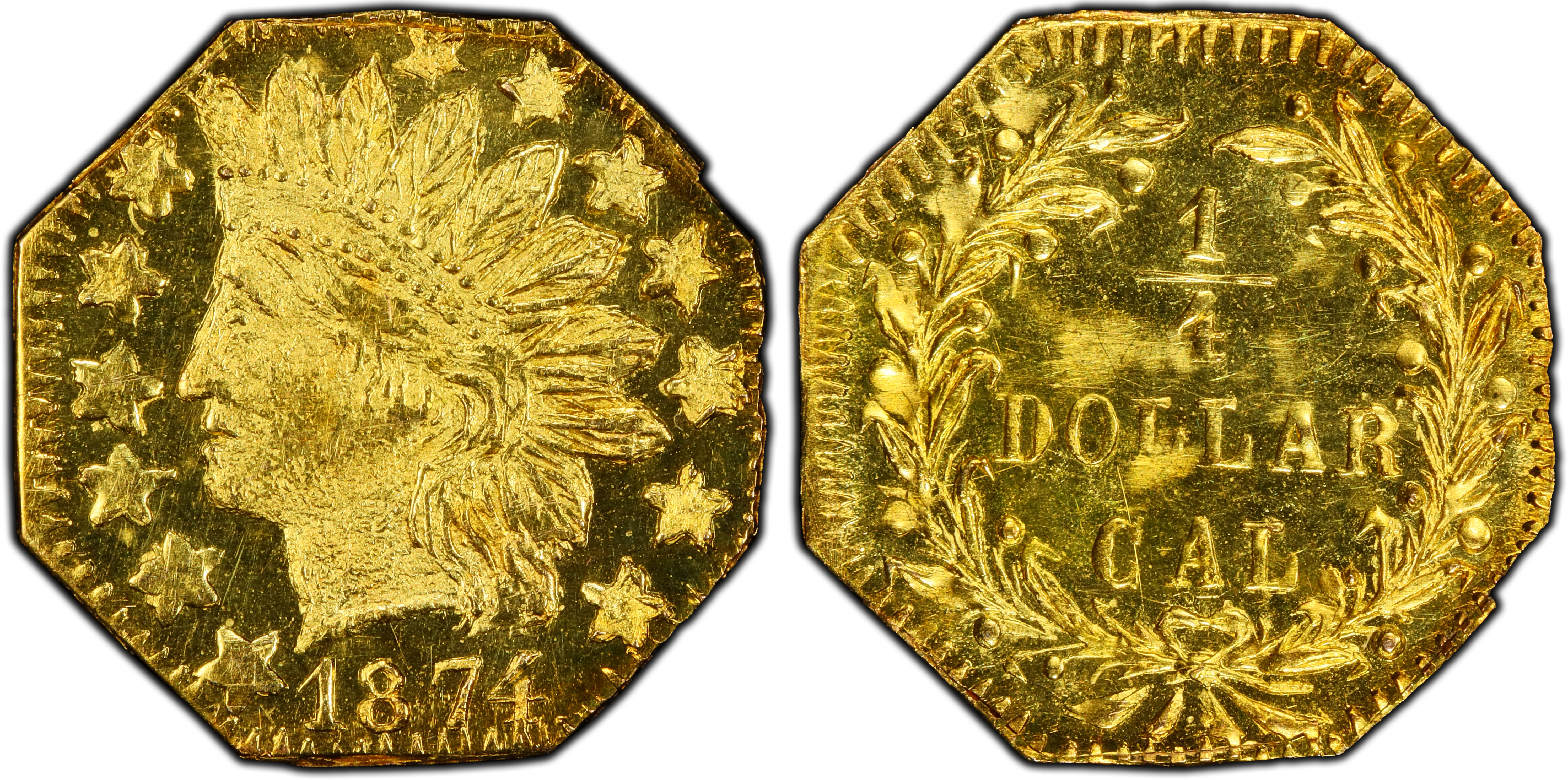
Obverse & Reverse
The 1874 25 Cent octagonal gold piece, cataloged as Breen-Gillio 795, is a quintessential example of a 'Period Two' California Fractional Gold coin. This era, spanning from 1858 to 1882, represents a significant evolution from the earlier 'Period One' issues. The initial fractional gold pieces of 1852-1857 were born of necessity, created by private jewelers and metallurgists to alleviate a severe shortage of small-denomination coinage that plagued the booming Gold Rush economy. These first issues were generally of good weight and were intended to, and did, facilitate commerce. By the 1870s, the landscape had changed. The San Francisco Mint, opened in 1854, was in full production, and federal silver and minor coinage had largely saturated the region, eliminating the acute need for private issues. Consequently, the motivation for producing fractional gold shifted from utility to novelty. The BG-795 was created not for the miner's pouch but for the tourist's pocket or the lady's jewelry box. These 'jeweler's issues' were primarily souvenirs, tangible mementos of the romanticized Gold Rush era sold in San Francisco's shops. As such, their gold content was often significantly less than their face value would imply; many were thinly struck, debased with other metals, or even merely gold-plated. The Coinage Act of 1864 had explicitly outlawed private coinage, but enforcement by the Secret Service was lax in California until the early 1880s, allowing this cottage industry to persist. Many Period Two minters were anonymous, leaving behind no identifying marks, earning their creations the numismatic moniker 'mavericks.' The BG-795 falls into this category, its maker lost to history. Its existence is a testament to the enduring allure of the gold fields and the clever marketing of jewelers who capitalized on it, creating a fascinating and complex series for future numismatists.
Associated EventPost-Gold Rush California Tourism
Reason For MintingPrimarily struck for sale as souvenirs and jewelry charms rather than for monetary circulation.
Minter HistoryThe specific maker of BG-795 is unknown. During 'Period Two' (1858-1882), numerous San Francisco jewelers produced a wide variety of fractional gold pieces, often without any identifying hallmarks. These anonymous pieces are referred to by numismatists as 'mavericks.' The focus of these makers was on novelty and appearance for the tourist trade, rather than adhering to a specific monetary standard, leading to great variety in design and quality but little historical record of their individual operations.
Historical SignificanceRepresents the transition of fractional gold from a necessary medium of exchange in the early Gold Rush to a popular souvenir item. It highlights a period of lax federal oversight on private minting and the capitalization of California's mystique for commercial purposes.
N/A
Denomination25 Cents
Minting Period1874
Assayer/MinterUnknown Private Jeweler
Geographic OriginSan Francisco, California
Obverse DescriptionA stylized head of a Native American chieftain facing left, wearing a feathered headdress. The portrait is surrounded by thirteen six-pointed stars.
Obverse Inscription1874
Reverse DescriptionThe denomination '1/4 DOLLAR' enclosed within a decorative wreath of leaves and berries, tied with a bow at the bottom.
Reverse Inscription1/4 DOLLAR CAL.
CompositionGold (often debased)
Stated Fineness Actual FinenessVariable; Period Two issues are notoriously inconsistent and often of low fineness, sometimes merely gold-plated.
EdgePlain
Unknown
Survival Estimate100-200 known. Based on combined NGC and PCGS population reports totaling over 120 graded examples as of late 2023, with an allowance for raw examples.
Rarity ScaleR-5 (Very Rare: 76-200 known). Some auction houses have listed it as R-3, but R-5 is more consistent with population data for this specific, dated variety.
BG-795 is sought after for its classic Octagonal Indian Head design, its status as a dated 'Period Two' type, and its relative affordability compared to rarer 'Period One' issues. Its connection to the souvenir trade of post-Gold Rush San Francisco provides a unique historical narrative.
Key VarietiesNo major varieties are noted for the BG-795 in standard references. As a 'Period Two' jeweler's issue, it was not officially restruck. However, contemporary counterfeits and modern replicas are extremely common for the entire California Fractional Gold series. Collectors should be aware of 20th-century pieces made for the tourist trade, which are typically gold-plated brass and lack a stated denomination (e.g., '1/4 CAL GOLD' instead of '1/4 DOLLAR').
Authentication TipsAuthentic Period Two pieces must have a denomination (e.g., 'DOLLAR' or 'CENTS'). Be wary of pieces with a bear on the reverse, as these are modern fantasy creations. The strike on genuine pieces can be weak in areas, but the details should be consistent with known examples, not soft and mushy like a cast copy. The date on BG-795 is known to sometimes slope down, with the '4' occasionally touching the rim. Examine the style of the wreath and lettering, comparing them to high-resolution images of certified examples. Third-party grading is highly recommended for this series.
Shopping ConsiderationsA premium quality example for this issue is defined by a sharp strike, particularly on the Indian's headdress and the details of the wreath. The user's input 'PL' refers to 'Proof-Like' surfaces, which are highly desirable and command a significant premium; look for deeply mirrored fields contrasted with frosted devices. Many Period Two pieces suffer from weak or uneven strikes due to the hammered coining process, so a fully struck specimen is rare. Check for evidence of having been mounted in jewelry, such as rim damage, solder, or tooling marks. Avoid examples that have been harshly cleaned, as this strips the original skin and luster, greatly reducing value. A CAC sticker is a strong indicator of superior quality and eye appeal for the assigned grade.
A coin's grade is its condition, rated on a 1-70 scale. For rare coins, this is the most critical factor in determining value, as a tiny difference in preservation can mean a huge difference in price.
Relevant Grade TypesOriginal 1874 issues of BG-795 were business strikes, although not intended for circulation, they are found in both Circulated (1-58) and, more commonly, Mint State (MS, 60-70) grades due to their status as souvenirs. No true Proofs were struck during the original period of issue. The 'PL' (Proof-Like) or 'DMPL' (Deep Mirror Proof-Like) designations are applied by grading services to business strikes that exhibit highly reflective, mirror-like surfaces from being struck with polished dies, a characteristic often seen on these souvenir pieces.
Mint State CharacteristicsIn uncirculated grades, the quality is determined by the sharpness of the strike, the quality of the luster, and the presence of marks. BG-795 is often found with a reasonably sharp strike on the central devices but can show weakness at the periphery. Luster can range from satiny to deeply proof-like. As these pieces were made for the jewelry and souvenir trade, they often exhibit exceptionally clean surfaces, but minor handling marks or die polishing lines are common. Traces of gold plating over a debased core can sometimes be detected under magnification on some Period Two issues.
Circulated Wear PatternsOn circulated examples, wear first appears on the high points of the design: the cheek and feathers of the Indian princess, and the highest leaves and bow of the wreath on the reverse. In lower grades (VF and below), the stars on the obverse and the letters in the denomination will begin to merge with the fields.
Key Factors For ValueThe primary value drivers for BG-795 are grade and surface characteristics. A Mint State coin will be worth many times more than a circulated one. A specimen with a Proof-Like (PL) or Deep Mirror Proof-Like (DMPL) designation carries a substantial premium. Strike is critical; a fully struck piece with all details of the headdress and wreath visible is highly prized. Eye appeal, encompassing attractive original toning and mark-free surfaces, is paramount. Given the prevalence of forgeries, certification by a top-tier grading service (PCGS or NGC) is virtually essential for establishing authenticity and market value.
PCGS Price Guide
| Grade | Price | Population |
|---|---|---|
| 62 | N/A | N/A |
| 63 | N/A | 1 |
| 64 | $650.00 | 3 |
| 64+ | $800.00 | 1 |
| 65 | $975.00 | 2 |
| 65+ | $1,250.00 | N/A |
| 66 | $2,250.00 | 2 |
| 67 | N/A | N/A |