1870 G25C BG-759 (Regular Strike)
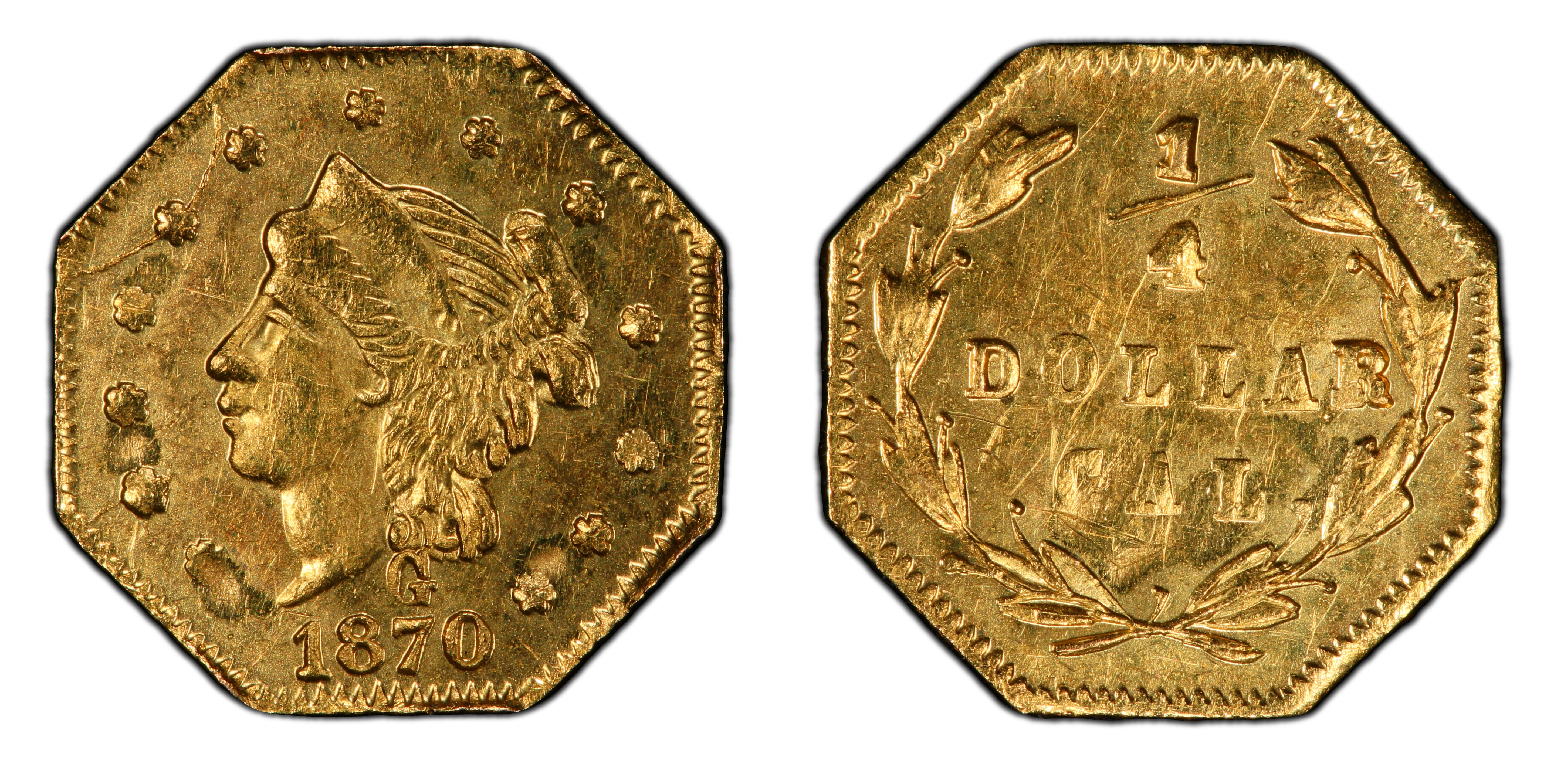
Obverse & Reverse
The 1870 G25C BG-759 is a tangible artifact from the second major phase of private coinage in California, a period driven less by commercial necessity and more by a burgeoning souvenir and jeweler's trade. The initial California Gold Rush (1848-1855) created a severe shortage of small change, leading to the first wave ('Period One,' 1852-1857) of privately issued fractional gold coins that were genuinely intended to facilitate commerce. By 1870, the San Francisco Mint was in full operation, alleviating the acute need for small currency. However, demand for the diminutive gold pieces persisted, primarily from tourists, merchants needing novel promotional items, and Easterners captivated by the romance of the Gold Rush. This 'Period Two' (1859-1882) saw jewelers like Robert B. Gray & Co. step in to fill this niche. These later issues, often called 'jeweler's pieces,' were typically lighter and of lower fineness than their Period One counterparts, functioning more as tokens or keepsakes than true circulating currency. The Coinage Act of 1864 had outlawed private currency, but enforcement was lax until the early 1880s, allowing firms like Gray's to operate in a legal gray area. Gray, who had purchased the business of another fractional gold minter, Antoine Louis Nouizillet, around 1859, began producing his own distinctive issues marked with a 'G' hallmark starting in 1870. These pieces were struck using the traditional hammer method, where dies were struck by hand with a sledgehammer, resulting in frequent variations in strike quality. The BG-759 variety, with its classic Liberty Head motif, represents a standard and popular design for the era, feeding a national curiosity for all things related to the California gold phenomenon. Its existence speaks to a mature post-Gold Rush economy where the metal was not just a medium of exchange, but a symbol of adventure and prosperity, commodified into miniature souvenirs.
Associated EventCalifornia Gold Rush (Later Souvenir Period)
Reason For MintingPrimarily struck to satisfy a growing demand for souvenirs and novelty items related to the California Gold Rush, rather than to alleviate a currency shortage.
Minter HistoryRobert B. Gray & Co. was a prominent San Francisco jewelry firm active in the production of California Fractional Gold during 'Period Two.' Around 1859, Gray acquired the dies, hubs, and business of Antoine Louis Nouizillet, one of the pioneering Period One minters. After using some of Nouizillet's old dies, Gray introduced new obverse dies in 1870 featuring his own hallmark, a small letter 'G,' typically placed in the field. Breen and Gillio note that Gray's issues are often heavier and more intrinsically valuable than many other Period Two pieces. The company continued striking these small gold tokens until Gray sold his interests to the California Jewelry Co. in 1871.
Historical SignificanceThe BG-759 is significant as a prime example of a 'Period Two' jeweler's issue of California Fractional Gold. It illustrates the transition of these pieces from utilitarian coins of necessity to popular commercial souvenirs, reflecting a shift in California's economy and national identity. It is also a key identifiable product of a known and important San Francisco minter, Robert B. Gray & Co.
Not Applicable
Denomination25 Cents
Minting Period1870
Assayer/MinterRobert B. Gray & Co.
Geographic OriginSan Francisco, California
Obverse DescriptionA classical Liberty Head portrait facing left, modeled after the U.S. gold dollars of James B. Longacre. She wears a coronet inscribed LIBERTY, and her hair is tied in a bun. The portrait is encircled by thirteen stars, representing the original colonies. The date, 1870, is below the bust, and the minter's hallmark 'G' is typically found in the field between the date and the portrait.
Obverse InscriptionLIBERTY
Reverse DescriptionThe denomination '1/4 DOLLAR' is centered within a wreath of leaves and berries. The wreath is open at the top.
Reverse Inscription1/4 DOLLAR
CompositionGold
Stated FinenessNot explicitly stated on the coin.
Actual FinenessVaries, but generally lower than official U.S. coinage of the era, typical for Period Two issues. Fineness for fractional gold could range from 14 to 22 karats.
Weight0.27 grams
Diameter9.60 mm
EdgePlain
Unknown; mintage records for private issues were not kept.
Survival Estimate76-150 coins known. The R-4 rarity rating suggests a population in this range.
Rarity ScaleR-4
This variety is highly collectible due to its direct link to the lore of the California Gold Rush, its identifiable maker's mark ('G' for Robert B. Gray), its classic Liberty Head design, and its relative affordability compared to Period One issues. It serves as an accessible entry point into the complex and fascinating world of California fractional gold.
Key VarietiesThe primary variety is the BG-759 regular strike. No proof or special collector issues are known from the period of minting. The Breen-Gillio reference work is the definitive guide to die states and minor variations within the BG-759 marriage. It is crucial to distinguish these original Period Two pieces from the plethora of modern, gold-plated brass replicas, which often lack a denomination and may feature a bear on the reverse.
Authentication TipsAuthentic BG-759 specimens will have a clear denomination ('1/4 DOLLAR') on the reverse. Most genuine pieces are very thin and were struck by hand, often resulting in areas of weak strike, especially at the centers or periphery; conversely, modern fakes are often thick and sharply, evenly struck. Look for the characteristic 'G' mintmark of Robert B. Gray. One catalog notes that this variety is known for a 'typical obverse state with cracks through certain stars,' which can be a key diagnostic. Genuine pieces are made of solid, albeit sometimes low-karat, gold, whereas fakes are typically gold-plated base metal and will show wear on high points.
Shopping ConsiderationsFor a premium quality example, seek a coin with a bold, well-centered strike, which is uncommon for the issue. Pay close attention to the stars and the word 'DOLLAR,' as these are often weakly impressed. Original, lustrous surfaces are highly desirable and command a significant premium over cleaned or polished examples. Look for attractive, original reddish-gold or deep yellow-gold toning. Avoid pieces that have been bent, holed, or used in jewelry, as this is common and significantly impairs value. Given the prevalence of forgeries, purchasing examples certified by major grading services like PCGS or NGC is strongly recommended, as they verify authenticity and attribute the BG number.
A coin's grade is its condition, rated on a 1-70 scale. For rare coins, this is the most critical factor in determining value, as a tiny difference in preservation can mean a huge difference in price.
Relevant Grade TypesOriginal issues of BG-759 were business strikes intended for the souvenir trade, though some may have circulated briefly. They are found in Circulated grades (AG-3 to AU-58) and Mint State grades (MS-60 to MS-70). No proofs were struck during the original period of issue, and there are no known later-date collector restrikes. Any piece described as a 'Proof' would be highly suspect.
Mint State CharacteristicsUncirculated examples of BG-759 are characterized by their mint luster, which can range from satiny to semi-prooflike. The strike is a key determinant of quality; many were weakly struck by hand. A high-end MS example will show sharpness on Liberty's hair details, the coronet, and the letters of the denomination. Due to the softness of the gold and rudimentary handling, even high-grade specimens often exhibit small planchet flaws or scattered contact marks. Die cracks, particularly on the obverse through the stars, are common and characteristic of the issue, not necessarily a flaw.
Circulated Wear PatternsWear first appears on the highest points of the design. On the obverse, check for flatness on Liberty's cheek, the hair above the ear, and the coronet. On the reverse, the leaves in the wreath and the letters in 'DOLLAR' will show initial friction and loss of detail. On lower-grade examples, the stars on the obverse will become faint and may merge with the field, and the date can become illegible.
Key Factors For ValueThe primary drivers of value for an 1870 BG-759 are grade and surface quality. An example with original, undisturbed luster will always be worth more than a cleaned coin of the same grade. Strike quality is paramount; a sharply struck coin with full details is a condition rarity and will command a strong premium. Eye appeal, including attractive original toning, also plays a significant role. Finally, certification by PCGS or NGC is essential for market acceptance, and a CAC sticker for a high-quality, original coin can add another substantial premium.
PCGS Price Guide
| Grade | Price | Population |
|---|---|---|
| 50 | $210.00 | 1 |
| 50+ | $210.00 | N/A |
| 53 | $220.00 | 1 |
| 53+ | $220.00 | N/A |
| 55 | $235.00 | 2 |
| 55+ | $240.00 | N/A |
| 58 | $260.00 | 11 |
| 58+ | $270.00 | N/A |
| 60 | $310.00 | 5 |
| 61 | $320.00 | 6 |
| 62 | $360.00 | 27 |
| 62+ | $400.00 | N/A |
| 63 | $450.00 | 24 |
| 63+ | $550.00 | N/A |
| 64 | $875.00 | 9 |
| 64+ | $1,000.00 | N/A |
| 65 | $2,750.00 | 3 |