1873 G25C BG-794 (Regular Strike)
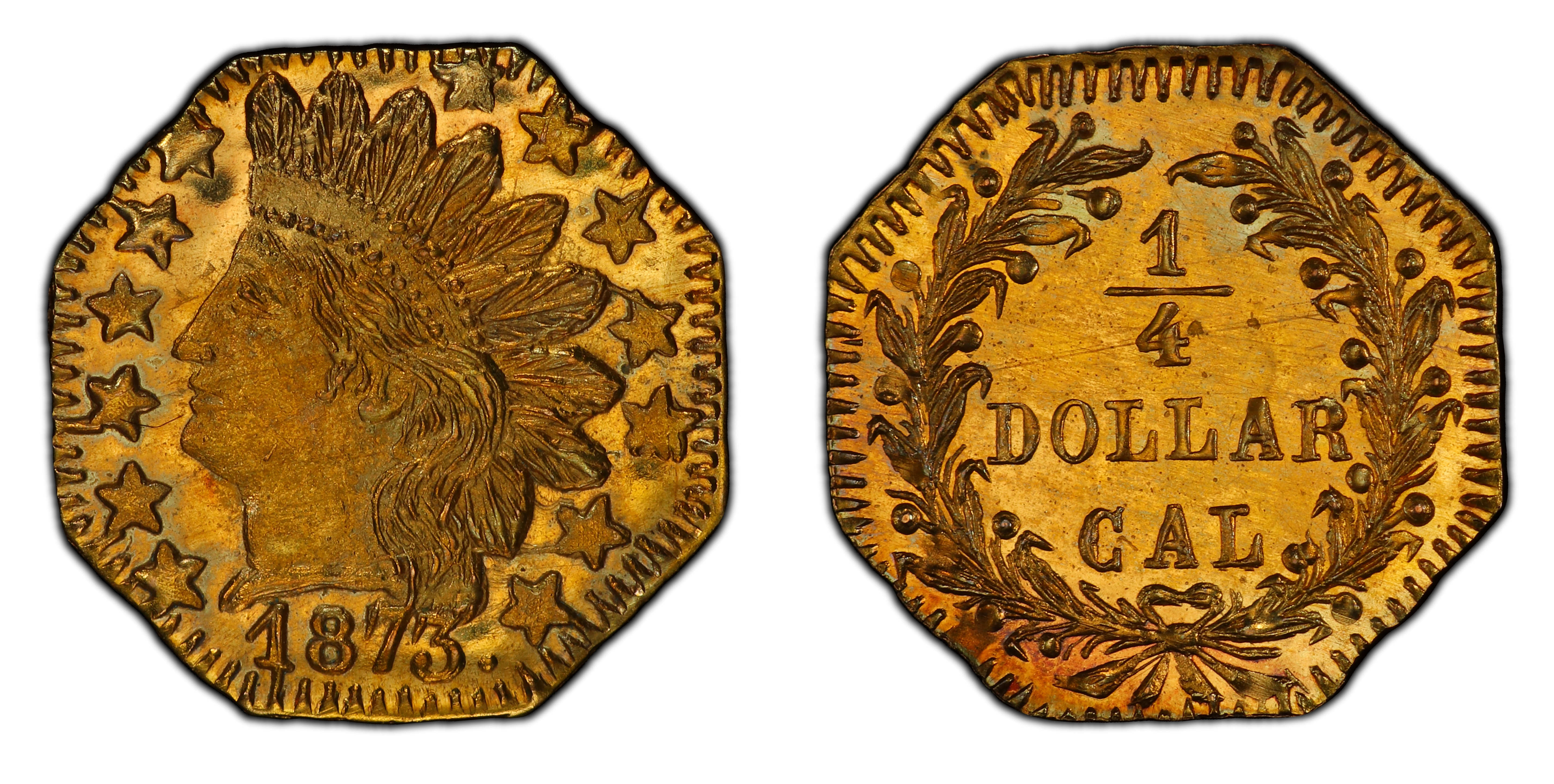
Obverse & Reverse
The 1873 25 Cents, cataloged as BG-794, represents a fascinating chapter in the evolution of California Fractional Gold. By the 1870s, the initial, desperate need for small-denomination coinage that characterized the Gold Rush era had largely subsided. The United States Mint in San Francisco was in full operation, and federal coinage circulated widely. However, a thriving industry of privately minted gold tokens persisted, shifting its focus from circulation to the burgeoning souvenir and jewelry market. These small gold pieces, reminiscent of the earlier period issues, were popular keepsakes for locals and tourists alike, tangible mementos of California's golden identity. The period from 1872 to 1882 is often termed the 'Jeweler's Period' for this reason. These manufacturers, many of whom remain anonymous but are sometimes linked to firms like Robert B. Gray & Co., produced vast quantities of these tokens. They leveraged advancements in minting technology, resulting in coins with a more refined and uniform appearance than their predecessors from the 1850s. The BG-794, with its standardized Liberty Head design and reeded edge, is a prime example of this later-period production. It was not intended to function as money in the same way the earlier issues were, but rather as a novelty item. Despite this, they were still made of genuine California gold and captured the public's imagination. The legal environment for these pieces was precarious; the Act of June 8, 1864, prohibited private coinage, but enforcement was inconsistent, allowing this trade to flourish for nearly two more decades until the Secret Service finally cracked down on the manufacturers in the early 1880s, ending the era of California Fractional Gold.
Associated EventPost-Gold Rush Economic Expansion & Souvenir Trade
Reason For MintingPrimarily created to be sold as souvenirs and keepsakes for the tourist and jewelry trade rather than to alleviate a currency shortage.
Minter HistoryThe specific minter for BG-794 is not definitively known, a common trait for 'Jeweler's Period' California fractionals. However, numismatic research, particularly by Breen and Gillio, often attributes this and similar issues to Robert B. Gray & Co. of San Francisco. Gray & Co. was a prominent firm of manufacturing jewelers active during this period, known to have the equipment and expertise necessary for producing such tokens. They created a wide variety of gold and silver items, and the small gold tokens were a logical and profitable extension of their business, catering to the public's enduring fascination with the Gold Rush.
Historical SignificanceThe BG-794 is significant not as a coin born of necessity, but as an artifact of cultural memory and commerce. It represents the commercialization of the Gold Rush legacy, demonstrating how the potent symbolism of California gold was packaged and sold to a new generation. It marks the final phase of private gold minting in the United States, a period characterized by mass production for nostalgic and decorative purposes, which ultimately led to federal intervention and the cessation of the practice.
BG-794 (Breen-Gillio)
Denomination25 Cents (Quarter Dollar)
Minting Period1873
Assayer/MinterUnknown San Francisco Jeweler; attributed to Robert B. Gray & Co.
Geographic OriginSan Francisco, California
Obverse DescriptionA small Liberty Head facing left, nearly identical to the design on the contemporary U.S. gold dollar. The head features coronet inscribed with 'LIBERTY'. Thirteen stars encircle the portrait, representing the original colonies.
Obverse Inscription1873
Reverse DescriptionThe denomination '1/4' is positioned in the center, enclosed within a wreath composed of two olive branches tied with a ribbon at the bottom. The inscription 'DOLLAR' appears below the wreath. The design is similar to other fractional gold pieces of the era.
Reverse Inscription1/4 DOLLAR CAL.
CompositionGold
Stated Fineness Actual FinenessApproximately .500 to .600 fine, though it can vary.
Weight0.25 grams
Diameter9.50 mm
EdgeReeded
Unknown, but believed to be in the thousands.
Survival Estimate500-750
Rarity ScaleR-4
The BG-794 is popular among collectors as a relatively affordable and accessible entry point into the California Fractional Gold series. Its clean, standardized design, reeded edge, and clear date make it an attractive and representative example of the 'Jeweler's Period.' It allows collectors to own a piece of the California gold story without the high cost of the earlier, rarer period issues.
Key VarietiesThe primary distinction for this issue is between the 'Regular Strike' and the 'Proof' (BG-795) striking. The BG-794 business strikes were made for general sale. A separate, much rarer variety, BG-795, was struck in Proof format with mirrored fields and frosted devices, specifically for collectors. No other major die varieties from the original minting period are widely recognized for BG-794.
Authentication TipsGenuine BG-794 coins have a sharp, well-defined reeded edge. The stars and lettering should be clear, though the strike can be centrally weak. Counterfeits often have mushy details, incorrect weight, or a 'brassy' color unlike the native gold hue of originals. Many fakes are cast, so look for casting bubbles or a seam on the edge. The wreath details on the reverse are a key diagnostic point; they should be finely detailed, not blended or crude.
Shopping ConsiderationsA premium quality example for its grade will possess a strong, sharp strike, particularly on Liberty's hair details and the reverse wreath. Seek out pieces with lustrous, original surfaces that haven't been cleaned, polished, or used in jewelry. Many surviving examples were mounted, so carefully inspect the rims and edges for evidence of solder or tooling. Attractive, uniform reddish-gold or orange-peel toning is highly desirable and commands a premium. Avoid examples with distracting planchet flaws or significant rim bumps, which are common on these small, delicate pieces.
A coin's grade is its condition, rated on a 1-70 scale. For rare coins, this is the most critical factor in determining value, as a tiny difference in preservation can mean a huge difference in price.
Relevant Grade TypesOriginal period issues of BG-794 are exclusively business strikes, produced for commercial sale and intended to resemble circulating coins. They are found in Circulated grades (AU-58 and below) and Mint State grades (MS-60 to MS-70). No true Proofs of BG-794 were struck during the original period; the Proof version of this design is a distinct catalog number (BG-795) and should be considered a separate numismatic item made specifically for collectors with deep, mirrored fields and frosted devices.
Mint State CharacteristicsIn uncirculated grades, the BG-794 typically exhibits a soft, satiny luster. The quality of the strike can vary; many examples are well-struck, but weakness on the highest points of Liberty's hair and the leaves of the reverse wreath is not uncommon. Due to their handling as souvenirs, even high-grade Mint State examples often show small, scattered contact marks. A truly choice specimen will have minimal marks, strong luster, and a sharp strike.
Circulated Wear PatternsWear first appears on the highest points of the design: Liberty's cheek, the hair just above the ear, and the coronet. On the reverse, the highest points of the wreath leaves and the bow of the ribbon will show the first signs of friction and flattening. In lower grades (VF and below), the word 'LIBERTY' in the coronet and the finer details of the wreath will become indistinct.
Key Factors For ValueFor the BG-794, the key value drivers are surface preservation and strike quality. A coin with original, undisturbed luster will always be worth more than a cleaned or polished one of the same grade. A sharp, fully struck example is highly desirable and commands a significant premium over a weakly struck one. Eye appeal is paramount; coins with beautiful, original toning and minimal distracting marks are eagerly sought. The presence of a CAC sticker, indicating a premium-quality coin for the grade, adds a substantial premium for this issue, as it provides third-party verification of originality and eye appeal.
PCGS Price Guide
| Grade | Price | Population |
|---|---|---|
| 62 | $375.00 | 2 |
| 62+ | $400.00 | N/A |
| 63 | $525.00 | 5 |
| 63+ | $575.00 | N/A |
| 64 | $700.00 | 15 |
| 64+ | $1,000.00 | N/A |
| 65 | $1,400.00 | 6 |
| 65+ | $1,550.00 | N/A |
| 66 | $1,750.00 | N/A |
| 66+ | $2,000.00 | N/A |
| 67 | $3,250.00 | N/A |