1874 G25C BG-799Q (Regular Strike)
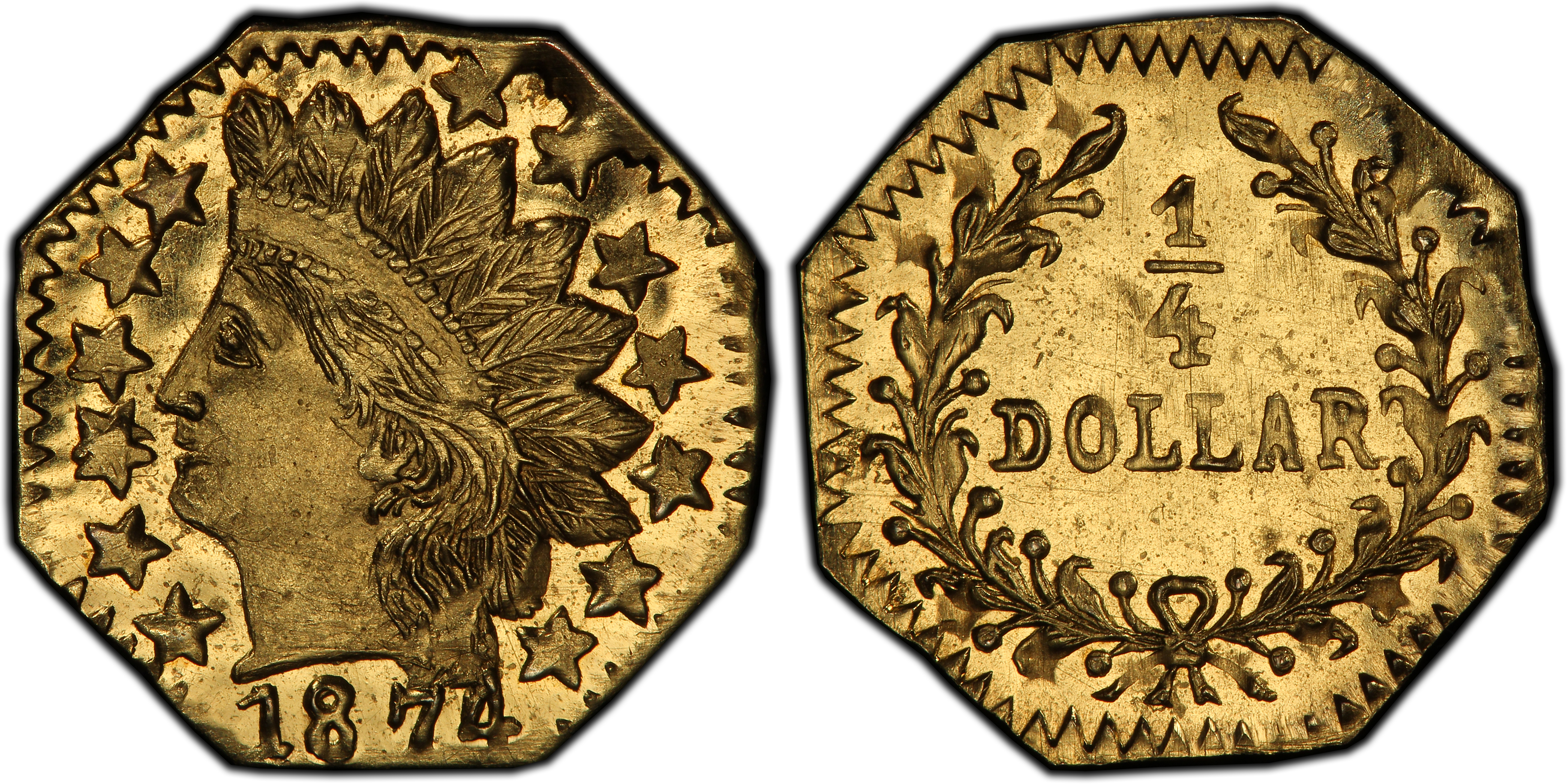
Obverse & Reverse
The 1874 G25C BG-799Q is a product of the second period (1859-1882) of California Fractional Gold production, a fascinating and complex chapter in American numismatics. By 1874, the acute shortage of small change that had plagued California during the initial Gold Rush years had largely subsided due to the output of the San Francisco Mint, which opened in 1854. Consequently, the purpose of these diminutive gold pieces shifted from utilitarian necessity to commercial novelty. Primarily struck by jewelers and artisans in San Francisco, these 'Period Two' issues were less a form of circulating currency and more a popular souvenir or keepsake for tourists and locals enchanted by the romance of the Gold Rush. Unlike the earlier 'Period One' issues (1852-1856), which were generally of good weight and intended for commerce, the later pieces were notoriously underweight, containing gold value significantly less than their stated 25-cent face value. The Coinage Act of 1864 had made all private coinage illegal, but the law was not strictly enforced against these small tokens until a Secret Service crackdown in 1883. This legal gray area allowed for a prolific output of diverse and often crude designs throughout the 1870s. The BG-799Q, with its Indian Head motif, was part of this vibrant souvenir trade. These pieces were often crudely manufactured using a hammer-striking method, resulting in inconsistent strike quality and planchet preparation. Despite their unofficial status, they remain tangible links to the post-Gold Rush era, reflecting a maturing California economy where the focus was shifting from raw extraction to commerce, tourism, and self-mythology.
Associated EventPost-Gold Rush California Commerce and Tourism
Reason For MintingPrimarily produced as souvenirs and jewelry items for a public fascinated with the Gold Rush, rather than to alleviate a coin shortage.
Minter HistoryThe specific minter for the BG-799Q die pair is not definitively known. Many Period Two issues were produced by anonymous or small-time San Francisco jewelers. One prominent manufacturer of the era was Robert B. Gray, whose initial 'G' appears on several varieties. While a direct attribution for BG-799Q is unconfirmed, the style and period of manufacture are consistent with the work of Gray or his contemporaries, who capitalized on the souvenir market for these miniature gold tokens.
Historical SignificanceThis coin is significant not as a circulating medium, but as a cultural artifact of post-Gold Rush California. It represents the commercialization of the Gold Rush legacy and the transition of private minting from a vital necessity to a novelty enterprise. Its existence highlights a period of lax federal oversight and the unique economic environment of 19th-century San Francisco.
BG-799Q
DenominationG25C
Minting Period1874
Assayer/MinterMinter Unconfirmed (Possibly Robert B. Gray or other San Francisco jewelers)
Geographic OriginSan Francisco, California
Obverse DescriptionAn Indian Head portrait facing left, likely modeled after James B. Longacre's design for the U.S. cent. The portrait is surrounded by thirteen stars representing the original colonies. The date '1874' is below the portrait. The execution is typically crude compared to federal coinage.
Obverse Inscription1874
Reverse DescriptionThe denomination '1/4' is centrally located within a wreath. The wreath is composed of two branches tied together with a bow at the bottom.
Reverse Inscription1/4
CompositionGold
Stated Fineness Actual FinenessVariable and typically debased, often ranging from 14 to 21 karats (.583 to .875 fine). These pieces were intentionally made with less gold value than their face value.
Weight0.25 grams
Diameter9.50 mm
EdgePlain
Unknown
Survival Estimate31-80 (per R-5+ rarity rating)
Rarity ScaleR-5+
The BG-799Q is sought after by specialists in California fractional gold for its specific Breen-Gillio variety, octagonal shape, and classic Indian Head design. Its high rarity (R-5+) makes any surviving example, particularly in high grade, a significant prize. The challenge of collecting these varied and often unattributed jeweler's issues adds to their allure.
Key VarietiesThe primary variety is the regular strike business issue. No proof strikings from the original period are known or expected. Breen-Gillio identifies numerous die marriages for the 1874 25C series, but BG-799Q itself refers to a specific die pair. Collectors should be aware of modern replicas, which are common and often made of brass or are gold-plated. These are not considered numismatic varieties.
Authentication TipsGenuine Period Two fractionals like BG-799Q are typically struck on very thin gold planchets. The strike is often weak in areas, particularly on the high points of the design or near the edges, and can be uneven due to crude hammer striking. Many counterfeits or modern replicas are struck on thicker, more uniform planchets and have sharp, even details. Genuine pieces will always be denominated (e.g., '1/4', '25 CENTS', or 'DOLLAR'); replicas often lack a denomination and may feature a bear on the reverse, a design element not used on authentic 19th-century issues.
Shopping ConsiderationsWhen acquiring a BG-799Q, prioritize originality of the surfaces. Look for examples with minimal cleaning, scratching, or evidence of being removed from jewelry. A 'premium quality' example will exhibit a reasonably sharp strike for the issue, particularly on the details of the Indian's hair and the wreath on the reverse. Given the manufacturing process, some planchet roughness or striations may be present and are not necessarily impairments. High-grade, problem-free examples are exceedingly rare. Third-party certification by PCGS or NGC is highly recommended to ensure authenticity and to provide a standardized grade.
A coin's grade is its condition, rated on a 1-70 scale. For rare coins, this is the most critical factor in determining value, as a tiny difference in preservation can mean a huge difference in price.
Relevant Grade TypesOriginal period issues were business strikes intended for souvenir sales, not circulation in the traditional sense, though some saw minor handling. They are found in Circulated (1-58) and, more commonly for this type, Mint State (MS, 60-70) grades. No Proof (PR/PF) examples were struck during the original period of issue, and no later-date Proof restrikes are known to exist for this specific variety.
Mint State CharacteristicsAn uncirculated BG-799Q is defined by its luster, but this can be deceiving. The luster is often flashy and prooflike due to the die preparation, but it is not a true proof. Strike is a major factor; many are weakly struck, with incomplete details on the Indian's hair above the eye and on the leaves of the wreath. A well-struck piece is a rarity and commands a significant premium. Small planchet flaws, fissures, or adjustment marks from the crude manufacturing process are common and should be distinguished from post-strike damage.
Circulated Wear PatternsWear first appears on the highest points of the design: the cheek and the feathers of the Indian's headdress. On the reverse, the high points of the wreath leaves and the bow will show flattening. In lower grades (VF and below), the stars on the obverse will begin to lose their definition and merge with the field, and the date can become weak.
Key Factors For ValueFor the BG-799Q, value is driven by three main factors: 1) Authenticity and Grade – A certified, high-grade Mint State example is the pinnacle. 2) Strike Quality – A sharp, well-centered strike can elevate a coin's value significantly above that of a weakly struck example of the same grade. 3) Surface Preservation – Original, uncleaned surfaces with minimal marks are highly prized. Any evidence of having been mounted in jewelry, harshly cleaned, or otherwise damaged will drastically reduce the value. A CAC sticker on a certified coin would indicate premium quality for the grade and add a further price premium.
PCGS Price Guide
| Grade | Price | Population |
|---|---|---|
| 58 | $245.00 | 2 |
| 58+ | $265.00 | N/A |
| 60 | $300.00 | N/A |
| 61 | $350.00 | N/A |
| 62 | $400.00 | 1 |
| 62+ | $475.00 | N/A |
| 63 | $600.00 | 10 |
| 63+ | $650.00 | N/A |
| 64 | $750.00 | 11 |
| 64+ | $850.00 | N/A |
| 65 | $1,750.00 | 8 |
| 65+ | $2,000.00 | N/A |
| 66 | $2,250.00 | N/A |
| 67 | N/A | N/A |