1876 G25C BG-779 (Regular Strike)
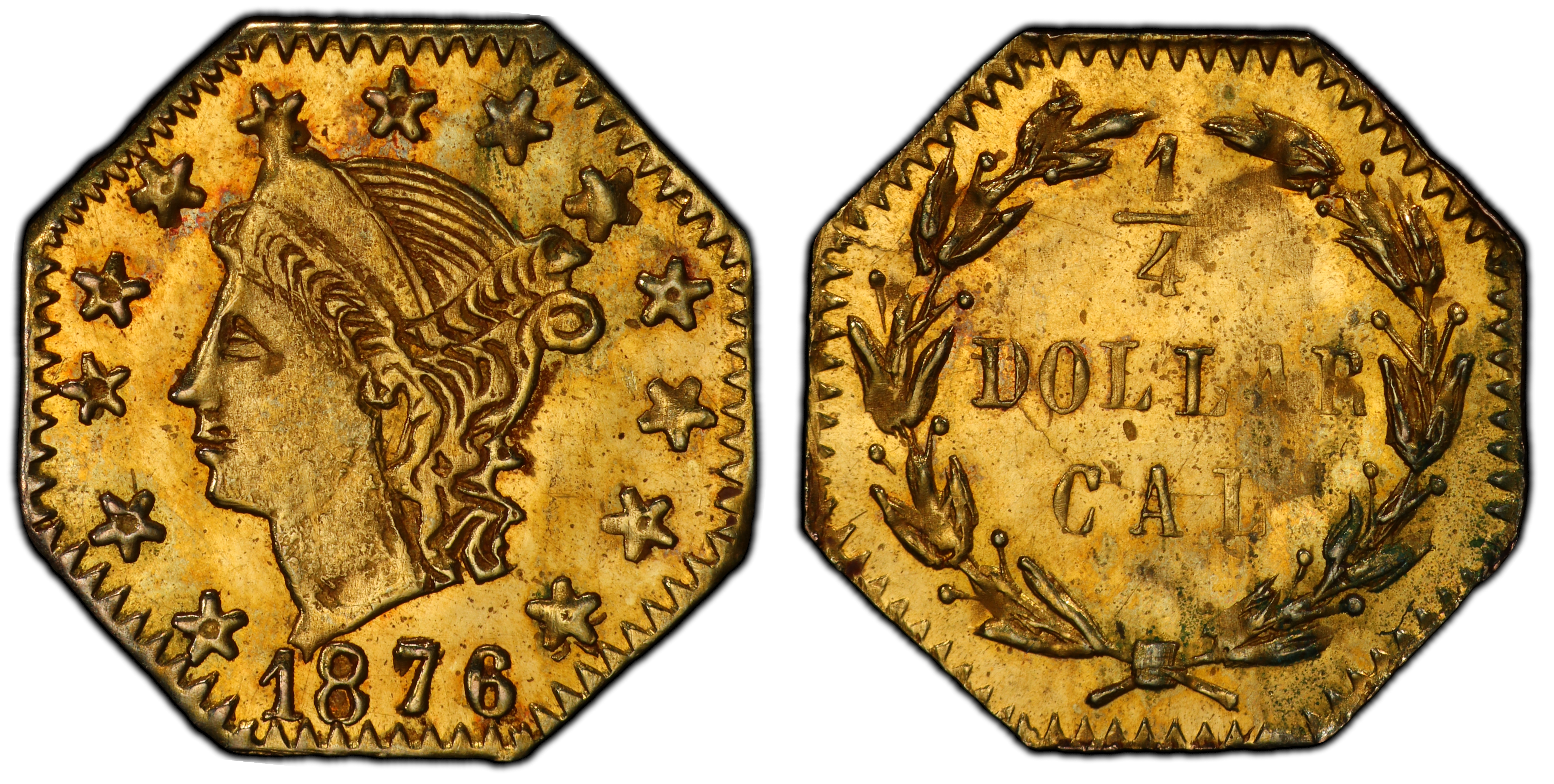
Obverse & Reverse
The 1876 G25C BG-779 is a product of the third and final period of California Fractional Gold production (1872-1882). By this time, the initial, desperate need for small denomination coinage that fueled the industry's birth in the early 1850s had long subsided. The San Francisco Mint was producing ample federal silver and gold coins, rendering private issues monetarily obsolete. Instead, these diminutive gold pieces transitioned into a vibrant numismatic and souvenir market. They were popular keepsakes of the romanticized Gold Rush era, often incorporated into jewelry or sold as curiosities to tourists and collectors. The year 1876 was particularly significant as it marked the Centennial of the United States, an event celebrated with great patriotic fervor nationwide, including at the major Centennial Exposition in Philadelphia. This likely spurred the production of various souvenir items, and the California Fractional Gold pieces of this date fit perfectly into that commercial niche. Unlike the earlier, more functional issues that were intended to and often did circulate, pieces from this later period were struck with a different purpose. They were typically made by jewelers and private minters in San Francisco, who leveraged the allure of California gold to create attractive, miniature novelties. The legal environment was also precarious; the Coinage Act of 1864 had prohibited private coinage, but enforcement was inconsistent. Producers of fractional gold often skirted the law by calling their products 'tokens' or omitting the word 'dollar' or 'cents'. However, by the early 1880s, increased pressure from the Secret Service would bring the era of California Fractional Gold to a definitive end, shutting down the remaining producers.
Associated EventPost-Gold Rush California / U.S. Centennial Year
Reason For MintingPrimarily created to be sold as souvenirs, keepsakes, and jewelry items during the U.S. Centennial year, not for monetary circulation.
Minter HistoryThe specific minter or jeweler who produced the BG-779 variety is not definitively known, a common trait for many later-period California Fractional Gold pieces. Production was often anonymous or marked with initials that are difficult to attribute with certainty. San Francisco jewelers such as Robert B. Gray & Co. were active during this period, but a direct link to this specific Breen-Gillio variety is not established in available records.
Historical SignificanceThe BG-779, like other issues from its period, represents the final evolution of private gold coinage in California. It stands not as a coin born of necessity, but as a numismatic artifact that captures the public's romantic fascination with the Gold Rush. Its creation in the Centennial year also ties it to a moment of national celebration and reflection, serving as a tiny, golden emblem of America's western expansion and mineral wealth.
BG-779
Denomination25 Cents
Minting Period1876
Assayer/MinterUnknown
Geographic OriginSan Francisco, California
Obverse DescriptionOctagonal planchet. Features a Liberty Head motif, likely a close copy of the designs used on contemporary U.S. gold coinage. The head is surrounded by a number of stars (typically 13, but arrangements vary by die). The date 1876 is below the bust. Specific die characteristics for BG-779 are not available in public records.
Obverse Inscription1876
Reverse DescriptionOctagonal planchet. The central design element is a wreath, which encircles the denomination. The specific style of the wreath and the fractional denomination (e.g., '1/4') are key diagnostics for Breen-Gillio varieties, but are not specifically documented for BG-779 in available sources.
Reverse Inscription1/4
CompositionGold
Stated Fineness Actual FinenessTypically varied from .500 to .900, but often unmarked and inconsistent between minters.
EdgePlain
Unknown
Survival EstimateExtremely low. This variety is not present in the NGC census, suggesting it is of the highest rarity.
Rarity ScaleLikely R-7 (4-12 known) or R-8 (1-3 known)
This is a coin for the advanced specialist. Its appeal lies in its extreme rarity and the challenge of acquiring a documented Breen-Gillio variety that is almost never offered for public sale. Being an octagonal type from the Centennial year adds historical and aesthetic interest.
Key VarietiesBG-779 is itself a key variety. No restrikes or special collector issues are known. The primary variations in 1876 fractional gold are between the different Breen-Gillio numbered dies, which feature differences in the portrait style (e.g., 'Baby Head' types), the number and arrangement of stars, and the reverse wreath and lettering.
Authentication TipsDue to its extreme rarity, any example appearing on the market would require certification by a top-tier grading service (PCGS or NGC). General authentication tips for the series include looking for sharp, well-defined details (many counterfeits are cast and soft), correct weight and size (though these varied), and the absence of a modern, mirror-like, gold-plated finish. Die diagnostics from the Breen-Gillio reference would be essential for positive identification.
Shopping ConsiderationsA potential buyer would likely wait years, or decades, for a chance to acquire this variety. The opportunity would most likely arise from the sale of a major, long-held collection of California Fractional Gold. For such a rarity, any example, regardless of grade, would be significant. A premium quality piece would be one that is well-struck, free of jewelry mounting or other damage, and possesses original, uncleaned surfaces. Given the lack of census data, any certified, problem-free example would be considered a pinnacle acquisition.
A coin's grade is its condition, rated on a 1-70 scale. For rare coins, this is the most critical factor in determining value, as a tiny difference in preservation can mean a huge difference in price.
Relevant Grade TypesAll original examples of BG-779 were struck as business strikes, though primarily for souvenir purposes rather than circulation. They are found in Circulated (1-58) grades if they were handled or used in jewelry, and Mint State (MS, 60-70) grades if preserved. No true Proofs from the original minting period are known to exist for this series. Later souvenir tokens are a separate category and should not be confused with original 1870s strikings.
Mint State CharacteristicsAn uncirculated BG-779 would be judged on the quality of its strike, luster, and surface preservation. Later-period fractionals are often sharply struck with prooflike or semi-prooflike surfaces, a result of polished dies used to enhance their appeal as novelties. Luster would be bright and frosty. Common marks include tiny planchet flaws or die polishing lines. As these were made by private jewelers, the quality control can be inconsistent.
Circulated Wear PatternsFor any fractional gold piece, wear first appears on the highest points of the design. On the obverse, this would be the hair above Liberty's eye and ear, and her cheekbone. On the reverse, the high points of the wreath's leaves and bow would show friction first. In lower grades (VF and below), the stars on the obverse would begin to merge with the fields, and the fine details of the wreath would become indistinct.
Key Factors For ValueFor a great rarity like BG-779, the primary factor is simply existence and authenticity. Beyond that, a problem-free surface is paramount; examples that have been mounted in jewelry, cleaned, or tooled will be worth significantly less than those with original surfaces. A sharp strike that brings up all the intended design details is highly desirable. Finally, superior eye appeal, characterized by attractive original gold toning and mark-free fields, would command a substantial premium. A CAC sticker on a certified example would provide further validation of quality for the assigned grade.
PCGS Price Guide
| Grade | Price | Population |
|---|---|---|
| 58 | $1,075.00 | 1 |
| 58+ | $1,300.00 | N/A |
| 60 | $1,750.00 | N/A |
| 61 | $2,500.00 | N/A |
| 62 | $3,000.00 | 2 |
| 62+ | $3,250.00 | N/A |
| 63 | $3,500.00 | 4 |
| 63+ | $3,750.00 | N/A |
| 64 | $4,250.00 | 3 |