1880 G25C BG-799W (Regular Strike)
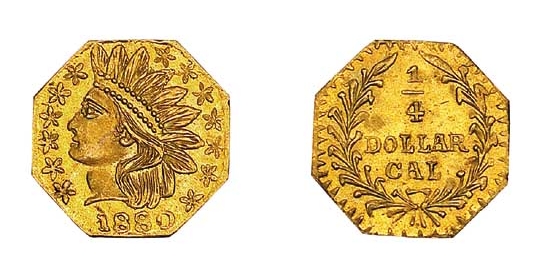
Obverse & Reverse
The 1880 G25C BG-799W is a product of the second great phase of California's private gold coinage, a period numismatists designate as 'Period Two' (1859-1882). Unlike the earlier 'Period One' issues, which arose from a genuine and desperate need for circulating small change during the initial Gold Rush boom, the pieces from this later era served a profoundly different purpose. By 1880, the San Francisco Mint had been in full operation for over two decades, supplying California and the West with ample federal coinage. The acute shortage of currency that had plagued the 'forty-niners' was a distant memory. Instead, the California Gold Rush had transformed into a powerful national myth, and San Francisco itself had become a major tourist destination. Enterprising jewelers and minting artisans, many of French origin, recognized a burgeoning market for gold souvenirs. These small, denominated gold pieces were not intended to facilitate commerce but to be sold as keepsakes, charms, and mementos of the romanticized Gold Rush experience. As such, they were often underweight relative to their face value, a fact that was of little concern to a tourist purchasing a novelty rather than a merchant accepting coinage for trade. The production of these 'jeweler's issues' existed in a legal gray area. The Coinage Act of 1864 had prohibited private coinage, but enforcement by the Secret Service was inconsistent and not aggressively pursued against these small, low-value tokens until 1883. This permissive environment allowed for a remarkable diversity of designs and issuers throughout the 1870s and early 1880s. The BG-799 series, with its Indian Head motif, was a popular design, likely intended to evoke a sense of the 'Wild West' for buyers. The 'W' variety represents a specific and very rare die pairing, a testament to the small-batch, almost artisanal nature of this souvenir production. Each die was hand-cut, resulting in numerous subtle variations that are now meticulously cataloged by specialists. The BG-799W is a tangible link to this fascinating twilight era of private minting in the United States, representing the commercialization of a historical phenomenon and the enduring allure of California gold.
Associated EventCalifornia Gold Rush Tourism
Reason For MintingPrimarily struck for sale as souvenirs and keepsakes for tourists, not for circulation as money.
Minter HistoryThe specific minter or jeweler responsible for the BG-799 die pairing is not definitively known, a common trait for many Period Two fractional gold issues. Production was often carried out by small, competing jewelry firms in San Francisco who did not consistently apply identifiable mintmarks. Prominent Period Two manufacturers included figures like Robert B. Gray & Co. and various French jewelers, but a direct link to this specific variety has been lost to history.
Historical SignificanceThis coin is significant not as a circulating medium, but as a numismatic artifact representing the transition of the Gold Rush from a daily reality to a celebrated historical event. It embodies the souvenir trade of late 19th-century San Francisco and the final chapter of private gold minting before federal enforcement ended the practice.
BG-799W
DenominationG25C
Minting Period1880
Assayer/MinterUnknown Private Minter
Geographic OriginSan Francisco, California
Obverse DescriptionAn octagonal planchet featuring a stylized Indian Head facing left, a common motif for the series. The portrait details are often crudely rendered compared to federal coinage. The date '1880' is below the bust.
Obverse Inscription1880
Reverse DescriptionA simple wreath design encircles the denomination. The details of the wreath are often softly struck. Specific die characteristics for the BG-799W variety are subtle and require comparison with other BG-799 varieties for positive identification.
Reverse Inscription1/4 DOLLAR
CompositionGold
Stated Fineness Actual FinenessVariable, but generally lower than federal standards for the period, consistent with jeweler's issues.
Weight0.15 grams
Diameter9.40 mm
EdgePlain
Extremely low; likely part of a very small batch.
Survival EstimateFewer than 10 known.
Rarity ScaleR-7 (4-12 known)
The BG-799W is highly prized for its extreme rarity. As a specific, cataloged die variety with a tiny surviving population, it appeals to advanced specialists of the California Fractional Gold series who collect by Breen-Gillio numbers. Its status as a Period Two 'jeweler's issue' also adds to its historical charm.
Key VarietiesThe BG-799 designation covers a series of die pairings from 1876-1882, all sharing a similar Indian Head obverse. The 'W' suffix denotes a specific and distinct die marriage. Other lettered varieties (e.g., BG-799A, BG-799J, BG-799X) exist for this type, each with its own rarity and subtle die characteristics. No later-date restrikes or patterns are known for this specific variety.
Authentication TipsAuthenticity is paramount. Genuine pieces often exhibit a somewhat crude, handmade appearance with imperfect strikes, especially on the high points of the design and at the borders. Counterfeits may appear too perfect, have incorrect luster, or show casting bubbles under magnification. The weight and diameter should be close to the known standard for this type. The most critical authentication method is comparing the piece to high-quality images of known genuine BG-799W specimens to match specific die markers and overall fabric.
Shopping ConsiderationsFor a coin of this rarity, any example is a major acquisition. A 'premium quality' specimen would be one free of damage (such as holes, bends, or harsh cleaning) and exhibiting a sharp strike for the variety, which is often weakly struck. Look for original, undisturbed luster, which can range from satiny to prooflike. Given the minuscule population, any certified example is significant. Avoid raw (ungraded) coins unless purchasing from a highly reputable specialist dealer in the series. Focus on eye appeal and the integrity of the surfaces.
A coin's grade is its condition, rated on a 1-70 scale. For rare coins, this is the most critical factor in determining value, as a tiny difference in preservation can mean a huge difference in price.
Relevant Grade TypesOriginal issues of BG-799W were business strikes, although sold as souvenirs and not intended for circulation. They are found in Circulated (1-58) grades (though unlikely given their purpose) and more commonly in Mint State (MS, 60-70) grades. The term 'Prooflike' (PL) is often applied to examples with mirrored surfaces, which is a manufacturing characteristic rather than a separate issue type. No true Proofs were struck during the original minting period.
Mint State CharacteristicsUncirculated examples are defined by their luster. Many Period Two fractionals have a bright, almost flashy luster and can be found with prooflike or deep mirror prooflike surfaces. Strike quality is a key differentiator; many are softly struck, so examples with sharp details on the Indian's hair and the leaves of the wreath command a premium. Due to the manufacturing and handling process, small planchet flaws or contact marks are common and must be evaluated in the context of the overall grade.
Circulated Wear PatternsWhile few circulated, any wear would first appear on the high points of the design. On the obverse, this would be the cheek and feathers of the Indian Head. On the reverse, the highest points of the wreath and the fraction would show friction first. In lower grades, the date and legends would begin to lose their sharpness.
Key Factors For ValueRarity is the primary value driver for this specific variety. After rarity, the grade is paramount. An example in MS-65 is worth substantially more than one in MS-62. Surface quality is critical; a coin with original, unimpaired, lustrous surfaces is far more desirable than one that has been cleaned, polished, or damaged. Eye appeal, encompassing the quality of strike and luster, is a major factor. A CAC sticker would provide a significant premium, confirming the coin is solid for its assigned grade.
PCGS Price Guide
| Grade | Price | Population |
|---|---|---|
| 60 | $625.00 | N/A |
| 61 | $650.00 | N/A |
| 62 | $675.00 | 1 |
| 62+ | $725.00 | N/A |
| 63 | $800.00 | 5 |
| 63+ | $850.00 | N/A |
| 64 | $1,000.00 | 9 |
| 64+ | $1,250.00 | N/A |
| 65 | $2,000.00 | 3 |
| 65+ | $2,500.00 | N/A |
| 66 | $3,250.00 | N/A |