1875 25C BG-798 (Regular Strike)
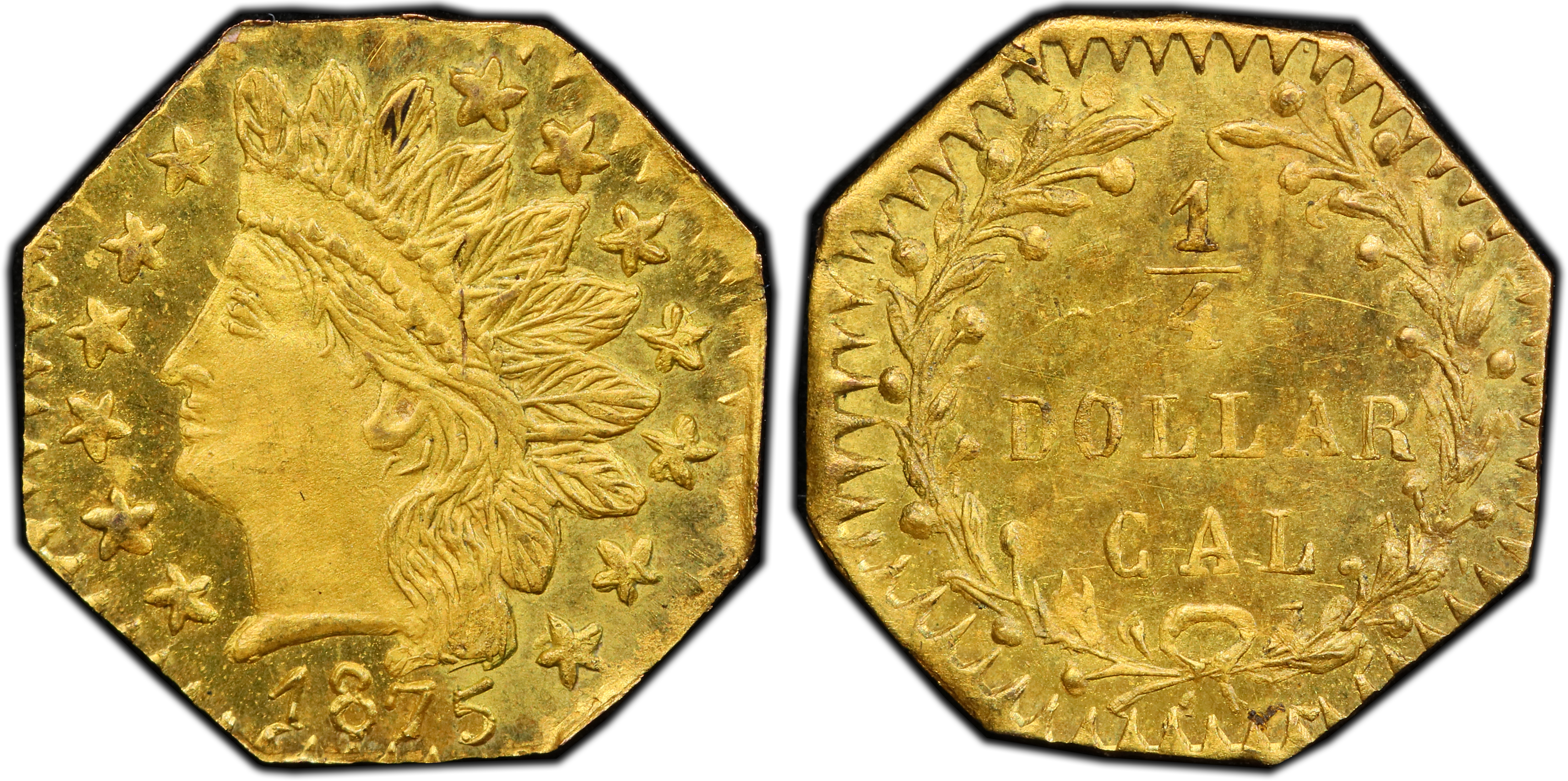
Obverse & Reverse
The 1875 BG-798 25 Cents represents a later phase in the fascinating and complex story of California Fractional Gold. By the mid-1870s, the initial fervor of the Gold Rush had long subsided, but California's economy remained dynamic and distinct. The use of gold dust and nuggets for daily transactions had largely ceased, replaced by official United States coinage. However, the smallest denomination U.S. coin in circulation on the West Coast was the silver quarter dollar. The chronic shortage of small-denomination coinage, a problem since the 1850s, persisted. This scarcity created a niche for privately-minted, small-denomination gold tokens, which served as convenient substitutes for small change in minor transactions. These pieces were not official government currency but were widely accepted due to their gold content and the public's familiarity with such issues. The production of these tokens was a commercial enterprise undertaken by various San Francisco jewelers and metalworkers. They were often sold as souvenirs to tourists and locals alike, capitalizing on the romantic allure of the Gold Rush, while also filling a genuine commercial need. The Act of 1864 had prohibited private coinage, but these fractional pieces cleverly skirted the law by omitting the word 'DOLLAR' and often using designs, like the Liberty head, that were reminiscent of but not identical to federal issues. The 1875 BG-798 is a prime example of this genre; it was designed to look and feel like money without technically being illegal coinage. Its existence speaks to a specific moment in California's economic development, where the legacy of gold was still potent enough to support a parallel system of private metallic tokens for commerce and keepsakes.
Associated EventPost-Gold Rush Economic Period
Reason For MintingTo provide a convenient medium for small change in commerce and to be sold as souvenirs, addressing the scarcity of small-denomination federal coinage in California.
Minter HistoryThe exact minter of BG-798 is unknown, a common trait for many later-date California Fractional Gold pieces. Production was often anonymous to avoid potential legal issues with the U.S. Treasury Department. Numismatic research, primarily by Breen and Gillio, suggests that jewelers like Herman J. Brand, Robert B. Gray & Co., and others operating in San Francisco were likely responsible for a large number of these 'Period Three' (1872-1882) issues. These minters were skilled craftsmen who produced the tokens using screw presses, creating pieces of generally good quality, though often with less gold content than their stated face value might imply.
Historical SignificanceThe BG-798 is significant not as a coin that financed the Gold Rush, but as a token that illustrates its long-lasting economic and cultural legacy. It represents the persistence of a localized, gold-based economy and the ingenuity of private entrepreneurs in meeting a commercial need that the federal government failed to address on the West Coast. These late-date fractionals are historical artifacts that bridge the gap between the raw frontier economy of the 1850s and the more integrated national economy of the late 19th century.
BG-798
Denomination25 Cents
Minting Period1875
Assayer/MinterUnknown private minter, possibly Herman J. Brand or other San Francisco jewelers.
Geographic OriginSan Francisco, California
Obverse DescriptionA beaded border encircles a right-facing portrait of a Liberty Head. The hair is tied in the back with a ribbon. Thirteen stars surround the portrait, representing the original colonies.
Obverse Inscription1875
Reverse DescriptionA beaded border surrounds the denomination '1/4' which is encircled by a wreath of two olive branches tied with a ribbon at the bottom. The legend 'CALIFORNIA GOLD' appears above the wreath.
Reverse InscriptionCALIFORNIA GOLD 1/4
CompositionGold
Stated Fineness Actual FinenessTypically around 14 to 18 Karat (.583 to .750 fine), significantly less than the .900 fineness of federal gold coins.
Weight0.25 grams
Diameter9.50 mm
EdgePlain
Unknown
Survival Estimate500-750
Rarity ScaleR-4
BG-798 is popular among collectors as a relatively common and accessible example of a genuine, dated California Fractional Gold piece. Its classic Liberty Head design, clear denomination, and direct link to the California Gold Rush era make it a quintessential type coin for those building a representative set of this fascinating series.
Key VarietiesFor BG-798, the primary distinction is the 'Regular Strike' intended for circulation or sale as a souvenir. No major die varieties are widely collected for this specific catalog number. It is crucial to distinguish these original 1875 strikes from modern 20th and 21st-century replicas, which are not considered numismatic items. No proof or special presentation strikings are known to have been created during the period of issue.
Authentication TipsAuthentic BG-798 specimens exhibit sharp, well-defined details, particularly in Liberty's hair and the leaves of the reverse wreath, consistent with die-striking. The planchets are typically flat and even. Look for a 'mushy' or cast-like appearance on counterfeits. The style of the numerals in the date '1875' and the lettering should match known genuine examples. Many fakes are underweight or made of brass. Weight and specific gravity tests are critical for authentication. The surfaces should have natural, old toning and luster, not the bright, artificial shine of modern copies.
Shopping ConsiderationsWhen acquiring an BG-798, seek a well-struck example with sharp details on both the obverse and reverse. A premium quality piece for its grade will possess smooth, lustrous surfaces free of distracting marks, cleaning, or damage. Due to their small size, these tokens are often found improperly cleaned or damaged from jewelry use (e.g., solder marks, holes, heavy rim bumps). Pay close attention to the fields for signs of harsh cleaning or polishing, which significantly diminish value. An example with original, undisturbed surfaces, even with some honest wear, is far more desirable than a higher-grade but cleaned piece. Eye appeal is paramount; a coin with a pleasing, uniform color and strong strike will always command a premium.
A coin's grade is its condition, rated on a 1-70 scale. For rare coins, this is the most critical factor in determining value, as a tiny difference in preservation can mean a huge difference in price.
Relevant Grade TypesOriginal period issues of BG-798 were business strikes intended for commerce or sale as souvenirs. They are found in Circulated grades (AG-3 to AU-58) and Mint State grades (MS-60 to MS-70). No Proofs were struck during the original period of issue. Any piece described as a 'Proof' is either a modern copy or a misattribution. These are distinct numismatic items from the original 1875 strikes.
Mint State CharacteristicsAn uncirculated BG-798 will display full, unbroken mint luster, which is typically frosty or satiny in appearance. The strike can be variable; high-end examples will show sharp detail on Liberty's hair curls and the individual leaves on the wreath. Weaker strikes may show some softness on these high points even in MS grades. Because they were handled as souvenirs, even Mint State examples often exhibit small ticks or contact marks in the fields. A truly 'gem' quality (MS-65 or higher) example is exceptionally rare and would be virtually free of marks with a blazing luster and a sharp strike.
Circulated Wear PatternsWear first appears on the highest points of the design. On the obverse, this includes Liberty's cheek, the hair just above the ear, and the tips of the coronet. On the reverse, the high points of the wreath's leaves and the bow of the ribbon will show the first signs of friction and flattening. In lower grades (VG and below), the stars, date, and legends will become progressively weaker and less distinct.
Key Factors For ValueThe primary drivers of value for an BG-798 are grade and surface quality. An example with original, uncleaned surfaces and strong luster will always be worth more than a cleaned coin of the same grade. Strike quality is also critical; a sharply struck coin is more desirable than a weakly struck one. Eye appeal, encompassing toning and the absence of distracting marks, plays a major role. Finally, certification by a top-tier grading service (PCGS or NGC) is essential for market acceptance, and a CAC sticker, indicating premium quality for the grade, adds a significant premium.
PCGS Price Guide
| Grade | Price | Population |
|---|---|---|
| 6 | N/A | N/A |
| 50 | $200.00 | 1 |
| 50+ | $210.00 | N/A |
| 53 | $235.00 | N/A |
| 53+ | $245.00 | N/A |
| 55 | $260.00 | N/A |
| 55+ | $265.00 | N/A |
| 58 | $275.00 | N/A |
| 58+ | $285.00 | N/A |
| 60 | $300.00 | N/A |
| 61 | $325.00 | 2 |
| 62 | $375.00 | 10 |
| 62+ | $395.00 | N/A |
| 63 | $500.00 | 22 |
| 63+ | $550.00 | N/A |
| 64 | $650.00 | 21 |
| 64+ | $800.00 | N/A |
| 65 | $1,600.00 | 5 |
| 66 | N/A | N/A |
| 66+ | N/A | N/A |