1874/1874 G25C BG-776 (Regular Strike)
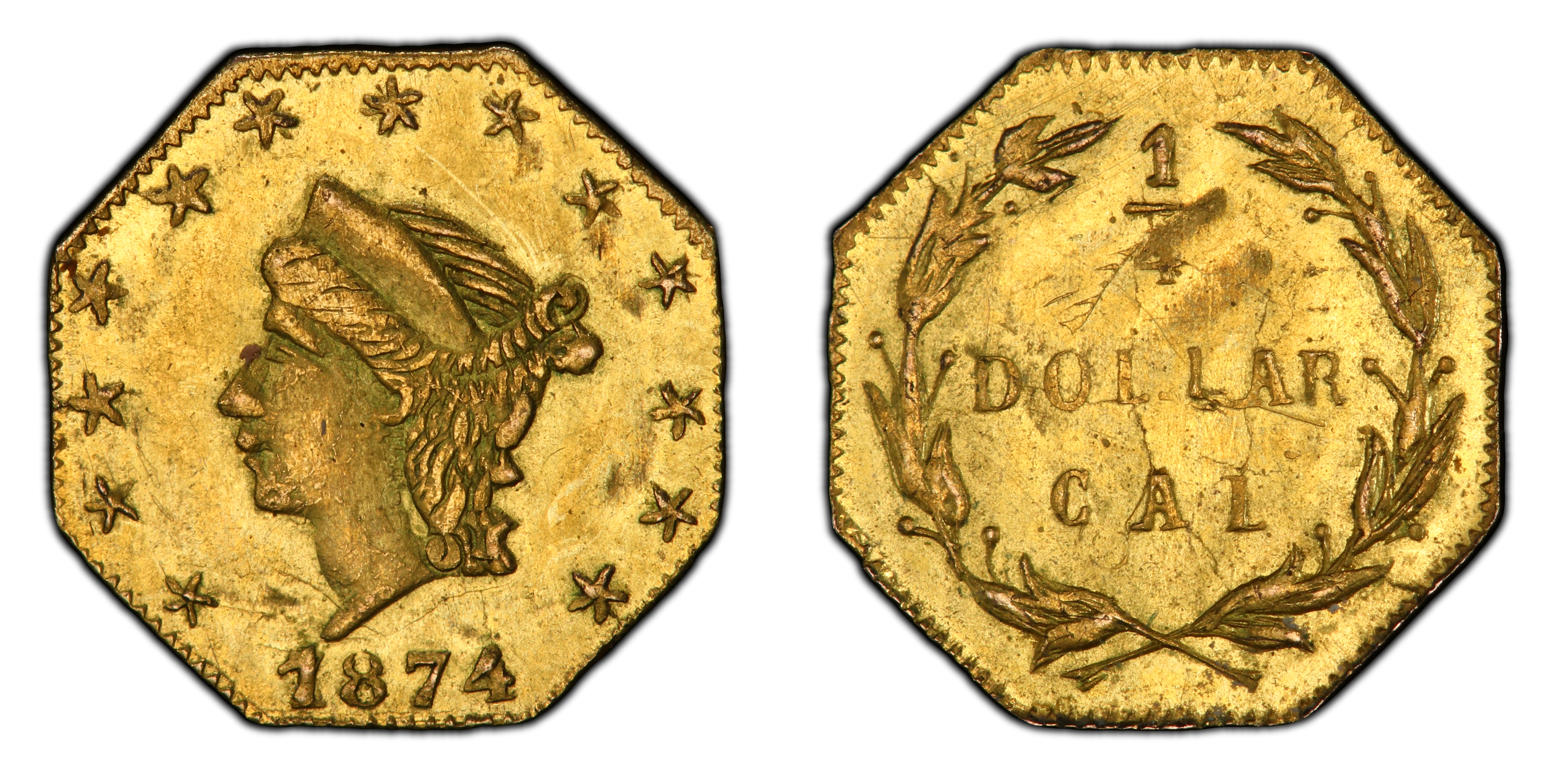
Obverse & Reverse
The 1874/1874 BG-776 25 Cents is a quintessential example of a 'Period Two' California Fractional Gold piece. By the 1870s, the initial, desperate need for small circulating coinage that characterized the Gold Rush's first decade had largely subsided. The San Francisco Mint, established in 1854, was in full production, supplying the region with official federal coinage. The production of fractional gold, therefore, shifted from a utilitarian necessity to a commercial enterprise catering to a different market: tourists, collectors, and sentimentalists. These small, intricate gold tokens became popular souvenirs of a Californian's visit to the famous 'city of gold' or mementos of the romanticized Gold Rush era. They were produced by jewelers and private minters who applied their craft to creating these miniature works of art. The BG-776 variety is attributed to Herman J. Brand, a San Francisco jeweler. The '1874/1874' designation, noted by researchers like Breen and Gillio, signifies a blundered or repunched date on the die, a common characteristic of private minting operations where dies were often hand-engraved and subject to such imperfections. This variety, like most from its period, was not intended to and did not circulate in the same way as the earlier Period One issues. Their intrinsic value was substantially less than their face value, rendering them effectively tokens. The federal government grew increasingly concerned about the private issuance of coinage, and the U.S. Secret Service began cracking down on these operations, culminating in a near-complete cessation of denominated private issues after 1882. This legal pressure adds a layer of historical intrigue to the later Period Two pieces, as minters were operating in a legally gray area. Today, the BG-776 is appreciated not as a coin that fueled commerce in a boomtown, but as a delicate artifact representing the maturation of San Francisco's economy and the birth of a numismatic souvenir market.
Associated EventPost-Gold Rush California Economy
Reason For MintingPrimarily minted for sale as souvenirs and keepsakes for tourists and collectors, rather than for general circulation.
Minter HistoryHerman J. Brand was a San Francisco-based jeweler active during the latter half of the 19th century. Like many of his contemporaries, he recognized the commercial potential in producing miniature gold 'coins' as souvenirs. These 'jeweler's issues' were a way to market California gold to a wider audience, capitalizing on the romantic allure of the Gold Rush. Brand's work is identified through die analysis and is cataloged in the Breen-Gillio reference, linking him to several varieties of fractional gold tokens from this era.
Historical SignificanceThe BG-776 represents the shift in fractional gold production from utilitarian coinage-of-necessity (Period One) to commercial souvenirs (Period Two). It is a tangible link to the burgeoning tourism industry of 19th-century San Francisco and highlights the craftsmanship of private jewelers of the era. Its existence also reflects the legal tensions between private minters and the federal government over the right to produce coinage.
N/A
Denomination25 Cents
Minting Period1874
Assayer/MinterHerman J. Brand
Geographic OriginSan Francisco, California
Obverse DescriptionA Liberty Head facing left, similar in style to contemporary federal gold coinage. The head is surrounded by thirteen five-pointed stars along the octagonal border.
Obverse Inscription1874
Reverse DescriptionThe denomination '1/4' is centered within a wreath of leaves and berries. The wreath is open at the top.
Reverse Inscription1/4
CompositionGold
Stated Fineness Actual FinenessVaries, but typically lower than federal coinage, ranging from 14 to 22 carats.
Diameter9.00 mm
EdgePlain
Unknown; mintage figures for individual varieties were not recorded.
Survival Estimate75-125
Rarity ScaleR-5 (Low R-5)
This variety appeals to collectors for its octagonal shape, the clear '1874/1874' overdate feature, its attribution to a specific minter, and as a high-quality example of a Period Two 'jeweler's issue'.
Key VarietiesThe primary variety is the BG-776 regular strike itself, characterized by the blundered date where a '1' was partially impressed over the '7' position of the date before being corrected. While no major contemporaneous varieties exist, examples can be found with varying degrees of die clashing and with prooflike (PL) surfaces, which are noted by grading services and command a premium. No later-date restrikes are known for this specific Breen-Gillio number.
Authentication TipsAuthentic BG-776 specimens will exhibit the specific die characteristics of this variety, including the precise location and nature of the date blunder. Genuine pieces often show a somewhat weak strike in areas due to being manually produced. The luster should be satiny or, more rarely, prooflike. Counterfeits are extremely common in the fractional gold series. Fakes often have a soapy, indistinct appearance, incorrect weight or specific gravity, and may lack the precise die markers. Any piece not cataloged in the Breen-Gillio guide should be treated with extreme caution. Professional authentication by a major third-party grading service (PCGS or NGC) is highly recommended.
Shopping ConsiderationsA premium quality example of BG-776 will have a sharp strike, particularly on the stars and the details of the wreath. Look for original, undisturbed satiny luster and a pleasing olive-gold or honey-gold patina. Since these were primarily souvenirs, many examples survive in Mint State condition. However, they are susceptible to damage from having been mounted in jewelry, so check carefully for evidence of removal, tooling, or rim damage. Heavy die clashing is common on this variety and, while not a flaw, its prominence can affect eye appeal for some collectors. An example with minimal clashing and strong surface preservation would be considered top-tier for the grade.
A coin's grade is its condition, rated on a 1-70 scale. For rare coins, this is the most critical factor in determining value, as a tiny difference in preservation can mean a huge difference in price.
Relevant Grade TypesOriginal issues of BG-776 were business strikes, although not intended for circulation, and are found in Circulated (1-58) and, more commonly, Mint State (MS, 60-70) grades. Due to their purpose as souvenirs, many were preserved in high grade. While no true Proofs were struck during the original period, some examples were struck from polished dies on polished planchets, resulting in a mirrored finish. These are designated as Prooflike (PL) by grading services and are considered a special category within the business strike issue, not separate Proof coins.
Mint State CharacteristicsUncirculated examples are defined by their luster. A typical BG-776 has a bright, satiny luster. Strike quality can be variable; a well-struck piece will show full detail on Liberty's hair and the individual leaves of the wreath. Weaker strikes are common, especially on the stars. Due to the softness of the gold and manual handling, small contact marks are common even on high-grade specimens. Prooflike examples are much rarer and are prized for their mirrored surfaces and frosted devices, though they are more susceptible to showing distracting hairlines.
Circulated Wear PatternsAlthough most are uncirculated, on the rare circulated examples, wear first appears on the high points of Liberty's hair, cheek, and the bow of the wreath. As wear progresses, the stars will begin to lose their sharpness and the finer details of the wreath will merge. In lower grades (VF and below), the date and legends will show significant flattening.
Key Factors For ValueFor the BG-776, value is driven by several key factors. Grade is paramount, with Gem (MS-65 and higher) examples commanding significant premiums. The second major factor is surface quality; coins with original, attractive patina and minimal contact marks are highly sought. The presence of a Prooflike (PL) designation substantially increases value. Strike sharpness is also critical; a fully struck piece is always preferred over a weakly struck one of the same grade. Finally, certification by PCGS or NGC is standard for the market, and a CAC sticker, indicating premium quality for the grade, adds another layer of value.
PCGS Price Guide
| Grade | Price | Population |
|---|---|---|
| 55 | $265.00 | 2 |
| 55+ | $270.00 | N/A |
| 58 | $275.00 | 5 |
| 58+ | $285.00 | N/A |
| 60 | $325.00 | 2 |
| 61 | $350.00 | 4 |
| 62 | $425.00 | 14 |
| 62+ | $475.00 | N/A |
| 63 | $675.00 | 21 |
| 63+ | $775.00 | N/A |
| 64 | $975.00 | 3 |
| 64+ | $1,250.00 | N/A |
| 65 | $2,350.00 | 2 |